
ALEX REVIEWS MUSIC (ARM): TAKING BACK SUNDAY – YOU CAN’T LOOK BACK (MUSIC VIDEO) | 2016-08-28

Watch the video first:

So last Tuesday my favourite band of all time Taking Back Sunday released a new single off their upcoming seventh studio album Tidal Wave (out on 16th September on Hopeless Records) titled “You Can’t Look Back”, which obviously got me overwhelmingly excited and all. Then, a couple of days and hundreds of plays later, I stumbled across a very funny and interesting article reminiscing about early Noughties punk-rock/emo nostalgia in which the author scrutinises frame-by-frame and with extreme meticulosity the band’s cult music video for fan-favourite track “You’re So Last Summer” released in late 2003. I immediately really liked the idea – less so the form and method used though – and hence thought to myself that, considering that thus far within my critically-acclaimed music review feature Alex Reviews Music I’ve only considered full records and or live shows, I might as well have a try myself at considering a music video as fundamental unit of my analysis. So here I am taking a closer look at the New York emo veterans’ latest single disguised as official music video (do they even still exist?!) directed by Anthem Films‘ DJay Brawner, also responsible for the band’s videos for Happiness Is‘s singles “Flicker, Fade” and “Better Homes and Gardens“. Yet, before I’d dug into any kind of reasoning or reflection and therefore somehow influence someone’s understanding of the track, I’d like you, my reader, to immerse yourself independently into the video hence why I copied it at the top of this page. Please do have a look at it before continuing reading if you’re interested in what I’m writing about.

The video starts off with a young man in a bright jeans jacket picking up a girl from what one understands might be her job place then driving off across desolated desert streets with a middle-range pick up truck. The couple then appears to be riding through unpaved roads before joining other friends at an outdoor party surrounding an impromptu fireplace on an empty clearing, all in an extremely joyous and intimate way. Nothing too spectacular so far. But more importantly, nothing that could somehow be misinterpreted or that is left hanging searching for meaning. This is when Taking Back Sunday themselves come into the game, as we find  – in order of appearance – lead guitarist John Nolan, drummer Mark O’Connell, singer Adam Lazzara, bassist Shaun Cooper and rhythm guitarist Eddie Reyes all already gathered around the festive rendezvous.

It is exactly from this point in time onwards that finding a common and indisputable meaning to the developments in the video, especially when paired with the enigmatic lyrics, becomes truly hard. That is, for example, as soon as the couple of leading actors joins the rest of the group I start noticing dark expressions and moderate discomfort on frontman Adam Lazzara’s face, who in the end is the one not only writing but also singing the lyrics in question. This impression doesn’t fade with time as Adam incidentally remains the only one not pouring with joy and light heartedness even when the lead actors mix themselves up with the rest of their friends and everyone else seems to be having a good time. In fact, this theory appears to be confirmed from minute 2:47 onwards, as an unexpected dramatic twist hits the so far linear and harmonic plot of the video, when Adam suddenly starts throwing up tons of blood from the depth of his stomach and searches his way through the crowd surrounding the fire, seemingly unaware of the whole thing.

Adam then starts to touch, approach and cover up other people with the dark blood coming out of his throat while every single one of them doesn’t bat an eye and keeps going on with what they’re doing. At one point, he then reaches for the lady who got picked up by the main character at the beginning of the video by touching her shoulder but even herself, albeit with a small and quick sign of awareness, ignores him altogether and keeps flirting with her alleged fiancée. Adam then collapses on the floor suffering in pain and rolls on his sides while at the same time covering himself up with sand and everything else that’s on the ground, before walking away from the feast and the group of people on a small path, not without falling back down the hill and adding to the existing damage even more. The video ends with Adam reaching the young couple’s truck parked not far from the party starting its engine seemingly ready to leave.

I guess my overall interpretation of the music video depends greatly from a few lines of the song’s lyrics that to me seem to ornament and complement the actual development in the visual story line. These verses are “I’m not the same man / not since you came in”, “Still feel the same way / Still don’t know where I’m going”, “I’m going to get you if it takes me all night long” as well as “Don’t know how you did it other than you did / I was there beside myself in my own skin”. My takeaway from them is that the young lady who joined the party with her man at the beginning of the video is the one Adam is (metaphorically) referring to in the song and obviously played an important part in his life, most likely sentimentally. Then, as soon as she joins the game he starts losing control of himself and so begins his physical downfall until he needs to leave the gathering altogether (“I’m not the same man / not since you came in”). Since he doesn’t seem able to explain such kind of reaction (“Don’t know how you did it other than you did”) he thus seeks time for himself and acquires ownership of one of the only things that could take him back to her later on, her fiancée’s car (“I’m going to get you if it takes me all night long”).

At heart, the track sounds to be about not being able of letting go of the past but at the same time convincing yourself that looking at the rearview mirror is only making things worse. As with all best songs, there’s much juxtaposition to be found and while for a great part it is a song about emotional weakness – not least when considered alongside its music video – after having listened to it one can’t help but feeling motivated to overcome said challenge and convincing themselves that moving forward in order to stop suffering about the past is not only an option but also the right one.

All in all, the beauty of art pieces is precisely that everyone is allowed the privilege of drawing different meanings and interpretations from them, sometimes very far off from what the creator first might have wanted to transmit, and this latest music video by Taking Back Sunday is probably no exception. I’ll leave you below with the complete lyrics for the song, perhaps they might help shed some clarity on its original meaning for the band and Adam most of all, looking back at how it all ties together with sounds and images. Or did we not just learn that we can’t look back?

[Verse 1]
I was living day to day
As the meetings they would suggest
Sitting pretty having one foot out that door
I didn’t know how to act
Started running and I didn’t look back
Still feel the same way
Still don’t know where I’m going
Oh, then you let me in
I don’t know how you did it other than you did

[Pre-Chorus]
You cut your wrist and said ‘come get you some’
It only works if you don’t look down
Bought the ticket, now you’re on the track
You can keep it but you can’t look back

[Chorus]
I didn’t know what I was looking for
And come to think I wasn’t looking at all
I’m not the same man, not since you came in
I’m going to get you if it takes me all night long
I’m not the same man, not since you came in
I’m going to get you if it take me all night
I’m going to get you if it takes me all night long

[Verse 2]
I was nearly four states away
Mamma calling from the other end
Something about someday a woman’s gonna need you most the time
I didn’t know how to act
I started running and I didn’t look back
Still feel the same way
Still don’t know where I’m going
But now I’m in it until the bitter end
So if you’re gonna do me then you do me like that

[Pre-Chorus]

[Chorus]

[Bridge]

[Outro]
Don’t know how you did it other than you did
I was there beside myself in my own skin
Unfamiliar, I tried it on and liked the fit
I don’t know how you did it other than you did
I’m going to get you if it takes me all night long
I don’t know how you did it other than you did
I was there beside myself in my own skin
Unfamiliar, I tried it on and liked the fit
I don’t know how you did it other than you did
Don’t know how you did it other than you did
I was there beside myself in my own skin
Unfamiliar, I tried it on and liked the fit
I don’t know how you did it other than you did
Don’t know how you did it other than you did

I’d like to thank you sincerely for taking the time to read this and I hope to feel your interest again next time.

AV

TBS_CantLookBack

ALEX REVIEWS MUSIC (ARM): BLINK-182 – CALIFORNIA | 2016-07-31

It’s another time of great artistic inspiration the one that led to me to the present new ARM instalment that scrutinises Californian pop-punk legends blink-182’s latest full length effort. That is, a renewed wave of exciting and refreshing TV shows has been fast approaching delivering, among others, Mr Robot‘s second season as well as Netflix original new cult series Stranger Things, which I’m sure will keep me busy for a good while during my holidays (yours sincerely writing this on the second day of well-deserved Summer vacation, indeed). Moreover, more time resources have been found lately being devoted to catching up with readings that had unfortunately been forced to be put aside for too long, such as Hermann Hesse, Dennis Lehane as well as good ol’ Chuck Palahniuk. Lastly, and possibly most closely related to the output of this blogpost, a number of new musical discoveries has permeated my non-work-related time over the past month, with the likes of Temple of the Dog – incidentally having just announced their first tour ever, though as of now only confined to the USA – Butch Walker and Phosphorescent adding up significantly to my personal list of new obsessions.

Back to the main purpose of this writing. Blink-182’s seventh studio LP California, recorded during the first months of 2016 and produced by notorious hitmaker John Feldmann (Panic! at the Disco, The Used, 5 Seconds of Summer), had been long on my radar of most highly anticipated releases of the year and couldn’t therefore get away from my fiercely ferocious and deeply feared sonic analysis. In fact, there are a ton of good and legit reasons to be objectively excited about the record, not least it being the first one after founding member Tom DeLonge’s departure – replaced by on guitar and vocal duties by Alkaline Trio’s Matt Skiba – and pretty much coming together not long after blink-182 being an inch away from splitting up and never playing together ever again. The album, previewed by catchy and explosive lead single “Bored to Death” and whose original artwork was created by UK street artist D*Face (cf. image below), did however get released on 1st July and has therefore been marinating in my mind for almost a month, which I believe is a fairly adjusted amount of time for a properly comprehensive tell all about it.

California cuts at just about 43 minutes of length with a total of sixteen (!) tracks, which I guess places itself well along a punk-rock pantheon made of collections of numerous, speedy and immediate songs. To be fair, two of these songs (“Built This Pool” and “Brohemian Rhapsody”) can’t really count as such being more of old-blink skits/jokey songs about male and female nudity with some shredding and drums fills spread across a handful of seconds running time each. The remaining fourteen songs don’t exaggerate in length either, with basically all of them ending at about the 3-minute mark exception made for opening track “Cynical” and live-favourite “The Only Thing That Matters”, both not even reaching two minutes and actually representing some of the best moments on this record, with some honest in-ya-face fast punk rock drive married with extremely catchy vocal melodies. Said formula unfortunately doesn’t seem to succeed in many other tracks of the album, with rather miserable attempts undertaken on “The Rock Show”-rip off “She’s Out of Her Mind”, “Kings of the Weekend” and “Teenage Satellites”, by far the most unnecessary, repetitive and overstayed songs on California.

Instead, it’s when blink-182 change the formula that things start to work out much better. One way of crystallising this is going back to thinner, basic songwriting towards a place that couldn’t be further apart from the punk rock edge that defines a big chunk of this album. Songs like “Home Is Such a Lonely Place”, which could have easily been developed in the same writing session as of fan-favourite “I Miss You”, and their homeland tribute “San Diego”, represent both pleasant acoustic surprises that, sonically and considering the overall tonal mood of the record, help mellow things out at number eight and thirteen on the tracklist. Another pattern that could roughly be spotted across the sixteen songs it’s the involvement of electronic sound touches that lie somewhere between +44 (bassist Mark Hoppus and drummer Travis Barker’s short-lasting side project borne out of blink-182’s first hiatus crisis in 2005) and the latter ambient incarnations of the band manifested in 2011’s Neighborhoods and the poorly-received EP Dogs Eating Dogs released in 2012. This pattern is found at best in tracks such as the anthemic and paramount “Los Angeles” as well as the album’s title track, possibly my favourite song off the LP. Less successfully, and somehow in disagreement with the band members themselves, such intersection between raw punk rock roots, big stadium sound and electronic finishings doesn’t really seem to take off in “Left Alone”, which was apparently long in the shortlist for the first lead single off the record.

Speaking of singles, besides the aforementioned “Bored to Death” the So-Cal punk rockers opted for the fast-paced and quite dark “Rabbit Hole” as a follow up shortly before “No Future“, where one can’t miss to find a wealth of similarities with classic blink “Adam’s Song”, found the light of the day as third preview of California. The picking choice of the three singles isn’t surely one that will go undiscussed and holds significant room for alternative suggestions, yet, at least from a commercial perspective, the final selection seems to have been a reasonable one given that the album debuted straight at number one in both USA and UK. It is however through a catchy, up-beat and generally great song like “Sober”, co-written with Fall Out Boy’s Patrick Stump, that one finds grand pleasure in welcoming blink-182 back to the scene, in many ways it seemed like the mainstream punk rock world had been missing them for too long.

blink-182 is currently on a headlining tour supporting their latest release, accompanied by an impressive list of supporting acts including A Day to Remember, All Time Low and The All-American Rejects. It looks however as if the California tour is only touching US ground so far, hence my suggestion would be (Pokémon) go catch the punk veterans live if you’re lucky enough to be based in America, though let me make damn sure that this very last sentence entailing said judgement of quality can only be used in conjunction to the above topic and bears no further reference to present tumultuous political times. Unless prank song “Built This Pool” turns into a new version involving the construction of something else, obviously.

I’d like to thank you sincerely for taking the time to read this and I hope to feel your interest again next time.

AV

BLINK-182

“CALIFORNIA”

2016, Viking Wizard Eyes LLC

http://blink182.com

Blink182_California


ALEX REVIEWS MUSIC (ARM): LETLIVE. – IF I’M THE DEVIL… | 2016-06-26

If you’re thinking I might be focusing too much on soul-punk representatives letlive. lately, you have got a point. That is, three of my last four blogpost entail more or less specific hints and references to the L.A. four-piece, but to be completely honest with you all I just don’t seem to get enough. As already anticipated within this feature, on 10th June the post-hardcore outfit released their lengthy gestated fourth studio album If I’m the Devil…, and after two solid weeks of infinite listening I’m officially attempting a verdict at its impact. I explicitly waited a while to pen down some thoughts on it because lately I’ve found myself agreeing with a very intelligent reflection by online music media outlet Consequence of Sound about how hysterical races to publish album reviews are actually bad for music criticism, something I fully agree on and try to embrace myself, not least because it simply means lack of representativity, depth, and big picture angle. To be fair, one might as well argue that a two-week span still falls within the “too early” category applying to said thinking, yet I feel that for me it’s been enough time considering the amount of plays this record has already registered in my iPod.

Some stage setting could be useful in here before jumping into break downs of single tracks of the 45-minute long album released under Hollywood-based indie record label Epitaph Records. In fact, the job has pretty much been done by the label itself, who produced and released a wonderful documentary – shot mostly in London during letlive.’s latest UK tour and directed by Ryan Mackfall – shortly after If I’m the Devil…’s saw the light of day two weeks ago and that can be watched here. The documentary takes viewers behind the scenes of the record’s making, reflecting on both high and lows with ind-depth interviews with all band members telling it all about the album’s meaning and background. Additionally, on letlive.’s official bio page Epitaph also shared very interesting insights as to where exactly If I’m the Devil… came from:

“The album is the follow up to letlive.’s critically-lauded 2013 release, The Blackest Beautiful. And the time spent between that and 2016 are defined by the band’s engagement with the griot lineage of Saul Williams and Ta-Nehisi Coates, the deaths of Eric Garner and Mike Brown, the social pathologies that led to Ferguson, Missouri and divisive redlining policies that are functionally domestic terrorism. And with those ideas letlive. is a band that aims to bring political messages into rock music again. ‘Our music is very left-leaning. It’s very clear I have a large disdain for the way a lot of systems are working and our society’s incapability to unravel,’ front man Jason Butler states.”

…concluding with the following:

“Guitarist Jeff Sahyoun explains, ‘We collectively wanted the audio realm we have spent years creating to give birth to a digestible powerhouse of modern sound.’ It is a strident, principled and heavy studio work created by 4 uniquely creative individuals known for letting their passion unfurl onstage. Those who have witnessed a letlive. show can attest that it is a connective, reactive and provocative experience that transcends the standard band performance and stage/audience dynamic. That explosive energy and fury is fully expressed on If I’m the Devil… As Butler states, ‘I feel we’ve spent years developing the idea that is letlive. and with this record I feel we have finally developed the SOUND that is letlive…’.”

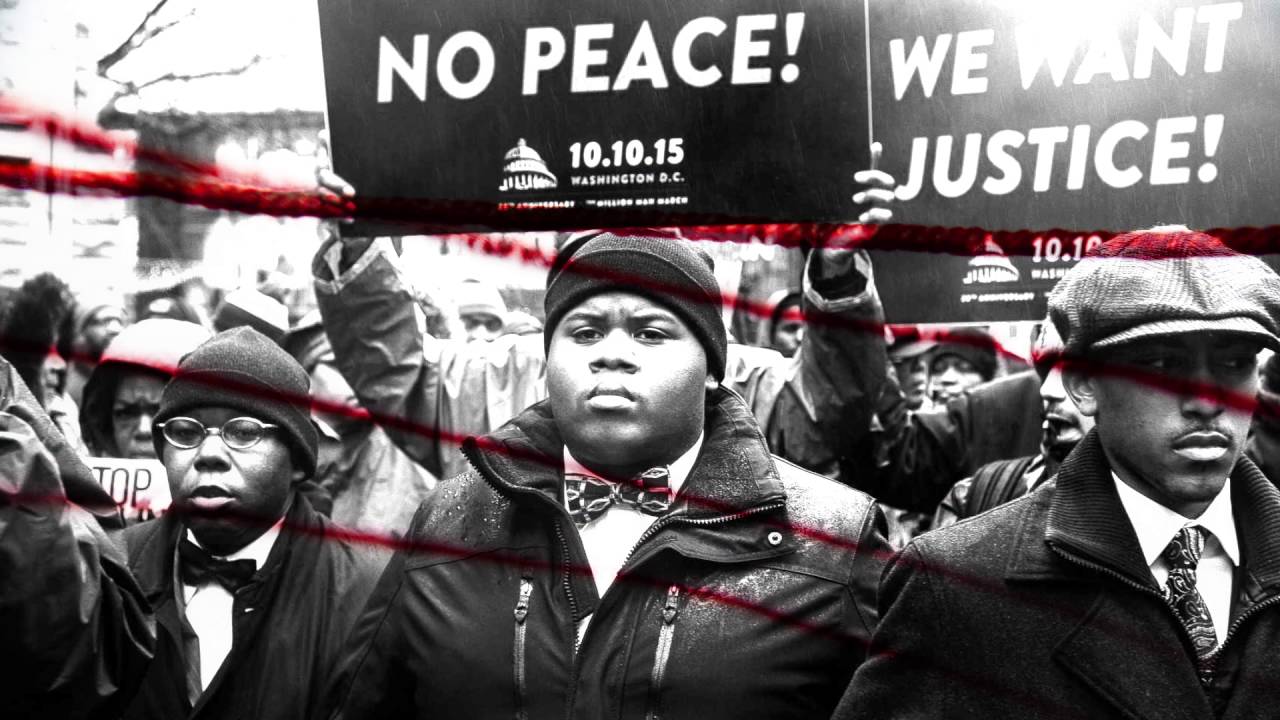
The record was anticipated by three of its most violent and angry cuts, although this being meant not necessarily sound-wise but rather more in their lyrical connotations: “Good Mourning, America“, brutally reflecting on recent sociopolitical and racial disorders in the USA while at the same time shouting for revolutionary claims of justice (cf. below frame pulled from its official music video), “Reluctantly Dead”, a chorus-heavy brick of a song that, once again, takes on a range of critical topics such as police brutality and individual self-abandon, and “Another Offensive Song”, the ninth track on the album’s tracklist and no doubt its heaviest and angriest one, possibly referring back to the band’s initial two albums and more raw times. This trio of tracks pretty much sums up the record’s overall sound and feel, a rare combination of anthems railing for social fairness, sonic violence aimed at raging against the machine, and introverted punky lullabies finding comfort and catharsis in one’s most intimate and personal spaces.

This very third topic is best expressed in “Who You Are Not”, surely among the catchiest tracks on the albums – alongside the grungy and Nirvana-evoking “A Weak Ago” – presenting some of the most melodic and radio-friendly vocals frontman Jason Butler has ever delivered. Similarly personal, intimate, and mature is sixth track “Foreign Cab Rides”, a brilliant confessional slow-burner in which Jason reflects on the relationship with his wife and even contains an actual voicemail recording between the two at the beginning. Calls for social justice, equality, and reactionism against disenfranchisement come back at their shiniest with the two album closers, title-track “If I’m the Devil…” and “Copper Colored Quiet”, two songs that quickly find themselves borrowed as rebellious and solidarity-invoking anthems wonderfully wrapping up the sociopolitically-filled undertones of the effort as a whole.

A special mention is due to the second track on the album, “Nü Romantics”, which follows the climaxing grand opening of “I’ve Learned to Love Myself” investing heavily in guitars and an inherent wall of sound. The thing with “Nü Romantics” though is not only that it’s beautifully structured with an unusual and unexpected break just 1:49 minutes in (of the total 3:36), but said interruption also feels as necessary as pleasant to the ears, navigating through minimal echoed guitar sounds ramping up a multi-layered chorus launching the track into a literal explosion in its last minute. Also, as far as Jason Butler’s lyrics and vocal job go, this one might be one of letlive.’s finest, although apparently it being performed live can turn into a little play with fire, for even the smallest deviation from its stinging and thin melodic line can sound quite off and overwhelming. Yet, the overall impression from the record is that with this effort the soul punkers really did try to challenge themselves both sonically and lyrically, pushing boundaries way out of their comfort zone. In this regard, one would have to agree that most of the times this is exactly where self-development and growth can find their shelter and flourish. The only hope is that this approach is to be undertaken not just by the band but also by a too often ill-advised and ignorant world at large.

I’d like to thank you sincerely for taking the time to read this and I hope to feel your interest again next time.

AV
LETLIVE.

“IF I’M THE DEVIL…”

2016, Epitaph

http://www.thisisletlive.com

Letlive_IfImTheDevil

ALEX REVIEWS MUSIC (ARM): ANDERSON .PAAK – MALIBU | 2016-03-05

I’ve been heavily into hip hop lately, blasting almost literally no other type of music into my ears for over a good couple of months. This is certainly partly due to recent explosive releases, such as Kanye West’s The Life of Pablo or Kendrick Lamar’s untitled unmastered., which surprisingly dropped overnight just 48 hours ago. Though I would say that a greater element justifying my latest musical inclination would definitely be the genre’s ability to get under the listener’s skin while at the same time activating juxtapositional feelings like probably no other genre can do. Certain rap songs simply beautifully succeed in sparking emotions of anger, excitement, sadness, angst, and freedom all within a single fully amalgamated track, which to me is an incredible sensation. While this phenomenon might be partly explained by the actual observable mixture and contamination of different genres found in the musical creations of, for instance, Kanye West, Oddisee, Kendrick Lamar, Rozz Dyliams or even Chance the Rapper, I genuinely feel that there’s something really specific to the genre itself that opens the door for multi-layered, holistic conceptions of sonic outputs originating the close-up series of feelings outlined above. The latest exponent of the like wonderfully succeeding in developing said process to me is Anderson .Paak, 30-year old Los Angeles-brewed rapper who’s just ended up becoming the new Dr. Dre’s protégé after releasing his second major release Malibu early this year. Let me tell you a little more about his recent album. (Interesting fact: the full-stop “.” preceding his last name is totally on purpose, reminding people of the importance of details in arts. I already like him)

Being praised – or rather grilled by too many, I should say… – as the new Kendrick Lamar for his poetic-narrative ability as well as the fruitful combination of soul, R&B and possibly jazzy elements all into one is probably not one of the lightest pressures to cope with, especially in this moment in time after the Compton MC literally took over the world and still has all eyes on him. Add to this the fact that after Dre’s endorsement the hype surrounding him is risking an unprecedented blow up and you’ll immediately get a big fat mountain to climb in the first place. Yet, his hypnotising latest 16-track release Malibu – excerpt: another reason why I love hip hop is heavily extensive tracklists –  thankfully speaks for itself and leaves all cheap talks and gangsta gossip aside.

As already hinted at, Anderson .Paak’s effort nods at a variety of musical influences, ranging from sexy soul atmospheres to edgy unspoken tributes to Motown, all mixed up in modern fresh production and an undisputed talent for hip hop storytelling (dawg’s got some flow there…). Though one should not be deceived by the initial trio of songs “The Bird”, “Heart Don’t Stand a Chance”, and “The Waters”, as albeit totally pleasant and low-profile, one of the LP’s best cuts already sits at number four. “The Season/Carry Me” is a rare beauty encapsulated into a little more than five minutes that perfectly showcases Anderson .Paak’s musical flexibility and lyrical refinement. And its live performance is possibly even more flawless, amplified by Anderson’s past as a drummer and expressive emotionality. Skipping the rather dull “Put Me Thru”, the best cohesive 5-piece segment of the album follow. Lead single “Am I Wrong”, featuring Lamar’s buddy ScHoolboy Q, is to me exactly what modern hip hop should be with great exposure to newer electro/ambient elements, while the edgy and raw “Without You” is for the redeemed angry ones, plus Rapsody’s guest appearance on there is incredibly intense and rad. The album takes a well deserved leaning-back break during “Parking Lot”, in which listeners can get smoothly transported by the sound while imagining of wandering though some sunny corner of L.A. The hypnotic and daring “Lite Weight” might definitely not please everyone, though over time it turns out to be one of my personal favourites, not least thanks to its whirly beat and vocal huge-quiet performance accompanied by Anderson’s smokey voice. The central and arguably best part of the LP comes to a close with latest single “Room in Here” at number ten, a witty and at times sensual track where a catchy piano riff and a master-verse by guest The Game dominate the scene.

After said fortunate and brilliant section the album unfortunately loses itself a little in a bit of self-indulgence and tracklist-filling numbers, where above all interlude “Water Fall” and “Come Down” could have easily stayed off the LP’s final incarnation without doing any harm whatsoever (on the contrary…). However, even with the risk of sounding repetitive, Anderson .Paak unveils his real magic on album’s curtains call “The Dreamer”, in my opinion one of those striking and anthemic songs that only get release once every couple of years. One can’t help but picture themselves on the beachy coast along Santa Monica – or in this very case I should say Malibu – escaping from every day carnal sins embracing the sonic journey that this gem is offering. The straight outta 70s chorusy guitar melody entangled with a contextual feeling of liberating chants and a reverberating choir make up for a song to be remembered for long. It’s somewhat at the same time a sound familiar to warm souls and a sonic architecture that has not been around for a long time, unlike anything else that’s come out in decades. Safe to say in this case that Anderson kept his best as last.

All in all, an L.A. born and bred album that definitely follows major recent hip hop patterns while – and I stress this as very important – simultaneously offering its own original angle shutting down all detractors accusing Anderson of stealing someone else’s authenticity. Moreover, the icing on the delicious cake in this case is the artist’s live ability (I haven’t seen him live yet but his YouTube clips are there to prove this), something that in this day and age of relentless touring and albums’ cross-monetisation through live shows should definitely not be taken for granted and could be the key element in the surviving-of-the-fittest race that’s the music industry. In this sense, Kendrick Lamar is the one to copy.

I’d like to thank you sincerely for taking the time to read this and I hope to feel your interest again next time.

AV

ANDERSON .PAAK

“MALIBU”

2016, Steel Wool/OBE/Art Club

http://www.andersonpaak.com

anderson-paak-malibu-album-cover

ALEX REVIEWS MUSIC (ARM): BLOC PARTY – HYMNS | 2016-02-04

I was actually going to publish a very different blogpost before I suddenly got enlightened by a powerful inspiration to draft down yet another ARM critical appraisal. Nonetheless, the other initial topic I had (and still have) in mind might find its way to the light too, sooner or later, don’t worry too much about that. Also, to be fair, Bloc Party is kind of a big deal. First and foremost for me individually as music fan, but also I’d say for the alternative music scene of the last two decades, really. Therefore, ladies and gentlemen, here I am delivering to the Interweb my personal take on the British indie outfit’s latest release HYMNS, dropped to the globe a bunch of days ago on 29th January 2016.

HYMNS follows quite a turbulent recent past for Bloc Party, who after the not so critically and fanbase acclaimed electro-garage-psychedelic Four in 2012 as well as an almost indefinite hiatus saw two of their four legacy members, bassist Gordon Moakes and drum beast Matt Tong, leave the band after what most people wouldn’t necessarily describe as an amicable departure. This presumably meaning that the contextual environment within which HYMNS was conceived and developed must have by all means been one of the harshest and volatile the band has ever been through. That is, no one is really ready to deny the fact that the Londoner band took a very clear descending path after 2008’s Intimacy, clearly positioning itself along a newly found sonic spectrum that visceral lovers of the first two full length LPs A Weekend in the City and especially indie space game-changing Silent Alarm found slightly difficult to bear to say the least. To be honest, I quite liked Four (softy ballad “Real Talk”, The Police-ian “Day Four” and spiritual “The Healing” are true gems, hands down), while on Intimacy and all other episodic and sporadic releases (see “One More Chance”, “The Nextwave Sessions” among others) I tend to agree with a vast majority of the public opinion I’ve come across over the years in finding them just too far away from where they truly shine.

With that being said, HYMNS finds the English indie masters taking yet another path across their musical and compositional journey. Gordon and Matt have in the meantime been replaced by almost-famous but pretty unknown Justin Harris (bass and keys) and Louise Bartle (drums), which is no little internal earthquake to begin with. On top of that, founding members Kele Okereke (lead singer and rhythm guitars) and Russell Lissack (guitars) kept themselves quite busy in between releasing and producing music on multiple fronts. This possibly all made for a very different set-up and mood approaching writing for the latest LP, and in many ways there indeed are different vibes and feels coming out of HYMNS. Overall, the album slows down quite drastically Bloc Party’s fast and sped up paces which were to be found, with different intensities and pronunciations, on all other punkier albums. This might partly have to do with Matt Tong’s departure and consequent substitution by Louise behind behind the drum set, something that lies along the lines of having to replace one of modern time’s most gifted and talented alternative-rock drummers, definitely not the easiest task ever. Such particular featuring, defining the 11-track LP in almost all its entirety, is however best observable – or in this case I’d rather say listenable – on songs like “Fortress”, “Exes” and curtain call “Living Lux”, which in fact get quite close to representing the worst the album has to offer. At the other end of this particular rhythm spectrum lie lead single and album opener “The Love Within” as well as “My True Name”, the latter being a song to me falls among the top three best tunes off the record, incidentally showing how the four-piece outfit still feels very much at ease when the BPMs tend to be rather high.

Furthermore, aside from the rather anonymous “So Real” (though that little edgy guitar lick is pretty rad and so catchy…) and “Into the Earth” – it must’ve been a B-side from one of their previous efforts, right? – the absolute and clear standouts off HYMNS are the magnetic and skin-wrapping “Different Drugs”, a true masterpiece, as well as third single and radio-friendly “Virtue“, reflecting a healthy and organic mixture of all those elements that made Bloc Party conquer the alternative scene in the last 15 years. And that’s more or less about it. I explicitly forgot to mention second on tracklist “Only He Can Heal Me” and second (no pun intended) single “The Good News”, simply because the still leave me quite indifferent to their effects even after repetitive listens, although the former one seems to possess a weird and perverse catchiness that might grown on me with time, to which though I’m not able to express anything more at the moment anyway.

Remember, I said it at the beginning, Bloc Party are a super big thing for me and one of my favourite bands ever. I really want to like this album, I truly do. In general, I believe I’m on the right path to getting there, as the initial impact has been good though possibly not quite Silent Alarm good. And while I tend to say this for very very few bands, Bloc Party’s case is definitely one of those where the pureness and genius of the debut effort have never been replicated after. I’d really like to go back to that kind of band, for once. Maybe, considering the rocky and fairly dark past the band has had, HYMNS was a necessary album to recalibrate themselves and reinvent a new beginning. Let’s give them this (one more) chance. Considering the above, if that’s the deal they’re making us, I’m buying it this time. I’m in. I have to.

I’d like to thank you sincerely for taking the time to read this and I hope to feel your interest again next time.

AV

BLOC PARTY

“HYMNS”

2016, BMG RIGHTS

http://blocparty.com

Bloc Party_Hymns

ALEX REVIEWS MUSIC (ARM): TAPE – BODIES | 2015-12-23

Every Time I Die (ETID) and The Damned Things‘ frontman Keith Buckley seems to have been pretty busy lately in terms of artistic outputs. After last year’s From Parts Unknown successful and critically-acclaimed release with ETID and a relentless run of worldwide tour dates in support of it, earlier on this year the Buffalo NY-native also announced his literary debut with semi-autobiographical novel “Scale” and recently dropped a rather surprising synth-wave influenced 5-track EP under the alias TAPE. While some well-deserved time and words will probably be spent in the future on this website with regard to “Scale” – which, for instance, is in the process of being read by yours sincerely and very recently saw the addition of a limited edition audiobook on vinyl read by Keith himself and scored by Fall Out Boy’s Joe Trohman and Josh Newton of Shiner and The Damned Things – it’s TAPE’s “Bodies” EP that represents the one and only focus of this new ARM blogpost, back after a long-awaited inspirational break.

“Bodies” is essentially the result of Keith teaming up with friend-producer Joshua Hurley while exploring foreign electronic territories and musical landscapes substantially cast away from his usual comfort zone, which places itself within a hardcore-punk-metal spectrum, broadly speaking. The EP, as hinted before composed of 5 tracks that taken together nearly reach 20 minutes of length, was produced by longtime acquaintance and Glassjaw frontman Daryl Palumbo as well as TJ Penzone (ex-Men, Women & Children). “Bodies” was released digitally on 6th November and as far as I’m aware is retrievable pretty much everywhere among the usual suspect music stores and services, though an entangling mystery surrounds TAPE’s desert SoundCloud profile. In fact, the synth-driven side project doesn’t necessarily seem to be willing to disclose much about themselves and its background, as information on the Interweb really runs low on that frequencies…

Anyways, enough for the introduction, the editorial shift now spins towards the musical output as such, which to me could be summarised with a bucketful of adjectives sounding roughly among the lines of mesmerising, pounding, fleeting and gelatinous. I’ll try to elaborate a little these judgements, though given the fact that I don’t really consider myself someone worth spreading elegant commentary on electronic music in general I urge you to not take these words literally and especially to let them attract meaning from alternative standpoints. Alternative used here in the sense of not being generated from within the context, lexicon and specific terminology of such music genre. Yet what I can surely say instead is that I often find myself relating to Keith’s music and lyrics so intensely and in so many different ways that I’d definitely rate myself eligible to express some thoughts about this very release, too. So there you go.

The EP kicks off with what might also be one of the highlights of the release, the wavy and cyclic “Synthetic” (the clue is in the name, I guess…). The track features vocal samples from Keith (and someone else?) that looking back and after repetitive listens begin to take shape as integral part of the song’s structure and almost even end up being catchy (Anything for you and Shine a light / In your eyes above all). The opening tune is followed by “Entry Request / Exit Strategy”, which despite its cool title fails to truly emerge and take a life on its own sticking too much to gloomy and darky undertones driven by hammering kicks. Next on the tracklist is “Nein” (German for “no”), easily the most melodic and lyrics-heavy track of all. However, its static dynamic and the fact of having the vocals too much in the background tend to soften up something that could’ve probably been leveraged a little more. “Nein” also introduces the listener to the latter half of the 5-track EP, probably the better one exposing “Monitor” and its unexpected melodic twists accompanied by Oriental (?) influences as the best tune of the release, despite being the shortest of all. The collection of songs is then wrapped up by the grand finale of “Guest Appearance”, without doubt the synth-heaviest and most layered as well as elaborated effort off the EP. Particularly convincing are the the e-drums beat as well as, once again, the layering vocals that in this case, as opposed to “Nein”, really seem to make sense leaving more room and prominency to the driving instrumental wall of sound.

When Keith announced this side-project and the release of “Bodies” it all truly came as a surprise to me, quickly followed by feelings of confusion and suspicion. Yet, after having given this EP a chance and actually even liking it pretty much, I gotta say it would’ve been a shame had it not been released. The overall judgement is thus primarily a positive one and it also seems to resonate elsewhere. Again, this is not the music I normally listen to and I really don’t feel comfortable describing its components and technical features while at the same time pretending to be taken as an expert (actually, I never do, but in this case less than ever before). Nonetheless, I must say I felt the need to let out some thoughts surrounding this release, possibly considering this some kind of experiment for me, departing from the usual rock and roll conceptional contexts I normally feel more comfortable in. Exactly the same thing Keith Buckley did with “Bodies”, really.

I’d like to thank you sincerely for taking the time to read this and I hope to feel your interest again next time. And happy holidays this time around.

AV

TAPE

“BODIES”

2015, ELECTRIC DENIM

https://www.facebook.com/TapeAudio1

Tape_Bodies

THE DARKER SIDE OF MAGIC: PRAISE FOR LEV GROSSMAN’S THE MAGICIANS | 2015-08-26

—- THIS BLOGPOST HAS BEEN DECLARED SPOILER-FREE BY THE ASSOCIATION OF AMERICAN PUBLISHERS

So go on, read it.

The past two-three weeks have been quite a tumultuous time for yours sincerely, having had to deal with a frenetic and exhausting flat-search in the living hell that the city of London is, the finalization of the Master’s dissertation (to which a separate blogpost may possibly be dedicated, since it’s partially about music), and the adventurous beginning of a new employment in the realm of video technologies. Thankfully, such overwhelming slices of pressing, yet compulsory time have been balanced and championed with some quality escapism accompanied by HBO’s brilliant second season of True Detective (with an outstanding performance by Colin Farrell) and, more relevantly, by US novelist Lev Grossman’s first book of his fantasy trilogy sensation “The Magicians“. Despite having published the first self-titled book of the saga already in 2009, the trilogy only seemed to have reached widespread mainstream attention over the past few years (unless I’m really, really late to the party…). In fact, its extraordinary popularity may momentarily be confined more to the USA (not least judging by the fact that the book seems to be physically untraceable in UK’s bookshops, get it through Amazon folks), although given its potential I wouldn’t be surprised to see it taking over this part of the Atlantic quite soon as well.

It is precisely for this last reason that I’d like to frame the present blogpost as both a genuine suggestion to insert “The Magicians” in your bucket-list of upcoming “must” readings and as personal praise to its plot and narrative. As I’ve already pointed out, the novel is the first book of a fantasy saga completed by “The Magician King” (2011) and “The Magician’s Land” (2014), and it tells the story of 17-year-old student and brainy talent Quentin Coldwater, who suddenly finds himself thrown into New York’s highly secret and exclusive Brakebills College to pursuit a cutting-edge education in magic and begins his personal journey into the good-bad juxtapositional worlds of real magic rawness. I have to say though, as I’m writing this I find myself being only at about two-thirds of the book, and while this of course positively restrains me from giving away too much in terms of the content, I must convey to you that I’m still unable to deliver a total judgement of the first instalment. I know, I know, this shouldn’t ever be done when dealing with literary reviews (blasphemy claims in 3, 2, 1…), but to be honest I really felt this was the right momentum to let you all know about this linguistic beauty. Also, in all frankness, even if from here on out the book really only delivers first-class shit until its conclusion, it would nonetheless still be saved by the greatness of the insights I’ve come to read so far. And by insights I mean the directness, honesty and tangibility of Quentin’s experiences at Brakebills, obviously transposed into a realm of fantasy landscapes, supernatural forces and powerful wizardry.

What I mean by all this is I guess Grossman’s literal and stylistic sensibility that allows him and the reader to perceive Quentin’s adventures as personally relatable as ever, and yet so dislocated from the very realities that shape us on an everyday basis. By placing Quentin’s social encounters, extravagant successes, and painful struggles through the brightest of days and the darkest of nights within such a surreal scenario, the author in fact constructs a deeper connection to such dynamics that trascends their own contextualisation. That is, it’s literally impossible not to emphatize with the protagonist as he goes through all of his challenges at Brakebills, precisely because the things that come to happen in Quentin’s life, from recalibrating one’s young adult self-confidence or coping with life’s ephemeral temptations and disillusionments, are exactly the same ones that sooner or later, and with varying intensities, will cross our life paths too. Some, probably too many, like to draw comparisons between “The Magicians” and Harry Potter or even more hazardously with Narnia, though I really think Grossman’s story is capable of better digging into our most inner selves than it’s the case with the other two masterpieces, probably also because it may relate even more to young adults like me. In this regard, and also ’cause now that I’ve entered the door of the fantasy world I’m probably authoritatively obliged to mention his opinion, “Game of Thrones” bestselling author George R. R. Martin likes to think the following of Grossman’s effort:

“The Magicians is to Harry Potter as a shot of Irish whiskey is to a glass of weak tea. Solidly rooted in the traditions of both fantasy and mainstream literary fiction, the novel tips its hat to Oz and Narnia as well as to Harry, but don’t mistake this for a children’s book. Grossman’s sensibilities are thoroughly adult, his narrative dark and dangerous and full of twists. Hogwarts was never like this.”

What I think it would be cool to do, for me, is to update you all on the matter a little later in time, possibly after having completed the first novel and having read the rest of the trilogy, which I predict it may happen in a not so distant future given the degree of appreciation I’m having for this. I honestly don’t know what to expect from the rest of the plot, not even what may happen before the end if this first instalment, but all in all I truly believe this is exactly what good reads should be all about. Thus, this one is definitely “to be continued”, unless I get myself invited and initiated into a mysterious and gloomy academy for magic in one of London’s suburbs, in which case, judging by Quentin’s fate, I may or may not ever come back the same…

I’d like to thank you sincerely for taking the time to read this and I hope to feel your interest again next time.

AV

L.Grossman_Magicians

ALEX REVIEWS MUSIC (ARM): JOHN NOLAN – SAD, STRANGE, BEAUTIFUL DREAM | 2015-07-25

A bunch of months ago I wrote a little something about Taking Back Sunday lead guitarist John Nolan‘s new solo album project in collaboration with PledgeMusic and about how the whole thing really got me excited and all. Well, as you all know time goes by really fast and we’ve eventually come to the point when John officially released his second full-length album entitled Sad, Strange, Beautiful Dream through a jointed partnership between the aforementioned crowdsourcing music platform and Collective Confusion Records, who’s primarily taking care of the physical copies of the release. Besides the amount of cool stuff worth a mention related to the chosen promotional strategy, such as the variety of pre-ordering packages or the fact that 10% of all the money collected through the album’s sale will be donated to a pediatric facility in Memphis, TN (St. Jude Children’s Research Hospital), I’ve now taken some time to give the full record, released digitally yesterday 24th July, a proper listen and I feel like I’ve got something to say about it. Also, it kinda makes sense to follow up on the matter on a more technical-musical note, doesn’t it?

John already unveiled a number of tracks over the course of the pre-release period, such as album opener and teenage era-teller “American Nightclub 1999”, the brilliantly titled – but possibly less convincing arrangement – “Drinking Your Way to Confidence” as well as existential-ballad “How Much”, although this latter one went through a substantive sound-polishing if compared to the early released version and arguably became the absolute best track on the record, mixing terrific melodic songwriting with a perfectly raw-edgy instrumentation delivering an immersive sappy feeling (How much can we control? / I don’t know / As much as we can). A little less than a month ago John then released the mastered version of the sparkling and lyrically-terrifying “Street Robbery Blues”, undoubtedly the most energetic and fast tune on the whole album entailing a very interesting uplifting-dark juxtaposition between the lyrics and the music itself. Yet, with the exception made of “How Much”, the best material on the album was not revealed until its full release.

“War is Peace” leads the list of never-heard-before songs on the album and immediately feels like it could have been born out of a raw idea for a Taking Back Sunday song, presenting a properly distorted rock band-modus instrumental base alongside a galloping tempo. The track is followed by the folky-acoustic “Next to You (In New Orleans)”, which probably depicts the lowest point of the record as it results incapable of really taking off in its own terms. The provisional down-status is suddenly mightily overcome with a consecutive couple of triumphant songs that really stand out on the whole. “I’ll Be Home Soon” is a piano-led ballad that truly gets under the listener’s skin and also delivers a quite catchy chorus, something that’s absolutely not to be taken for granted when it comes to slowed down ballads: well done John. It follows the album’s title track, which in some ways does sound a little out of context with its abundance of synth-fillings and indie-pop dyeing but which, after a few listens, already begins to make sense again, not least because it does really encompass traces of sadness, strangeness and beauty in a dreamy atmosphere. After a re-interpretation of 2012 track “C’est Le Fin Du Monde”, originally released on a split 7″ with indie rock band Mansions and the sonic perfection of the previously mentioned “How Much”, John Nolan’s second solo album comes to a close with the brilliant “I Will Be Released”, a sing-along choir anthem curiously and romantically written with his wife Camille.

In a way it’s truly funny and misleading to read on his artist’s description on PledgeMusic that he’s being labelled as folk-acoustic musician, because Sad, Strange, Beautiful Dream seems to confirm he’s actually not, and even at the times when he probably is, the record feels the most vulnerable (cf. “Next to You”). Given the quality of this last effort, he should feel no shame at all to confidently present himself as a modern alternative-rock act, not least given the mighty studio collaborations he took advantage of during the recording process. Yet, tags and label don’t really matter at all as soon as one realises where musical quality lies and that it shouldn’t be constrained by arbitrary boundaries at all. This is precisely what John Nolan has apparently come to realise with this record: with precious songwriting, instrumental rawness, lyrical honesty, and a little experimentation he’s delivered his best musical outcome to date.

I’d like to thank you sincerely for taking the time to read this and I hope to feel your interest again next time.

AV

JOHN NOLAN

“SAD, STRANGE, BEAUTIFUL DREAM”

2015, COLLECTIVE CONFUSION RECORDS

www.pledgemusic.com/projects/johnnolan

JOHN-NOLAN

ALEX REVIEWS MUSIC (ARM): ALABAMA SHAKES – SOUND & COLOR | 2015-05-08

Alright, alright. I know. I should be rattling on about what was long praised to be the most uncertain UK general election in a century to date. In fact, it’s been a quite controversial last night here in Britain. According to mass logic, at this point I should be writing up the always dangerous morning-after reflections on what, personally, has been an extreme and quite dramatic electoral delusion. Instead, against all odds, I’m opting for yet another feature piece for the critically acclaimed music review section ARM. Like it or not, I don’t really think this whole thing is meant to be hosting political reflections. At least not yet. Also, not only have I ruled out a socio-political essay on the current status quo, but I’m sure my musical choice will certainly leave some folks disappointed, bearing in mind the present release-intense period (with new music being revealed by Blur, Mumford & Sons, Brandon Flowers, among others)…

This time I’ve taken under close scrutiny newest Alabama Shakes‘ “Sound & Color”, released shortly ago on 21st April via Merge Records. It’s the US rock band’s second studio effort, following highly praised groundbreaking first LP “Boys & Girls” in 2012, which literally transformed the Alabama-native quintet into global mainstream talkabouts. That is to say, expectations were quite high for this second one, not least because of the considerable amount of time taken to work on it, considering present-day digital music industry rhythms and fast-food releases. Despite these external pressures, Alabama Shakes didn’t fail to meet such expectations.

The album as a whole is positively and overwhelmingly dominated by frontwoman, lead vocalist and rhythm guitarist Brittany Howard’s vocal performances, who’s able to fully exploit her unlimited talent to deliver chills on fine tracks such as lead-single “Don’t Wanna Fight” and heartbreaking “Gimme All Your Love”. The 12-track LP immediately establishes itself smoothly with title-track opener, that leads the listener along a rising climax that gets abruptly stopped by the emergence of catchy “Don’t Wanna Fight” as second in song listing. After a softened laying back offered by “Dunes”, the album achieves poppy and most-likely radio-friendly “Future People” as fourth one on the list, before showing some of its artistic best with aforementioned “Gimme All Your Love”. After the first very intense 20 minutes, “Sound & Color” loses itself slightly in its central portion with some melodic and harmonical repetition in following songs “This Feeling” and “Guess Who”, before unveiling some real excitement and fun again with speedy track number 8 “The Greatest”.

The LP, which to me really sounds like a natural and unforced continuation of debut “Boys & Girls”, quiets down a bit for its final segment, where mellow and sappy “Miss You”, alongside mighty instrumental “Gemini”, see Howard at her vocal top once again. Captivating and gospel-reminiscent “Over My Head” brings the album to its conclusion leaving a deep feeling of satisfaction to the listener. Alabama Shakes seems to have not lost their success formula with the passing of time (and, some would say, with the danger of notoriety), delivering a solid, mature, and evolved second effort building upon their fabulous debut. Before finishing up, I’d like to make a special last mention of the sober album’s artwork (see attached below), which not only appears to follow a late trend of essentialism and minimalism within music industry’s visual dimension, but that also truly suggests that the best is to be found in the songs. Nothing has ever been more true, in this occasion.

I’d like to thank you sincerely for taking the time to read this and I hope to feel your interest again next time.

AV

ALABAMA SHAKES

“SOUND & COLOR”

2015, ROUGH TRADE

www.alabamashakes.com

alabama-shakes-sound-and-color

ALEX REVIEWS MUSIC (ARM): TOM DELONGE – TO THE STARS… DEMOS, ODDS & ENDS | 2015-04-22

Welcome back to another ARM blogpost. Again, the picking choice was hard on this one, having just witnessed the global celebration of Record Store Day and being forced to set aside other recent releases such as Alabama Shakes‘s Sound & Color or even waiting just for another bit before the highly anticipated The Desired Effect by Brandon Flowers and My Morning Jacket‘s The Waterfall would have been published. Yet, partly because of my past (and present) blink-182 and Angels & Airwaves (AVA) fandom and party because of the recent publicly aired band drama causing quite an uproar, I felt like I had to give Tom DeLonge’s first ever solo album To the Stars… Demos, Odds and Ends a try.

Freshly released in Europe’s mainland a day ago (21st April), the half-EP half-LP is allegedly containing blink-182 demos “along with a few extra tracks”, summing up to a total tracklist of 8 units (-1, considering instrumental filler “Landscapes” as a non-song). The album had already been sort of previewed by the anticipated release of singles (?) “New World” (to which a very angst-filled music video has been dedicated), acoustic ballad “The Invisible Parade” as well as skateboarders’ new anthem “Circle-Jerk-Pit” (which, not surprisingly, soundtracks a video made of skating pools, beers and pretty girls). With the exception made of the latter, which is almost too messy to be properly understood, the two songs Tom decided to release before the actual full-album publication are, sadly, in fact the only remarkable compositions present on the effort. Fluctuating between AVA nostalgia (“Suburban Kings” could’ve easily been born out of “Rite of Spring”‘s ribs) and quite embarrassing blink-182-success formulas (“Golden Showers in the Golden State”: “First Date” and “The Rock Show” anyone?), the album doesn’t appear to be able to take a shape on its own, even after repeated listens. I’m actually saying this with genuine disappointment, being a long-time DeLonge fan myself and having always appreciated his ability to reunite big melodies with compactness and effective lyrics.

To be fair, the record itself got in fact promoted as a kind of B-sides bucket of his, possibly intended as a concrete and material response to blink-182’s intentions to continue as a band even without him (Alkaline Trio’s Matt Skiba has so far replaced Tom on guitar and vocals in the line-up). Still, this isn’t probably the best self-esteeming reply Tom could have given to both his previous bandmates and the public/fans at large. Why not waiting a little bit more and instead releasing another solid AVA album like last The Dream Walker, maybe with a little help of his (new) friends (Ilan Rubin)? Directionless, at times dull and repetitive, “To the Stars” doesn’t really deserve to get associated with his songwriting abilities (maybe with the exceptions made for the aforementioned “New World” and “The Invisible Parade”), not least because even initially-promising “An Endless Summer” and “Animals” turn out, unfortunately, to be truly dislikable with time. Ok, “Suburban Kings” and “Golden Showers in the Golden State” aren’t bad songs at all, but they nonetheless sound desperately over-heard and too familiar to past successful attempts of his.

This one seems to be an extremely busy year for Tom, according to his own statements to the press (announcing the release of 4 albums and 15 co-written novels all this year, come on…), and while he’s always been someone who doesn’t necessarily like to take breaks between musical, cinematic, and entrepreneurial projects, his explicit plans appear to be too ambitious even for a persona like his. Probably, hadn’t he released this very album, he could’ve managed and allocated his resources more wisely into a more thoughtful product, ideally released later this year or even during the next one. Yet, sometimes the urge to respond to unclarity and defeats can be stronger than anything else, pushing its way through light and converting into forced pieces of art. The result in this case? Tom still De…longing for blink-182.

I’d like to thank you sincerely for taking the time to read this and I hope to feel your interest again next time.

AV

TOM DELONGE

“TO THE STARS… DEMOS, ODDS AND ENDS”

2015, TO THE STARS…

http://www.tomdelonge.me

TDL_TTS