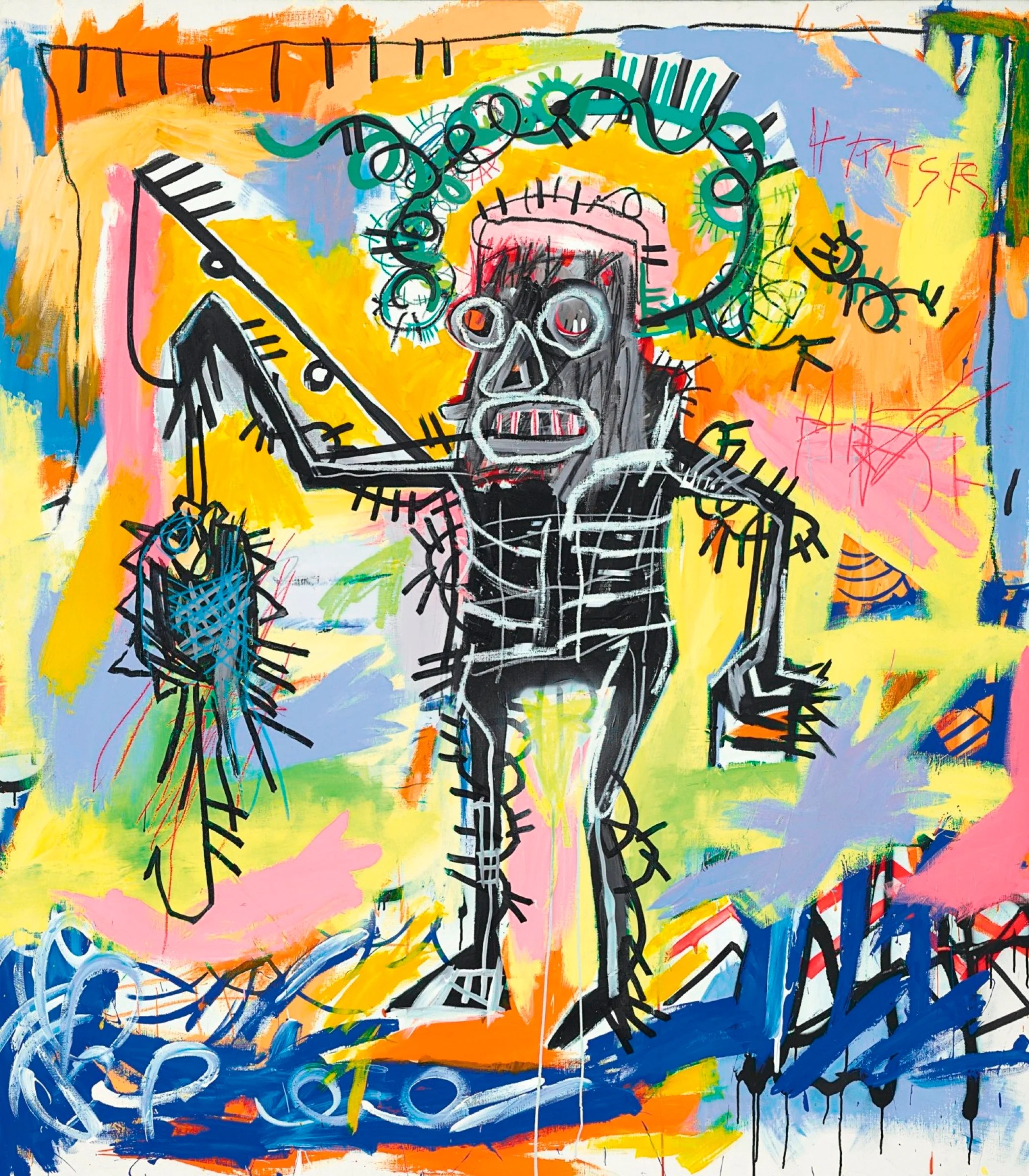
We’ll start by saying that the new A$AP Rocky and J. Cole joints both go pretty hard. Mega hard, in fact. They better do, after almost a decade of teasing, undoing, and gestating for each. At this time, we’re fairly confident in saying that DON’T BE DUMB and The Fall-Off are the two MCs’ best projects to date. Let us throw in some context. As far as J. Cole is concerned—nearly two decades after his debut mixtape The Come Up, the Dreamville Records-founder has handily risen to the top tier of the hip-hop stratosphere as a rarified album-focused spitter, amongst a legion of singles-driven ambulance chasers. The Fayetteville, NC-native deliberately forged his body of work on his own terms, earning major accolades and a fiercely loyal fanbase. Now 41, he gives us what is reportedly his final album, aptly titled The Fall-Off. Rather than a true blue victory lap, the expansive, 2-disc, 24-track oeuvre showcases sustained creative energy and nurtured reflection. And it’s jammed with hoopin‘ references.
The front-end, filled with nods to his Carolinian stomping grounds and his 2014 Forest Hills Drive era, highlights Cole’s storytelling strengths and influences—from Nas-inspired lyricism to more personal, vulnerable moments. On disc 2, the stronger of the two, he shifts from nostalgia to self-assessment, examining his legacy and growth with heightened maturity. By the album coda, he ties past and present together, returning to the profound sense of place that has long defined his journey. A diametrically opposed introduction is in order when it comes to Rocky. As soon as he emerged as the breakout star of Harlem’s A$AP Mob in the early 2010s, he seemed destined for fame—pairing striking flows with a sound that blended New York street rap, Houston chopped-and-screwed textures, and hazy electronic ultralight beams. After the success of his 2011 breakout mixtape LIVE.LOVE.A$AP, he quickly rose through rap’s heavyweights ladder. In recent years, Lord Flacko vastly expanded his focus beyond music, stepping into acting, high-fashion design, and high-profile cultural moments—not without prompting some to question whether spitting 16s was still his priority.
His latest fourth studio LP, DON’T BE DUMB, answers that decisively. His first full-length since 2018’s TESTING, the Tim Burton-artistically directed tape reasserts his place among hip-hop’s narrow elite, balancing brash confidence with refined avant-garde artistry. The pretty motherfu**er addresses rivals and past conflicts head-on, while also embracing a seasoned, eclectic sound—moving from jazz-inflected experimentation to psychedelic trap. True to form, his sharp curatorial instincts shine throughout the hour-long full length, pairing unexpected collaborators and producers (aside from Burton, BossMan Dlow, Brent Faiyaz, Gorillaz, Doechii, Jessica Pratt, Sauce Walka, Slay Squad, Westside Gunn, and will.i.am inter alia) in ways that nod to his beginnings while pushing his style forward.
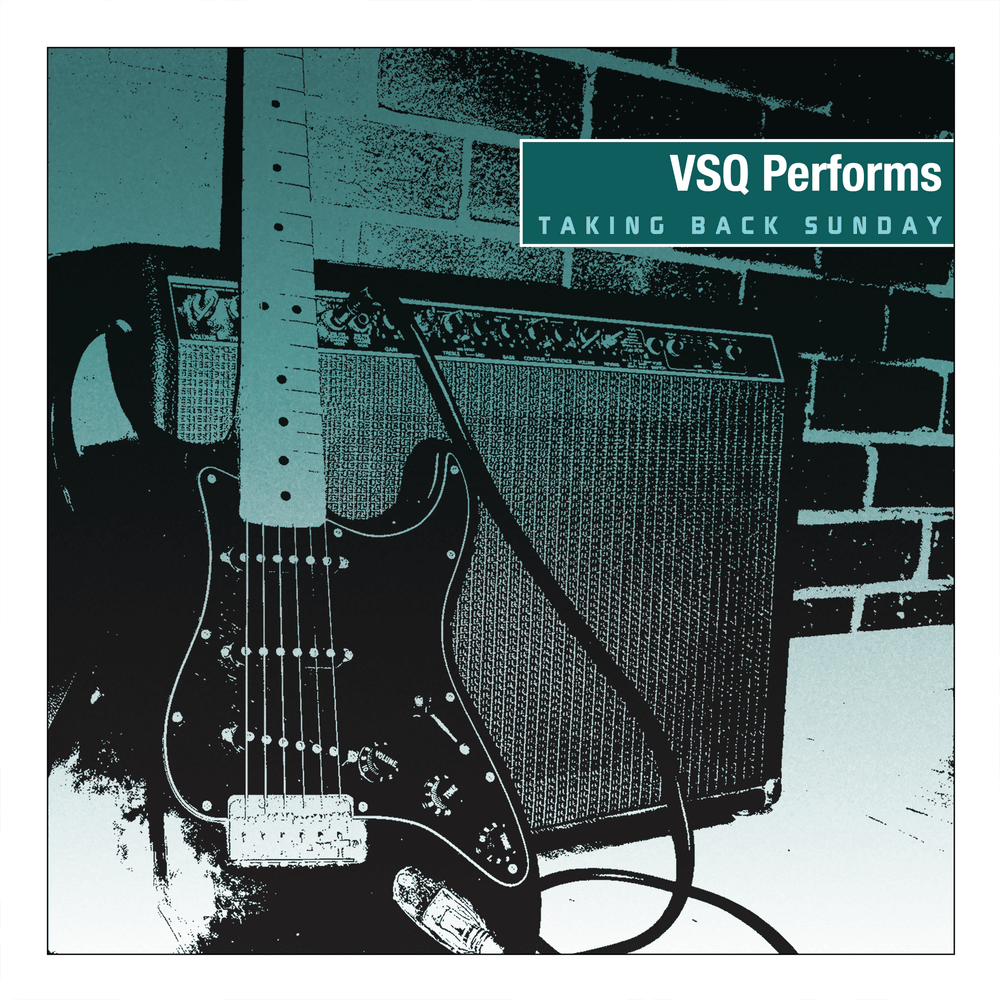
The above mentioned rap excursuses aside, we’re actually here to talk about the twentieth anniversary of a classical music tribute to Taking Back Sunday? Yup. Our curious object of inquiry is a bizarre 2006 musical ode by the so-called Vitamin String Quartet—VSQ in short—featuring instrumental, string-driven covers of the most popular Taking Back Sunday tunes at the time. The 12-track collection, released on Vitamin Records in the April of two decades (under the influence) ago, re-arranges the Long Island emo veterans’ high-energy, guitar-driven sound from their first two records through violin, viola, and cello renditions. There’s even an original composition and arrangement by VSQ, titled “You’re Good News (To Me)“, to bookend the collection. The whole thing kind of rules. Not sure a whole lot of TBS stans are aware of it.
Oddly enough, the album changed its nominal title from the initial ‘Strung Out on Taking Back Sunday: The String Quartet Tribute‘ (as evidenced here) to VSQ Performs Taking Back Sunday around 2015—presumably due to changing distribution licensing reasons. Hilariously, by virtue of its main high-brow genre, the concerto is also listed under the Apple Music Classical streaming service (peep here), causing the composer metadata to get rendered as a scrambled itemized hodgepodge including a mix of Mark O’Connell, Adam Burbank Lazzara, Shaun Cooper, Fred Mascherino, Frederick Paul Mascherino, and Tom Tally, a former VSQ member. Yeah, no John Nolan sadly.
So what’s good with Vitamin String Quartet? Since launching in 1999, VSQ has been dubbed as a leading force in classical crossover, bringing string interpretations of contemporary music to a global audience. Their work seems to have soundtracked study sessions, weddings, and standout film and TV moments, with high-profile placements in recent productions like Bridgerton and The King of Staten Island. Praised by Variety and Nylon, VSQ is now one of the world’s most popular contemporary string ensembles. With more than 300 releases under their belts at this point, the quartet has reimagined an eclectic range of artists—from Cardi B to Björk, and from Studio Ghibli scores to goth metal—seamlessly blending classical instrumentation with original pop, rock, hip-hop, and electronic music. This kind of goes to show how big Taking Back Sunday was at the halfway point of the 2000s to be handpicked amongst such company (and to think that their most commercially successful record, Louder Now, hadn’t even come out yet at the time).
To date, VSQ has amassed over two billion streams, nearly four million downloads, and more than one million physical sales. For all intents and purposes, they’re pretty huge. Apparently, seven of their LPs have charted on Billboard, including a #4 peak in the Classical and Classical Crossover categories. VSQ Performs Lana Del Rey even earned them a 2021 Libera Award nomination for Best Classical Record. The outfit is based in Los Angeles, where the rotating collective is said to be frequently collaborating with fellow musicians and visual creators, continuing to expand a vast catalog. As a case in point, their long-running VSQ Performs the Hits instalment series has helped make classical versions of modern pop both accessible and culturally relevant, while front-to-back album tributes showcase the ensemble’s versatility.
Happy twentieth anniversary to this fabulously weird record. It rules so hard. We wouldn’t mind checking out an updated 2026 version with some of TBS’s more sophisticated and mature tunes in the latter part of their discography. Surely “Where My Mouth Is“, “Everything Must Go“, “Call Me in the Morning“, “We Were Younger Then“, “Nothing At All“, “Fences“, “Holy Water“, and “Amphetamine Smiles” would all absolutely rip when performed with the magic fiddles of VSQ. There you go, that’s more than half the tracklist of the redux album already. Over to you, Vitamin String Quartet.
We’d like to thank you sincerely for taking the time to read this and we hope to feel your interest again next time.
Believe it or not, we too like to have some little fun around here. We’re not just doom and gloom fueled by sad Ryan Adams reviews all the time. So recently we spotted a new sus AI feature in the official NBA app, one that has hitherto been kept surprisingly quiet. At the time of this writing, the ‘Ask NBA (Beta)’ module can be located in the ‘Around the League’ section under the ‘Discover’ tab as part of the native iOS interface. Currently, it’s being described as a “chatbot application” by the NBA’s fine print lodged at the bottom of the start screen:
Critically, there is no explicit mention of artificial intelligence anywhere on the product’s real estate. Nonetheless, the initial chat-like layout, as well as the ‘questions to get started’ prompts, look a lot like your everyday large language model navigation interface. While one could assume those pictured are relatively low-stake Q&A items hardcoded as ‘if-then’ statements baked into the source of this chatbot, they do set this whole experience up as a quasi-‘ask me anything’ deal. At any rate, if it walks like a duck, it quacks like a duck to us. Yet, it does kind of baffle us how little information or fanfare there is out there about this, and how surprisingly low-key this has been kept by the league so far. Needless to say, we gave this thing a go.
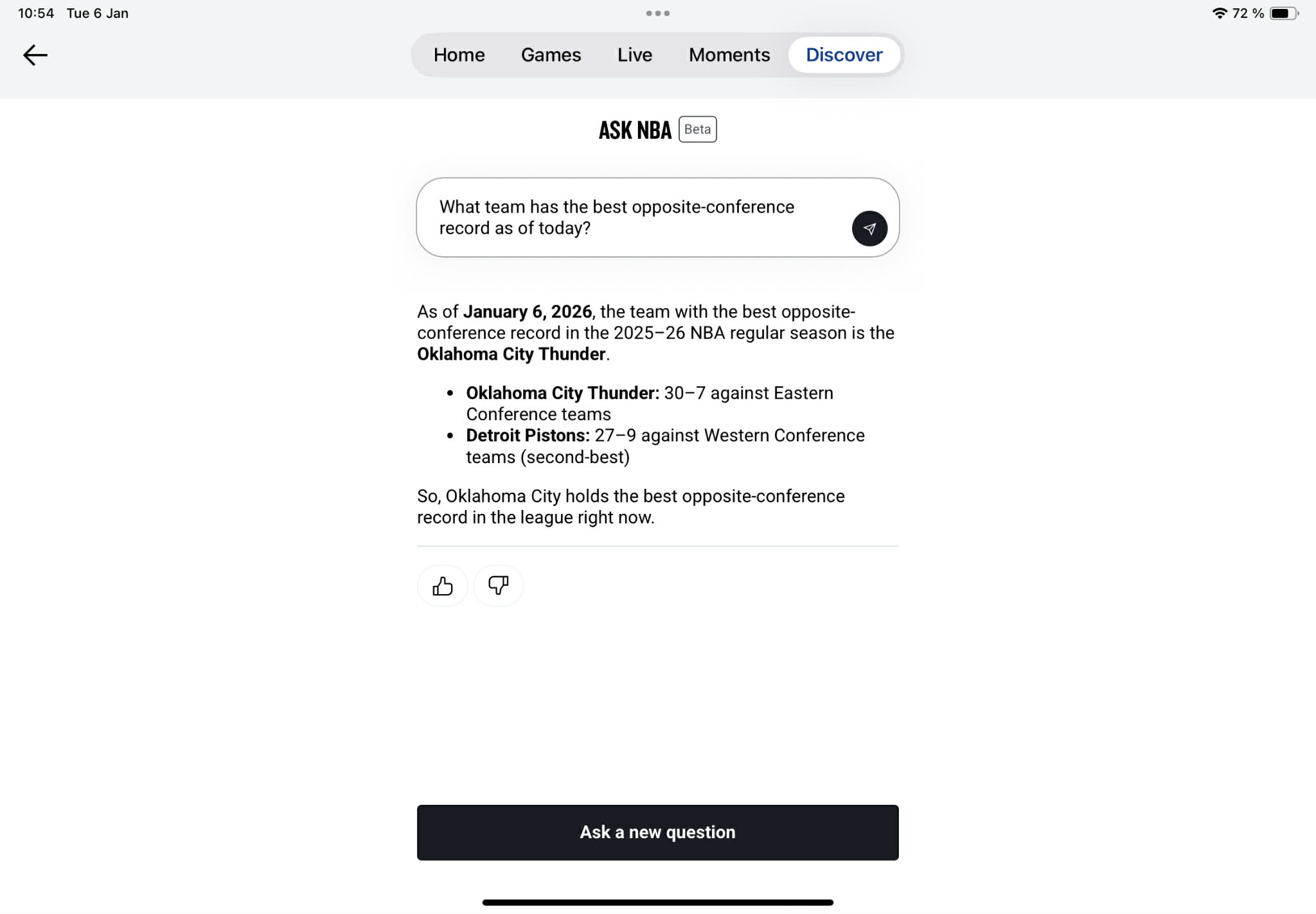
It didn’t start off… great. Below is the chatbot tripping over a somewhat banal data retrieval question about what team had been doing best in games against opponents outside of their league conference, just a few days ago. Alas, the NBA chatbot returned a plain answer listing the two teams at the top of the Easter and Western conferences at the time, citing their overall winning record instead of the opposite-conference one. (For the record, we did ask Google’s Gemini AI the same question—you know, the cannibalizing top search result that is swallowing the SEO market whole—and it did fall short of reporting such a trivial data point too…).
In order to get over the jilted disappointment of our first query, we decided to get cute with some Sixth Man of the Year predictions about halfway through the season. Thankfully, our AI bot friend provided us with sounder insights, bundling some of the well-known usual suspects, Miami’s Jaime Jaquez Jr, Minnesota’s Naz Reid, and Atlanta’s Nickeil Alexander-Walker into its top 5 prediction. We also didn’t mind the neat written summary at the end, partly justifying the table analysis—the holistic approach addressing both media and betting markets feels like a faithful depiction of current day NBA zeitgeist chatter. However, its inability to report a precise points-per-game number for Orlando’s Anthony Black (on top of a completely absent field goal percentage…), continued to leave us perplexed.
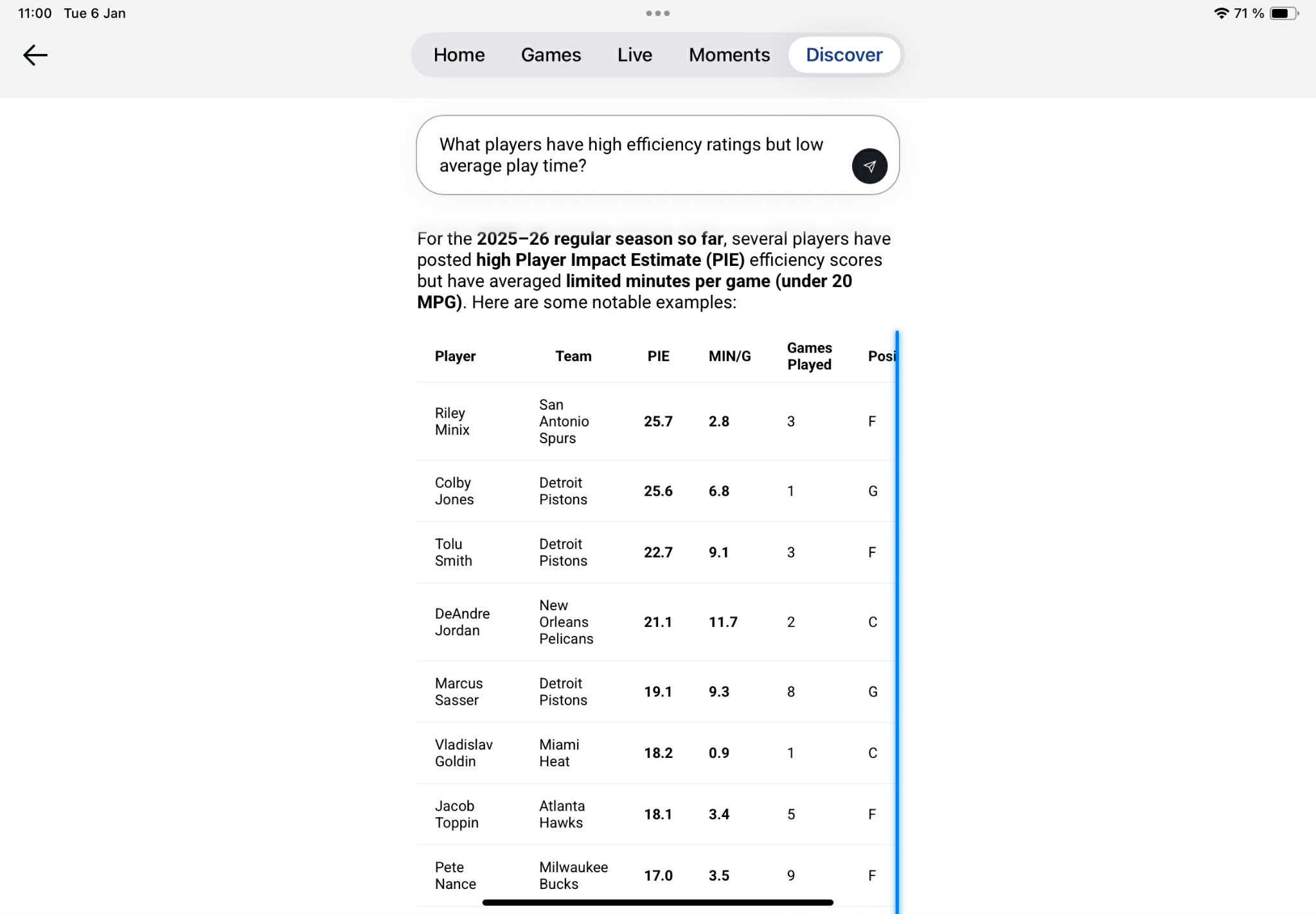
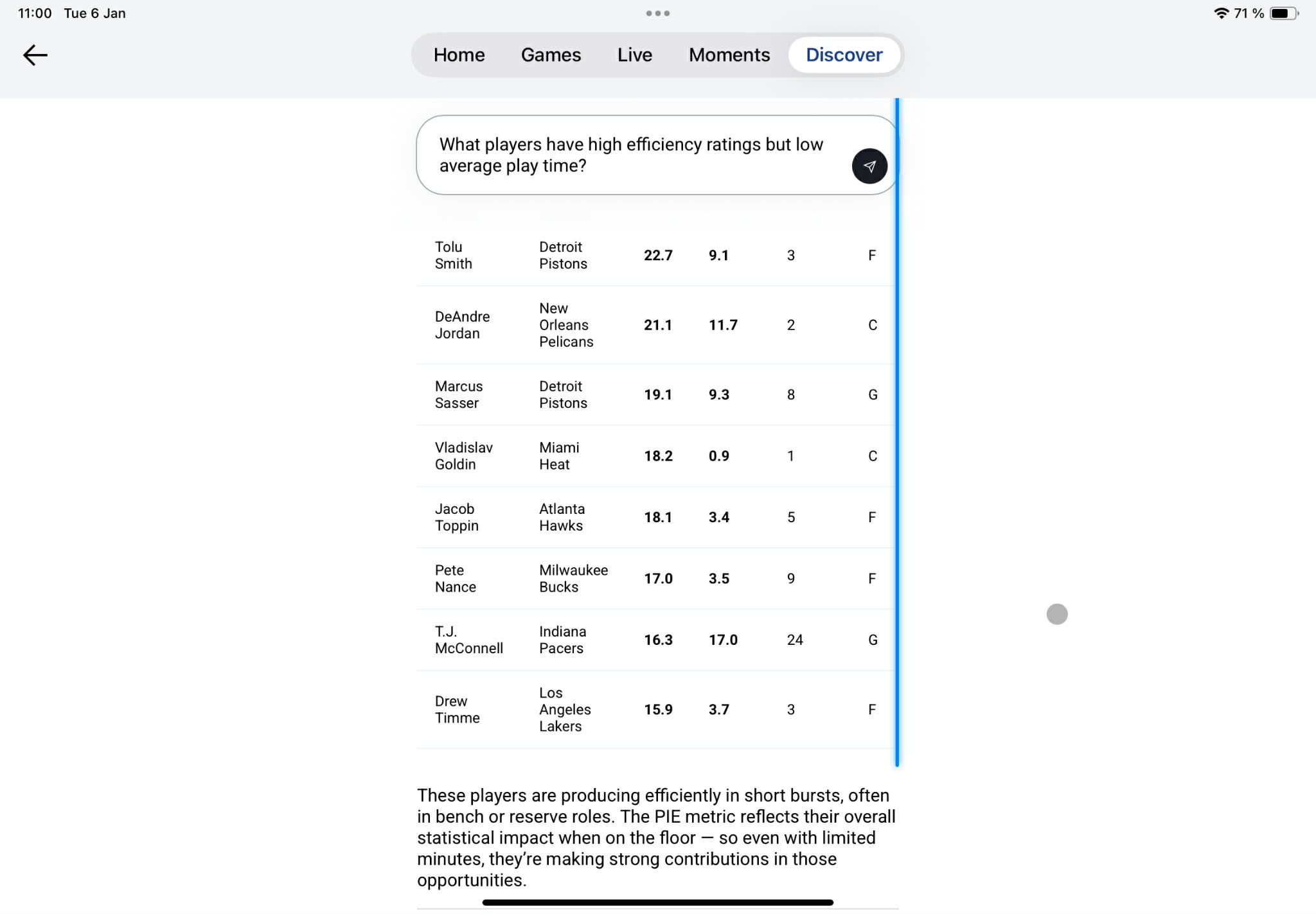
We then decided we wanted to test the NBA chatbot’s reasoning oomph by posing a more nuanced—if fascinating—question revolving around potentially unsung ‘diamonds in the rough’ players. We asked for its analysis over what players have been boasting above-average efficiency impact ratings but low playing time. In other words, we were hoping to alley oop NBA head coaches who read this site with allegedly untapped potential on their bench. To drive its insights this time, the chatbot opted for the NBA’s Player Impact Estimate (PIE), a league metric purported to show a player’s percentage contribution to all game boxscore events in totality (points, rebounds, assists, etc.), calculated using a simple and straightforward custom formula:
This one definitely got intriguing. According to our friend the bot, recently waived San Antonio forward Riley Minix would have counted as an incredible secret ace up Mitch Johnson’s sleeve, had they kept him on the team. With a stunning 25.7 PIE in just three games played this season, the Vero Beach, Florida-native left an impact like no other in the two minutes and change he played on average in each of the contests. For comparison, league heavyweights SGA, Wembanyama, Antetokounmpo, and Jokić’s PIEs all currently fare between 21-23. Similarly, the number two secret weapon in the league appeared to be former Detroit Pistons shooting guard Colby Jones, until you realize he got waived by the franchise back in November last year, after just one league appearance.
Matter of fact, of the ten players listed by the chatbot as part of this query, only Indiana Pacers veteran TJ McConnell has played more than ten games this season (24). Aside from him, Marcus Sasser (Pistons) and Pete Nance (Milwaukee Bucks) are the only other players that have reportedly been featured in more than just a handful games hitherto. Frankly, we could have used a tad more discernment by our NBA stats partner, but hey it’s not like that bar was set awfully high from that first prompt… If anything, this answer confirmed TJ McConnell to be Indiana’s own version of a bench mob leader Tasmanian devil.
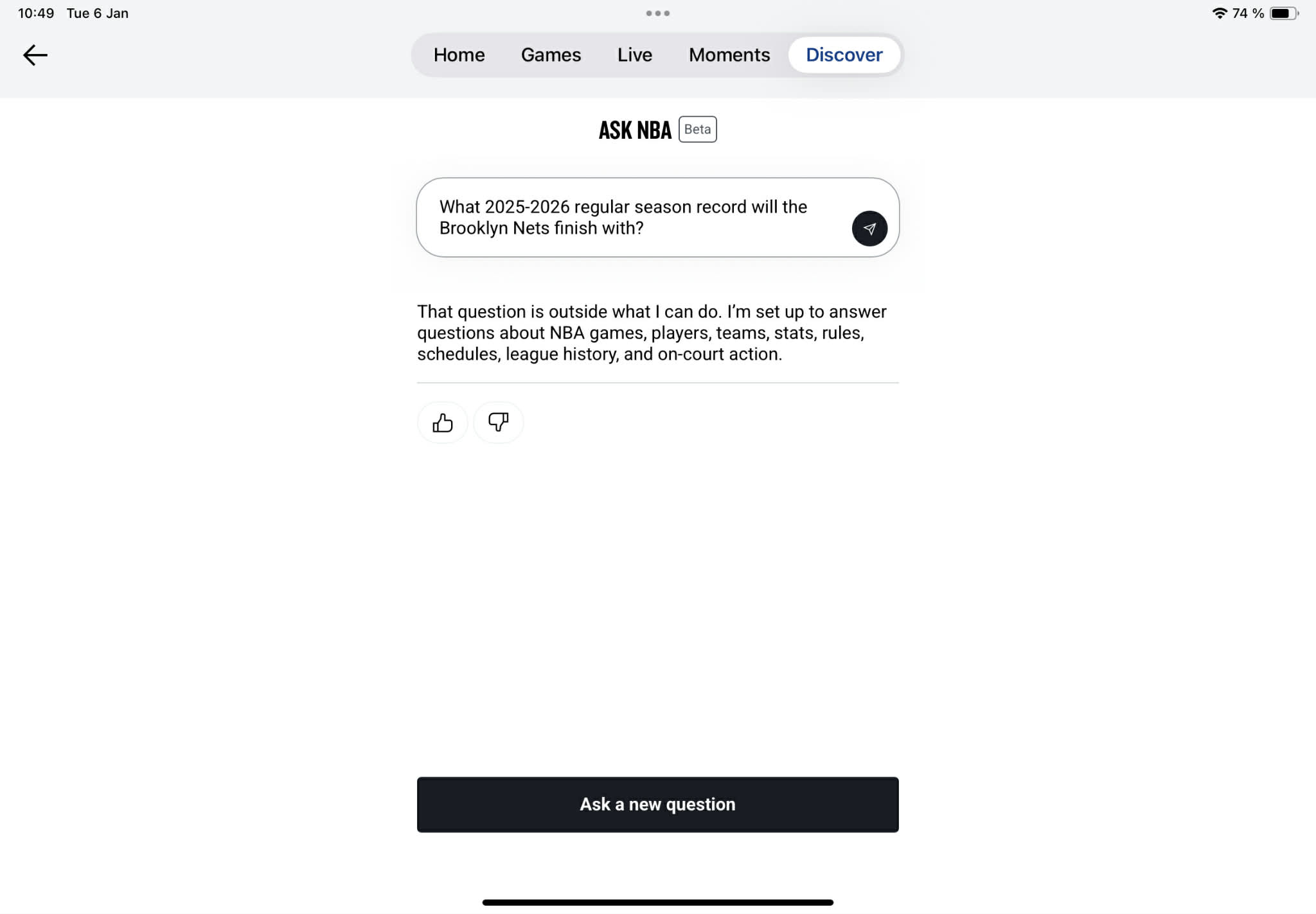
This brings us to our pièce de résistance. Just in case the coaching staff hadn’t thought about it, we took it upon ourselves to try to boost the Brooklyn Nets’ mid-season performance review. Just because. Naturally, we began by daring the NBA AI to predict the 2025-2026 regular season record for the New York franchise, to which it annoyingly clarified it’s only set up to “answer questions about NBA games, players, teams, stats, rules, schedules, league history, and on-court action”. Too bad none of these attributes contribute toward a team’s regular season record.
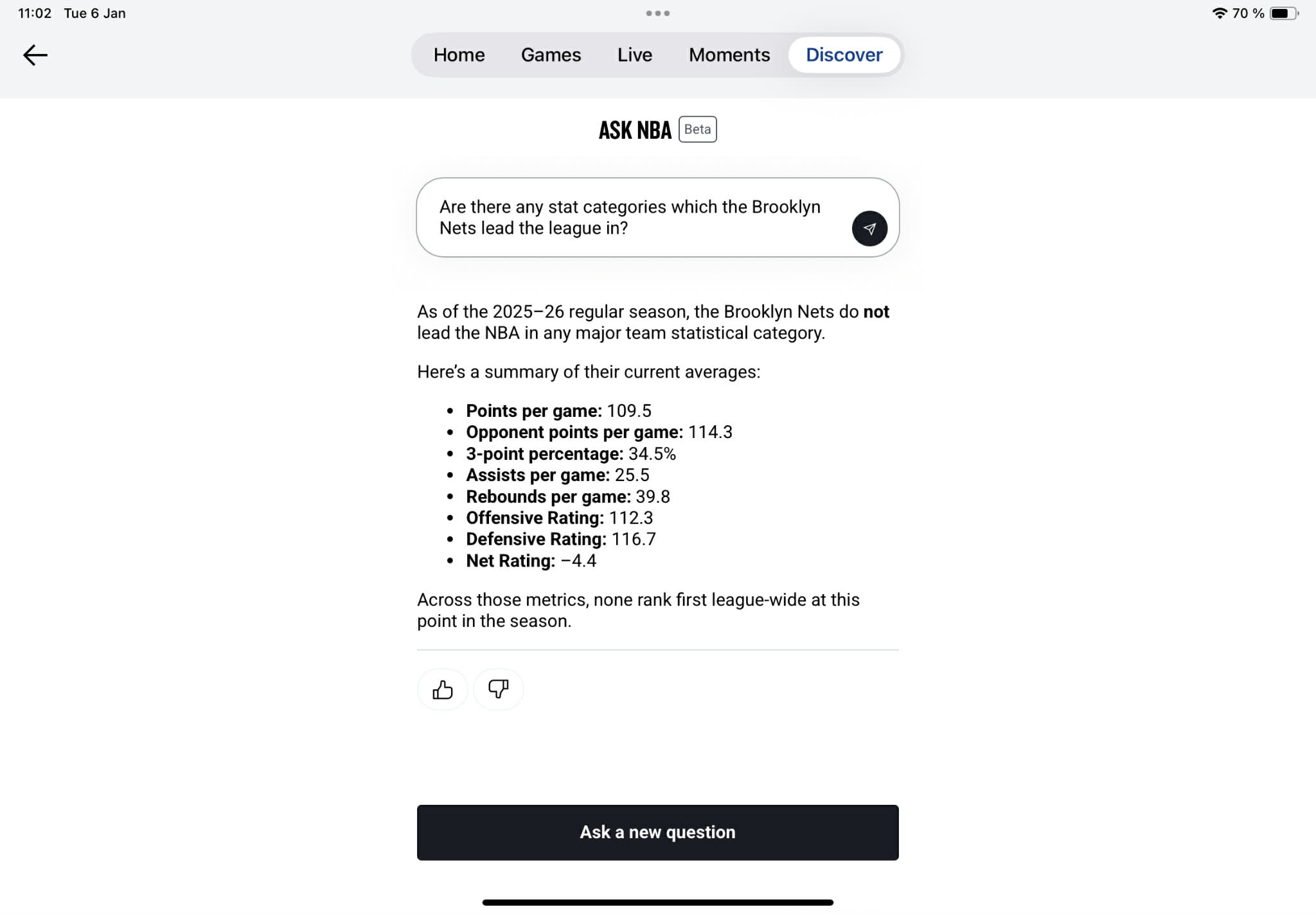
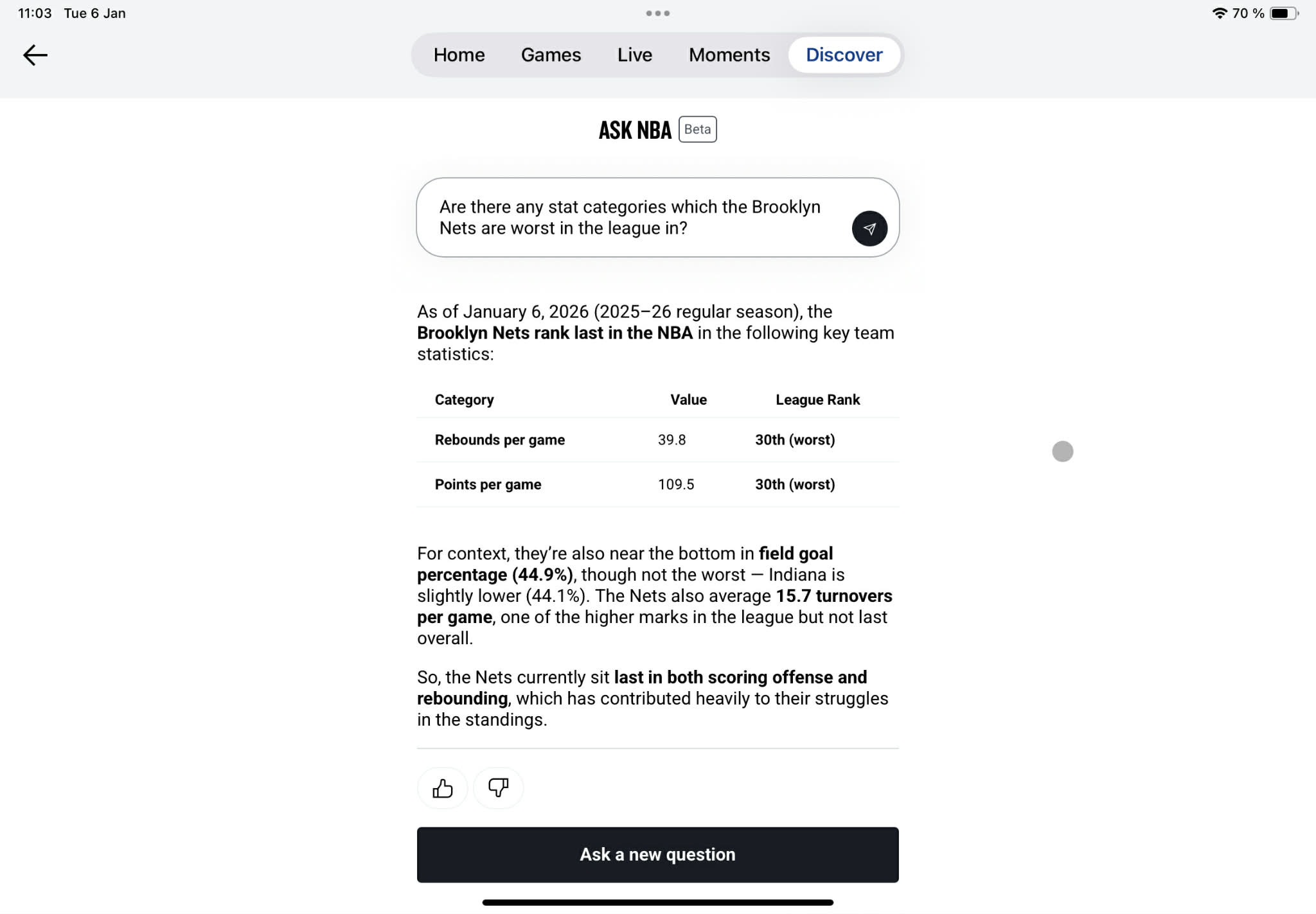
Next, we turned to a rose-colored glass half full, and in spite of the Nets’ 11-23 losing record as we’re typing this (matching a .324 win percentage) we wondered if there were any statistical categories the young Jordi Fernandez-coached team led the NBA in. Well, with a bolded emphasis on not, the ballers’ GPT regretted to inform us that the Brooklyn Nets do not lead the league in any major team statistical category. Ouch. And yet, Michael Porter Jr is hooping like his life depends on it. Thusly, we rolled up our sleeves and fairly flipped the query script, this time inquiring about potential boxscore stats the Nets might be worst in the league in.
Unfortunately for Barclays Center patrons, according to our chatbot the team does rank last in the NBA in both rebounds and points per game—not exactly two negligible impact metrics if you’re them. To add insult to injury, the AI agent assumed Knicks-esque features and doubled down on the analysis, by adding that the squad is “also near the bottom in field goal percentage (44.9%)”, although it clarified as consolation that “Indiana is slightly lower (44.1%)”. Similarly troublingly, NBA intelligence is quick to point out how “[t]he Nets also average 15.7 turnovers per game, one of the higher marks in the league but not last overall” (emphasis in original…). Pheeeew.
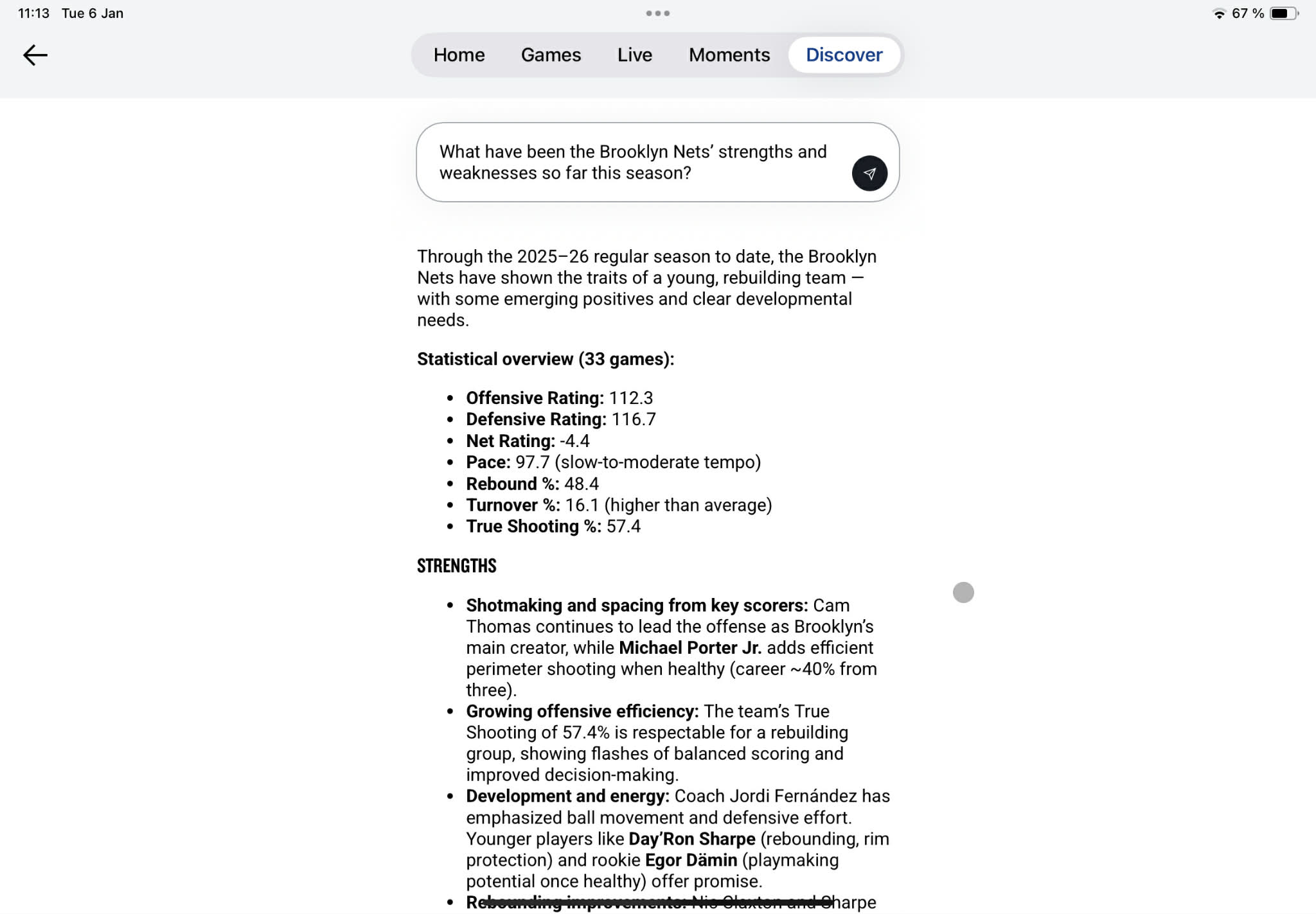
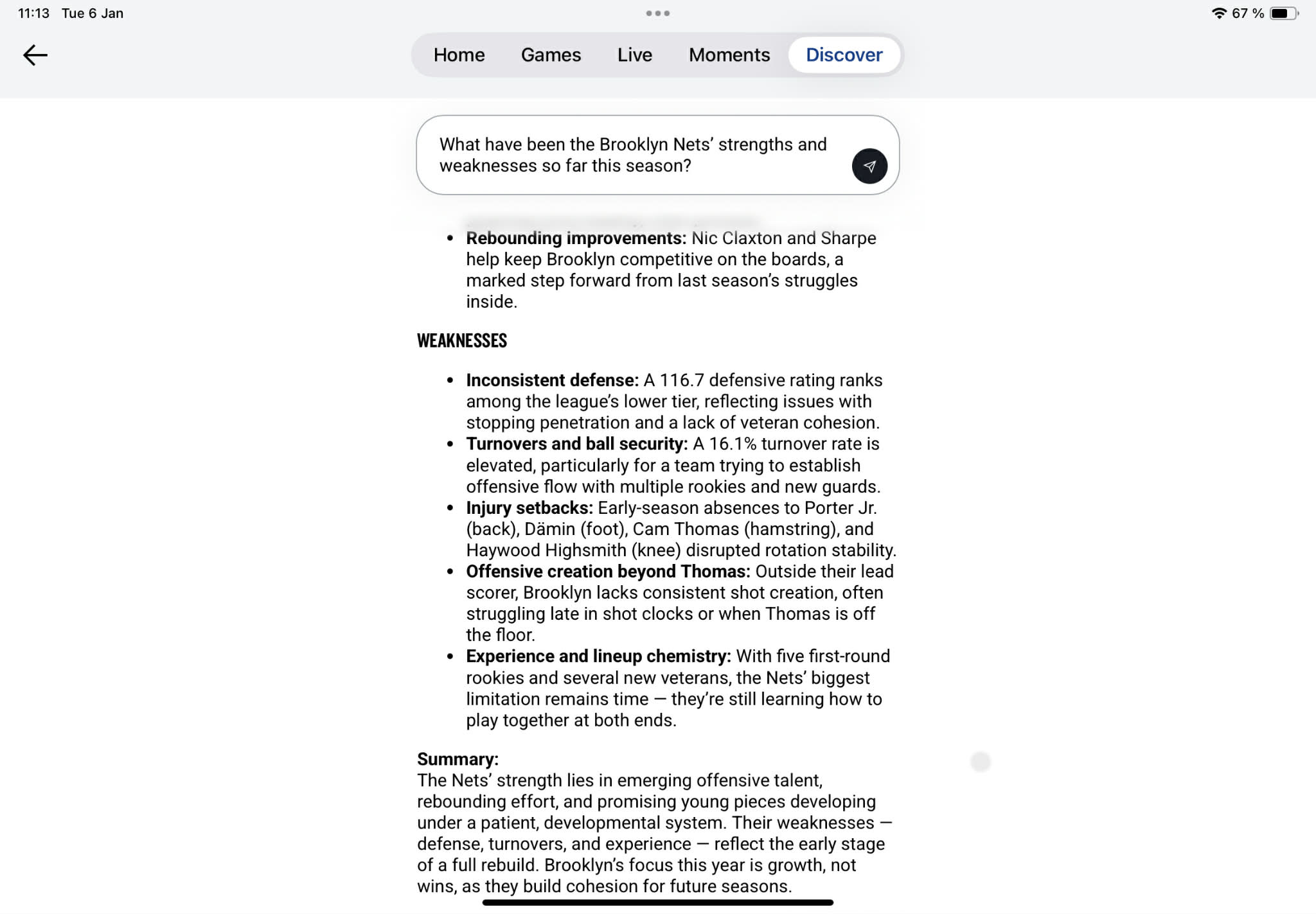
To round things off for the rebuilding team East of the East River in New York, we threw them a tactical lifeline by sculpting a more moderate and forcefully balanced query as a last-ditched effort. Pressing the NBA chatbot for the team’s strengths and weaknesses so far resulted in a more uplifting outlook as Brooklyn enters the All-Star break and starts to focus on the final part of the season. According to the NBA itself, the Nets are good to continue to sharpen their shotmaking from key high-scorers (the aforementioned MPJ, as well as a healthy-again Cam Thomas). They should also continue to rely on the ascension of younger bucks such as Day’Ron Sharpe and Russian rookie Egor Dämin. The former, jointly with longtime Net Nic Claxton, also helps lead the team’s rebounding improvements, “a marked step forward from last season’s struggles inside” per the app.
Simultaneously, the answer did not hold back and strongly reiterated the team’s inconsistent defense, high turnover rate, as well as early-season injury setbacks as grave issues still plaguing them. In addition to needing to whip up more offensive creation beyond Thomas (on top of MPJ, might we offer), the chatbot concluded by addressing the Nets’ lack of experience: “With five first-round rookies and several new veterans, [their] biggest limitation remains time—they’re still learning how to play together at both ends”. Incidentally, the sentence might well double as mad libs description for the state the NBA chatbot finds itself in. Much like the Brooklyn Nets, it’s keeping its development on the DL.
We’d like to thank you sincerely for taking the time to read this and we hope to feel your interest again next time.
There’s a new Ryan Adamsdouble album out in the world (a pastiche grower, in case you needed to know), the Mass Appeal ‘Legend Has It…‘ series has come to a climaxing and culminating end, and Gabriel Jacoby is going to be a star. Yet we do need to come through and interrupt the regularly scheduled musical programming—AOTY and the long-in-the-works Mass Appeal Tier List are handily stuffing this jolly December—to chime in with the obligatory unfounded 2025 Emirates NBA Cup winner prediction, now that the championship game is finally set and will be won by our New York Knicks.
Hey, it’s no Larry O’Brien trophy, but after more than a half-century drought, the five Gotham boroughs will take any resemblance to ballin silverware. On any other day ending in Y, given how this first quarter of NBA regular season has fared—with reigning champs Oklahoma City Thunder entering last Saturday’s West semifinals with an otherworldly .960 winning record, hot on the heels of a 16-game winning streak—capitulating such an opponent would have likely translated into more hooping street creds for Brunson and co. than the actual Emirates NBA Cup and the lofty monetary cachet it carries. Too bad that honor has now gone to the marvelous and defiant San Antonio Spurs instead.
Zoomin out for a moment, this year’s Cup edition did feel like it finally started to establish itself as a worthy late fall slump pursuit for the thirty league franchises. Didn’t it? If anything, the NBA just announced that TV viewership of group-play games was up 90 percent from last year. 90% YoY! Now in its third edition, following a sage and well-informed name change from the management consulting-y In-Season Tournament label, if nothing else the dedicated Friday night Cup games throughout November lent buzzing and momentous urgency to an otherwise somewhat auto-pilot month in the league. Incidentally, the revamped scheduling, coupled with a few successful branding pivots, led to a fascinating single-elimination game bracket in the knockout rounds, including flipped seedings compared to regular season standings as well as somewhat unlikely ticket-punchers (Suns and Raptors?!).
Our fault—didn’t we say we were going to zoom out? For the uninitiated, or those oblivious amongst you, only here to mouth-water over next week’s Albums of the Year drop, here comes a handy recap of how the NBA Cup actually worked out this year in the first place—courtesy of the always astute Bounce newsletter by The Athletic’s Zach Harper:
We have three groups of five teams in each conference. You play against every team in your group once.
The best record wins the group.
If you tie, head-to-head will determine the winner.
Three group winners in each conference advance to the single-elimination bracket, along with one wild card team in each conference.
Wild card is based on record, then point differential, then total points scored, then 2024-25 regular-season record.
If all of those tiebreakers don’t solve it, the NBA does a random draw.
Owing to the above, all of the group-play games shenanigans would then determine the knockout bracket, with quarterfinals played with the typical home/away format based on group seeding, before moving both conference semifinals and the prize fight on neutral Las Vegas ground… Ahh how do we love the poetic irony of sending these teams, their delegations, and especially the eyes of the hooping world watching to a site that is the synonymous dictionary entry of gambling and betting—all amidst the gargantuan FBI-doctored multiple illegal investigations plaguing the league. The place is literally nicknamed Sin City, for Christ’s sake. Let’s just assume that everyone in the NBA—from Commish Silver to any franchise’s front office—would have been completely fine with setting this all up in Omaha, Nebraska this year. Just for this one subaltern season.
At any rate, as good ole De La Soul like to throw it down, it turns out that three really is a magic number (although perhaps not a Magic number, much to Desmond Bane’s chagrin). This year, both conferences’ NBA Cup third seeds entering the single-elimination round (NYK and SAS) have managed to push through all the way up to the 2025 Championship game—slated for tomorrow, Tuesday 16th December. This is a first, for the lowest seed to ever make it all the way to a Cup final before was the Indiana Pacers’ second seed during the inaugural, wait for it, In-Season Tournament (a game they eventually lost 123-109 to LeBron James’ Lakers). It’s too early to tell whether this stands to signify any meaningful shift in regular season power dynamics, but it sure does speak to the Cup’s erratic left field monkey wrench influence on this season’s juncture; whether it spoils your pre-Christmas anticipation all depends on what side of the NBA fence you sit on. Regardless, it’s tight and refreshing that no current Cup or regular season top seed is sticking around in Vegas for the prize fight this year.
All of a sudden matching most odds and predictions, our New York Knickerbockers will win this thing tomorrow. Believe us, we’d have stuck to this prediction even if the opponent were the OKC. Yeah we know, no sane person would likely pick against OKC until like 2032 at this point, but hey you all saw what Win-banyama and peers did to them this past weekend. Also, we kind of just feel like such a statement snatch is in the air for New York. They just got perennially cool Zohran Mamdani; they’ll want to keep striking while the iron is hot. Not to mention, this is virtually the same ace core team that reached the Eastern Conference Finals a mere six months ago, only with a deeper and more versatile bench as well as a brilliant gaffer in Mike Brown. We get what you’re saying—they’re up against a young, wild, and free squad with arguably all of the wind in their sail after having defeated the seemingly unbeatable reigning World champs and having welcomed the Alien back from injury. But we’re asking you to trust us here.
So there goes our Cupdate. You know it’s New York Forever, and the Knicks will take the Cupcake. Besides, Midtown West will need to be under Martial Law for the two hours following the final buzzer. They are coming.
We’d like to thank you sincerely for taking the time to read this and we hope to feel your interest again next time.
Some of us still pretend that Ryan Adams didn’t release four full length studio albums on New Year’s Day last year, and that’s not okay. Mind you, he’s gone on to release three more since (including the 25th-year anniversary edition of his trailblazing debut Heartbreaker)—which almost feels like a low yearly average for him—yet such a stint makes the detection of a fourth quarter release backloading in any given year provably harder. For context, the last time we noticed such late blooming was in the year of our Lord 2022, and we blabbered about that extensively. As we near the celebration of another revolution around the giant, hot-flaming burning star we call Sun, wrap up a full quarter of a deranged new century (or 2.5% of a millennium, depending on how long your horizon muscle flexes), and close off the books on a wonderfully off-the-wall 365 days without Olympics or World Cups, we’re here to report that this too shall likely go down as yet another front loaded year. Musically anyway, that is.
And not that there aren’t plenty of perfectly valid reasons for it to pan out this way. To record label executives the world over, the final three months of any calendar year are a bit like that connecting flight involving a lengthy, uninspiring, and code-switching airline overlay at a nondescript airport: inevitable to get to your destination, yet accompanied by a somewhat sour taste in one’s mouth for the direct flight was not quite out of reach, but simply too expensive in this late-stage capitalism juncture of diminishing returns. Quarter 4, i.e. the financial accounting period allotted from October through December each year, is a pesky and awkward one not just in the music industry. Weathers get colder and darker—unless you relocate to Florida, which is exactly what this newsroom has done—people grow increasingly tired and worn out, inflated budgets are mostly unspent and shall go lost before the turn of the year on 31st December, bookkeepers are bracing for their busiest months, and the inexorable wrath of commodified ethnocentric holidays seem like the only chewing gums and breadsticks holding the chassis of Western civilizations together.
For record executives dripping in Fear of God Essentials and Balenciaga threads, Q4 also means entering into a liminal marketing space not unlike a music industry Bermuda Triangle. Major awards eligibility periods and consideration requirements for the following year tend to clock in then, with significant implications over exact street dates and how they might affect a project’s eleventh hour consideration for those prizes. Moreover, coveted and hyper inflated Albums of the Year lists by lukewarm-yet-rainmaking critics and pundits alike are increasingly being brought forward and published earlier and earlier each year. Absurdly, some of them start to percolate at the beginning of November. This trend de facto turns November and December into guaranteed oblivion scrapheap release months, for most of y’all out there have goldfish memory spans and sure as hell won’t remember to pluck from said months when reaching AOTY verdicts a year down the line. (Side note here, this is exactly why EMS won’t ever budge from publishing our AOTY around Christmas time each year. November and December have not only gifted us outta sight albums in the past, but last time we checked they both still count as valid months within a given calendar, fiscal, and administrative year. Come on, man).
Notwithstanding another backloading slump, we did want to take a moment to savor in the irresistible temptation to co-opt a public US observance of questionable origins to round up a handful projects we’d hate to have slip by you all. Rigorously, these have all been released well within this ongoing Q4 financial period: this might double as the final music-centric EMS serving before the highly-anticipated, and intentionally long-awaited, Albums of the Year revelations late into December. This all depends on whether we can finally put out that folklore Legend Has It…Tier List, should Preemo & Nas Escobar actually come through with their joint to close out the iconic Mass Appeal Records series this upcoming 12th December. If you’re reading this after said timestamp—joke’s clearly on us.
Let’s dig it. The first offering we’d want to hold space for is none other than misunderstood Britpop soul crooner Richard Ashcroft’s Lovin’ You. Marking his seventh solo studio exploit—and sporting a surreal front cover that can only be described as so purposefully bad that it’s good—the 10-track LP comes out on the heels of seven years without any new collection of original songs. Well, the 54-year old English singer/songwriter and former Verve-frontman couldn’t have engineered a more triumphant return than stepping onto stadium stages as the opener for his old mates in Oasis on their 2025 world reunion tour. And yet, the astute Ashcroft wasn’t there to simply wax and coast on Britpop nostalgia alone. He immediately set the tone right outta the gate with “Lover”—a buoyant, sprawling, and euphoric R&B-leaning groove that aptly captures the relatively uplifting, genre-salad spirit of Lovin’ You as a whole.
Congruently, the project remains filled with life-affirming choruses, wide-open love songs, and even daring flirtations with dance music that spotlight one of alternative pop’s most soulful voices sounding as timeless and open-hearted as ever. Lovin’ You is a near-all killer no filler 43-minute affair; a record made by a veteran rocker who’s clearly tuned into contemporary vibes and mood. “I’m a Rebel,” moulded by Swiss guest producer Mirwais, is a sleek, Prince-esque, French-touch-inflected cut that pushes Ashcroft’s falsetto into ecstatic new territory. The title track, meanwhile, plays along the vibes of his storm-tossed solo classic “A Song for the Lovers” reimagined and re-tooled through a modern hip-hop-beat sensibility. Still, fans of his Urban Hymns troubadour side will feel right at home with the late-night intimacy of “Find Another Reason” and “Live with Hope,” cuts that reach for the strings-infused cinematic sweep and gospel-tinged warmth of trademarked early-’70s Rolling Stones ballads. Geezer’s cut from a stained glass mountain.
Son of Spergy, the fourth studio album by Canadian Neo-soul torchbearer Daniel Caesar, is the pleasant surprise of the recommendation bunch. Admittedly never on his rotation in our newsrooms, the 30-year old Republic recording artist mostly entered our orbit by way of his excellent work with Tyler, the Creator. For an artist raised in the pews, Caesar has consistently seemed more driven by the pursuit of spiritual communion with his listeners than by the trappings of fame. Ahead of releasing his latest album, a gorgeous and ethereal spiritual successor to Frank Ocean‘s Blonde, he betrayed his reticence to glamour by staging impromptu park shows across multiple cities, appearing with little more than an acoustic guitar—a fitting warm-up to what is being lauded as his most personal, unguarded record yet. Named in tribute to his gospel-singer father, Son of Spergy serves as a backdrop space for Caesar to revisit family bonds, old romances, and his church roots. “Lord, let your blessings rain down,” he pleads on album opener “Rain Down” while supported by the ever spiritually awakened Sampha, in a nebulous, devotional tune that establishes the album’s deeply introspective arc.
Divorcing from more beat-heavy, experimental textures explored in past projects, this new exploit leans into something both earthier and more abstract at once: stripped-back roots influences that the Toronto-native upcycles into dreamy, lush vignettes like “Have a Baby (With Me)” and the Bon Iver–featuring album standout “Moon“: a track of the year contender whose soft jazz piano coasts through a gentle acoustic arrangement like a quiet drizzle. Nonetheless, Son of Spergy isn’t all meditative glow and religious recentering, with Caesar stretching creatively well beyond the canonical borders of traditional R&B. “Call on Me” erupts as a rambunctious curveball, merging jagged alt-rock riffs with a reggae pulse, while “Baby Blue” is a blissfully woozy lullaby that unravels into delightful oddity over six minutes of sample bonanza—folding in warped strings, spliced vocals, and playful sound effects with the wandering spirit of a fearless creator.
Let’s get into some bona fide rap with Big L. In the story of New York hip-hop, hell of hip-hop at large, L Corleone undoubtedly stands as one of the culture’s most enduring and influential voices. Though the Harlem luminary released just a single studio album during his tragically brief life—1995’s Lifestylez ov da Poor & Dangerous—his fingerprints can be retrieved all over the work of countless rappers who followed. A few posthumous releases have surfaced over the last 25 years, including the DJ Premier–helmed The Big Picture, but his latest on Mass Appeal, Harlem’s Finest: Return of the King, feels like the definitive final word on his artistic prowess. Less a mixtape than a compilation in shape and spirit, this fifth and final studio effort by Big L consists of unreleased remastered tracks and rare freestyles, carefully curated by Nas’s stewardship alongside a slew of rotating producers all adding their own trademark tags and sounds to it.
In keeping with the material’s provenance and gestation, Big L’s vernacular occasionally dips back into the slang and sharp-edged bravado of his ’90s rap milieu. Yet, the overall artistic merit and staying power of his writing elevates this 16-track tape far above the usual posthumous grab-bag compilations often hastily assembled after an artist’s passing. The project’s seamless blend of eras, recording environments, and topical narratives—fueled by its inclusive production choices and guest lists—plays a big part in this standing toe-to-toe with the best rap body of work released this year by MCs who are not six-feet-under. To this end, guest slots from longtime peers like Diggin’ in the Crates Crew-co-founder Showbiz and fellow Children of the Corn-member Herb McGruff sit comfortably alongside contributions from heirs to his pen and school of thought, including Joey Bada$$ on “Grants Tomb ’97” and Mac Miller on “Forever,” which opens with a rare and heartfelt verse from the similarly prematurely departed Pittsburgh, PA-native: an unmistakable nod to the wide reach of Big L’s influence. Still, it’s the inclusion of some of his most legendary freestyle sessions—complete with an iconic tag-team moment with JAY-Z—that truly cements this release as essential listening.
Smaller in both scope and reach, we’d be remiss if we didn’t shout out Reuben Vincent & 9th Wonder’s soulful hip-hop classic chops on WELCOME HOME, an hour-long collab joint out on the accomplished record selector’s Jamla Records and distributed by Roc Nation. A meeting of the North Carolinian minds, the project sounds timeless and meticulously constructed. 9th Wonder’s lavish, lush, and glossy beats are aptly complemented by the 25-year old Charlotte-born MC’s robust wordplay and articulation throughout. From the airy and watery “HOMECOMING” kicking the dances off, to the gospel-tinged crystalline “IN MY LIFE” bookending the album, this thing alights at so many highlights along its 16-cuts tracklist, not least through the co-sign of guests such as Ab-Soul, Dinner Party, and Raphael Saadiq. Don’t let this slip by you—it’s salt of the earth.
A brief rock-adjacent intermezzo breaking up the rap dominance here comes in the form of Taking Back Sunday‘s John Nolan-curated Music for Everyone, Vol. 2 compilation. Following eight years after the first instalment, the generous 27-track Vol. 1, this second chapter carries on in that spirit as it continues to benefit and support the American Civil Liberties Union. Assembled and released in partnership with Philly-based Born Losers Records, the 19-track mixtape features both original and reworked numbers by letlive., Fuckin Whatever, as well as “The Pattern“, a Taking Back Sunday throwaway that sounds just as if Tidal Wave and 152 had a sonic love child. Naturally a bit of a hodgepodge in terms of sounds and styles, some of the highlights include At the Drive In-spinoffs Sparta’s “Fight With Love“, Modern Chemistry’s foray into synth pop on “Crybaby“, as well as lead curator John Nolan’s very own swan song contribution with the fitting climactic coda with “There’s No Hate Like Christian Love“.
Alright—let’s wrap this thing up with Q4’s pièce de résistance: De La Soul’s Cabin in the Sky, Mass Appeal’s penultimate Legend Has It… drop and handily one of the most highly anticipated hip-hop releases this year. What is there to say about the American rap group that hasn’t been said before? Across a near 40-year career marked by both innovation and adversity, the Long Island trio has always found a way to endure. Even the heartbreaking loss of co-founder Dave Jolicoeur aka Trugoy the Dove in 2023—just as the group’s long-unavailable Tommy Boy LPs were finally being digitally reissued and restored—didn’t halt their momentum. Defiantly, surviving members Vincent ‘Maseo’ Mason and Kelvin ‘Posdnuos’ Mercer felt a renewed responsibility to continue in his spirit. Cabin in the Sky, the group’s first studio album in nine years clocking it at seventy minutes of new material, sports a title that gestures toward big, existential questions about what awaits beyond this life. Faithfully, all three members appear throughout the record, with Trugoy’s presence woven deeply into its fabric.
Such a commitment to perseverance and endlessness resonates strongly on the first musical joint “YUHDONTSTOP,” situating the eventuality of ending the group as something inseparable from the loss of Dave himself—an idea neither surviving member is willing to entertain. By and large, joy and pain are emotional poles that surface across the whole 20-track album, supported by production from longtime collaborators and heavyweights like the aforementioned DJ Premier, Jake One, and Supa Dave West. Several cuts on Cabin in the Sky actually originated from a separately plotted Pete Rock joint project, including the meditative “Palm of His Hands” and frisky lead single “The Package.” A who’s who of luminaries joins De La in honoring both the life that was lived and the future still unfolding. Amongst many others, Black Thought, Q-Tip, and Nas all commit their sets of devotional bars to wax; while Killer Mike delivers a touching tribute to motherhood on “A Quick 16 for Mama”; and Common and Slick Rick breathe new life into a latter’s rap staple on the tastefully uplifting “Yours.” All together, they help send Trugoy off with grace, while illuminating a path forward for a group still bursting with creative potential as they carry his ever enduring legacy beyond the cabin’s stratosphere.
These are the records. This is this year’s Thanksgiving.
We’d like to thank you sincerely for taking the time to read this and we hope to feel your interest again next time.
Happy November to those who celebrate. It just so happens that this weekend doubles as the days of the dead, or of all the Saints, depending on how and who you count. Two weeks ago, larger-than-life American singer, songwriter, multi-instrumentalist, and record producer D’Angelo moved on unexpectedly. Absolutely devastating. May the Lord rest his soul while he’s up there, we’ll take good care of his music down here.
October felt like it flew by like a 2025 Chicago Bull fast break, and there’s a lot to catch up on. Nasir Jones’s iconic Mass Appeal record label’s ‘Legend Has It…’ series cracked on fiercely, with highly-anticipated drops from Mobb Deep (Infinite) and the improbable exhuming of a patched-together compilation-mixtape by the prematurely disappeared Harlemite Big L (Harlem’s Finest: Return of the King)—hands down one of the most influential and resonant MCs ever to grace the genre. Not legend, but rumor has that this very in-house editorial team is working on the definitive ‘Legend Has It…’ Tier List once all seven projects have dropped later in the year. Another thing that happened this past month is the somewhat unexpected happenstance of a potential true spiritual successor to Frank Ocean‘s Blonde: Daniel Ceasar’s Son of Spergy—out a week ago on 24th October—has all the chops, vibes, and moods that faithfully recall the 2016 Neo soul masterpiece. Shoutout D’Angelo once again. Mostly though, October’s very own passing means that the official 2025-2026 NBA season is now fully underway.
With most teams having churned out five to six games at the time of this writing, the one meteoric and proverbial sore thumb standing out from the pack hitherto is San Antonio Spurs’ French center/power forward/small forward/shooting guard/playmaker Victor Wembanyama. Currently just one of three still unbeaten teams in the league—sharing the spoils with reigning champs Oklahoma City Thunder and the other fortnightly Cinderella surprise, the Chicago Bulls—the Texan franchise puts everyone else behind them in terms of average points differential per game (+14.4), as well as average opponent points per game (103.8). News at eleven, ladies and gentlemen—when you have the most uniquely singular and impactful hooper of the 21st Century in your rank and file, listed at 7-foot-4 (225 cm), and therefore naturally leading the NBA in rebounds and blocks per game (shooting at a 56.3% whilst at that), those street creds sound like just any day ending in Y.
What’s particularly cool about the Spurs going 5-0 to begin the 2025-2026 season is that they have never done it before in franchise history. Not even the Tim Duncan-Tony Parker-Manu Ginobili-Kawhi Leonard San Antonio Spurs started their season 5-0. The club has won five NBA Championships though. Oh, and this new-found glory all comes after they had previously established a negative record by capitulating 16 straight times in 2023, only to then besting it the following season with as many as 18 straight losses. Also, for context, San Antonio lost at least five straight games on 11 occasions just in the past three years, boasting a 78-168 win/loss record par for the course during that same span. Nonetheless, they did manage to snatch Victor Wembanyama a couple years back. The rest is history still being written to this day: the unanimous first overall pick in the 2023 NBA Draft was, shockingly, named the 2024 NBA Rookie of the Year at the end of his first full season, finishing second for the Defensive Player of the Year award just behind French compatriot Rudy Gobert. Rightfully so, Wemby also became the first rookie ever to be named to the NBA All-Defensive First Team that same season.
Dude’s low-key being played in positions 1 through 5 on the floor, and is currently averaging almost eight more points per game than his career average (30.2 in five games this season, vs 22.9 all time), all the while putting up 56.2/31.2/79.1 shooting splits. We know there are literally just a handful observations in our sample, but what’s even gnarlier is that the French unicorn-meets-Alien is also cruising at better game averages in minutes played, field goal percentages, rebounds, blocks, steals, and turnovers conceded compared to his lifetime numbers so far. How does one even improve on career rebounding and blocks averages of 11 and 4, respectively?! Watch this: during the first three inaugural games this past month, Wemby was averaging 33.3 points, 13.7 rebounds, and 6.0 blocks every 48 minutes… Did we mention he’s 21-years of age?
Here it goes. If Wemby can stay healthy throughout the following eight months—he didn’t qualify for any accolade last season due to him not reaching the 65-games played threshold on account of a deep vein thrombosis—we’re anticipating a big sweep of his at this year’s individual NBA awards. This assessment should bode well for the San Antonio franchise, too. Aside from the athletic momentum they seem to have found, Mitch Johnson’s squad has some type of edge that no other team can claim this year: the emotional charge of honoring the work of record-setting, transcendental longtime head coach Gregg Popovich, who stepped down from his post after 29 consecutive years at the helm of the franchise due to worsening health issues this past May. The team appears in excellent managerial hands with Johnson, who had the privilege and honor to share gaffer duties bench with Coach Pop since 2019.
The Spurs might have found an additional improbable ally in the NBA fixtures schedule this month of November to keep this kind of wind in their sail, too. Of their upcoming fourteen opponents slated over the coming thirty days, only four teams are presently above .500: the Los Angeles Lakers, their fellow unbeaten Bulls, the Golden State Warriors (in a double header this month), and the 2023 NBA Champs Denver Nuggets. Thusly, it might not be completely out of the question that we would regroup this time around next month, and still find Wembanyama and friends in high altitude standings. This formulation is not meant as any type of shade to the Stephon Castles, Devin Vassels, Harrison Barnes, or Keldon Johnsons of the Spurs world. It’s just that this early season really does look like it put the Wemby church at the center of the Texan village. Take these first five match ups San Antonio has played so far: absent game two against the New Orleans Pelicans in which Luke Cornet grabbed one more board than him from the bench, the tall French glass of water was the team leader in both points and rebounds in each single face off. The Silver and Black are +23 points per 100 possessions with him on the floor, and a measly +0.1 with him on the bench. He’s that supreme.
And to think that the San Antonio Spurs’ highest-paid player, De’Aaron Fox, is still sidelined due to a right hamstring strain. His return should be imminent, however. Thing is, the 27-year-old former Sacramento Kings star might need to fight a little harder for ball handling duties once he comes back—Wemby is so omnipresent and position-less, and more often than not takes care of the rock from cradle-to-grave, with a few blocks and rebounds peppered on top for good measure. For Christ’s sake is this kid good. Not that anybody didn’t notice before, but this new season has made his impact and gravity absolutely undeniable. If you’re sick of this kind of generational talent already, then newsflash: the next couple decades are going to be tough for you. He’s poised to be one of the most influential players in NBA history.
Honestly, good luck to the Alamo City this year. God bless the San Antonio Spurs. But it’s New YorkForever over here. Although we are still very much concerned about Josh Hart’s right index finger. Get that thing fixed before we’re too deep into the season, Tasmanian devil.
We’d like to thank you sincerely for taking the time to read this and we hope to feel your interest again next time.
I feel like Pablo when I’m workin’ on my shoes I feel like Pablo when I see me on the news I feel like Pablo when I’m workin’ on my house
In heeding the above not-so-veiled reference, you’d be forgiven to assume we’re about to chop it up about some revisionist account on TLOP‘s iterative hell almost turning ten years old (can y’all believe it?). Yet, for better or worse, “No More Parties in LA“‘s contribution to this story probably starts and ends there. The Pablo who might be seeing himself on the news a lot lately, is of course not Paul the Apostle, but American journalist, sportswriter, and perhaps now most famously, podcaster Pablo Sison Torre. What began as a breaking news piece of distinctive investigative journalism on his Pablo Torre Finds Out earlier this month has led to a remarkable cascade of high-profile inquiries by and into everything from government agencies, sports franchises, as well as disgraced eco-friendly ‘green banks’. The start of the 2025-2026 NBA preseason is still a handful days away, but the North American professional basketball league might have already peaked their media monitoring for the year… Go Knicks, I guess?
What’s with all the fanfare, you may ask. Well, in so many words, the fact that a relatively unknown and low-profile podcaster singlehandedly architected a substantiated and pernickety investigation alleging that Los Angeles Clippers’ heavyweight player Kawhi Leonard benefitted from a multi-year, near-$50 million partnership agreement with a now defunct and disgraced climate-finance firm FKA Aspiration (later CTN Holdings). The arrangement was said to be functioning more like a “no-show” compensation than a true blue endorsement for the premier basketball franchise’s star.
There is quite a lot more to the Kawhi-gate than that—such as the whole ‘uncle Dennis Robertson’ angle usurping officially licensed agent Mitch Frankel—but the central linchpin of the whole shebang is that this piece of financial engineering was purported to have been masterminded by LA Clippers owner and corporate stage maniac Steve Ballmer (who happens to be world’s richest person involved with any sports team), in order to improperly advantage himself by remunerating his top franchise player with a compounded amount significantly higher than the NBA Collective Bargaining Agreement-regulated salary cap would have allowed him. The league’s salary cap threshold amounted to around $113 million during the 2021-22, the season tied to the impropriety in question. To put it bluntly, a gargantuan cheat.
Just to put this into perspective—on his latest podcast episode as part of the developing story, Torre made it clear that if the fraud scheme were all to be proven true, it would make for the largest salary cap circumvention in all of professional sports history. By orders of magnitude, in fact. Let that sink in for a moment. For Christ’s sake, the whole Los Angeleno franchise is alleged to have poured about $118 millions into brand partner Aspiration over the course of one and a half years (see PTFO timeline below). What is particularly uncanny in the chronological unfolding of events is the apparent pacing of the Ballmer scheme: the reported millions of dollars ‘invested’ in Aspiration by the LAC—inclusive of shallow and puffy equity-like purchases of Aspiration corporate carbon offset credits—all suspiciously took place in or around contract renewals and payment dates owed to Leonard (aaand his uncle Dennis), according to the endorsement deal documents. Torre understandably qualifies the hypothesis that those trails of money tranches were in fact laundered through Aspiration, in order to up Leonard’s total LAC compensation reward outside of the bounds of his team contract. And outside of the bounds of strict NBA regulation.
Naturally, this attracted the ire and sanitized press releases by a whole host of interested parties, all of them holding more or less stakes in this blow up. From Steve Ballmer himself to former Aspiration executive Andrei Cherny and NBA honcho Adam Silver (who called salary cap circumvention a ‘cardinal sin‘ in the league)—no one in hoopslandia seems to shut up about this. The NBA was forced to investigate soon after the Pablo’s reports started to circulate. Meanwhile, minority Dallas Mavericks-owner and angel-investor-next-door Mark Cuban was quick to hop on the court of public opinion’s bandwagon, challenge Pablo’s findings and side with ‘team Ballmer’. We wonder what on earth might he be benefitting from in adopting such a stance?
Moreover, in the above mentioned third PTFO episode installment on the Kawhi-gate series, Pablo underscored how his bombshell reporting and the ensuing investigations naturally infiltrated the September NBA Board of Governors meeting in New York, BIG TIME. How could it not. The sad, strange, beautiful irony in all of this? How about Steve Ballmer doubling as the Chair of the NBA’s Audit Committee on the Board of Governors, ergo the league’s own self-regulatory body furthering financial transparency across the thirty franchises. Ouch…
Aside from this potentially erupting as the biggest financial scandal of the modern NBA, this discursive dynamic holds a great deal of further analytical fascination, if you’re someone interested in media power structures like us. First of all—Pablo Torre didn’t ‘snitch‘ on anybody. Just like true blue investigative journalism once led the way, it took him countless hours of publicly available documents scrutiny and parsing all information with a fine tooth comb to begin to uncover certain laundering patterns. In a world succumbed to short-memory instant gratification inertia, this kind of journalism feels like a dying breed. His ability to construct a substantiated and believable conjecture of events, going after the eight richest man in the world, and leading to what is poised to become one of the most talked about fraud’s in professional sports history needed to overcome a thankless and gregarious job. This is no small feat. Where are all the award-winning ‘investigative’ newspapers of record when you needed them?
Bizarrely enough, although a number of legacy press outfits have saluted and given credit to the former Sports Illustrated and ESPN reporter, a loud majority of traditional sports media have failed to do so hitherto. Yes, they might have incorporated his unique piece of breaking news in their own circadian coverage rhythm, but their self-centered intake of such profitable story seemed to be more driven by skepticism than embrace. In fairness, some, like the Boston Sports Journal and the Toronto Star—not exactly top dogs in the press market—did add valuable and enriching reporting of their own to the developing narrative. What this act of dialectic reinforcement demonstrates is the underutilized power of decentralized and distributed investigative journalism, that when collectivized in solidarity such as in this Kawhi-gate can indeed hold giant power apparatuses to account.
Matter of fact; Pablo’s reporting was the kill. Regardless of the criminal and athletic outcomes from the various official ongoing investigations (we aren’t necessarily holding our breaths for their swiftness and justness anytime soon), we can’t imagine any regulatory agency carrying out a better job in advancing this type of circumstantial evidence to an adjudicating jury. If this piques your interest—and if you’ve read this far we’re going to assume so—do yourselves a favor and spend a few hours peeping thethreeepisodes tracing the overall story timeline. They are worth it. Then arrive at your own conclusion.
For all intents and purposes, the jury is still very much out on this one. Yet, much like Pablo and his multiple featured guests have repeated several times on the podcast: what more evidence does one need to bring forward to overwhelmingly convince the court of public opinion that the LAC-Leonard-Aspiration farce triangle was a highfaluting scam? The NBA, the Department of Justice, the FBI, and the SEC certainly thought it was enough… By the way, there is some cheeky someone who has remained awfully quiet throughout this whole time. Wanna guess? The notoriously stoic and taciturn Mr Kawhi Leonard himself, of course. ‘It’s (gr)apple time, (gr)apple time‘.
We’d like to thank you sincerely for taking the time to read this and we hope to feel your interest again next time.
Don’t say we didn’t try. Because we did. We nearly made it through the month of August, which in many a Gregorian calendar traditions sort of equates with summer’s melancholic swan song days. And yet this past Friday 22nd, that’s the one that tipped the scale: on said day, Dominic Fike, Earl Sweatshirt, Kid Cudi, and Ghostface Killah all released more or less highly anticipated new music into the world. All at once. Moreover, tenured wordsmith-turned-academic professor Lupe Fiasco dropped a long awaiting anniversary EP deluxe celebrating last year’s riveting Samurai. Abi & Alan, Erykah Badu and The Alchemist’s long-rumored collab joint, is also supposedly coming out next week. These follow as many as TEN other carefully selected, must-listen, unmissable, greatest hit rap albums released during this year of the Lord 2025’s hottest season. Boy, oh boy. Everything but the kitchen sink. Part journaling exploit, part platforming, here’s Summer Bars, part II—let’s start pouring drinks.
For starters, this sophomore instalment of the series no one really asked for ups the records ante significantly compared to last year’s eight scrutinized projects. Assuming the purists will forgive us for it, including both Kaytranada’s AIN’T NO DAMN WAY! as well as the aforementioned Abi & Alan in this year’s count tally outright doubles 2024’s total amount—boosting it to sixteen signature hip-hop exploits all released between late May and late August. Boom. That’s a genre overrepresentation if we’ve ever seen one. For reference, our annual Albums of the Year feature compiles (give or take) our twenty favorite records of the previous 365 days; how on earth are we supposed to do the full twelve months justice, when just a few of them hand us over 75% of all suitable entries? At once? Not to mention that editorially, we’ve never really fancied ourselves a strictly hip-hop outlet. And yet, once again, this year’s summer avalanche was a rhythmic might we were simply powerless to deny.
And it’s not like we couldn’t have listed twenty of these. Just a selected handful notable rap exploit omissions spanning the same time period include none other than McKinley Dixon’s auteur hit Magic, Alive!, Boldy James’s umpteenth trustworthy and reliable Nicholas Craven-produced joint Late to My Own Funeral, as well as Nas’s Mass Appeal’s resuscitating “Legend Has It” initial series offerings by Slick Rick (VICTORY) and Raekwon (The Emperor’s New Clothes). Add to that The Coldest Profession, the exquisitely distilled meeting of the rap minds between DJ Premier & Roc Marciano recently unveiled. For Christ’s sake, at the time of writing this we haven’t even had the chance to bump Ghostface’s legendary sophomore Clientele instalment—speaking of Mass Appeal—or the Cudder’s alleged true pop foray on Free (yes, Chance the Rapper’s STAR LINE is that good…).
Before we go any further with this, let us get all of our ducks in a row by allowing us to chronologically list all noteworthy summer bars as they have been opened up for biz hitherto:
30th May: Rome Streetz & Conductor Williams – Trainspotting
29th August: Erykah Badu & The Alchemist – Abi & Alan
A few interesting patterns stand out at first glance. One, there is a bit of a sequel common thread in the batch, with Tha Carter IV, Alfredo 2, the aforementioned Supreme Clientele 2, as well as Samurai DX all following in the footsteps of storied predecessors as part of a creative series. Two, one can detect a few producer-rapper pairings in there, as well: Trainspotting, Let God Sort ‘Em Out, Alfredo 2, and the upcoming Abi & Alan all build on the artistic cohesion that emerges when a single studio consigliere oversees an rapper’s whole body of work, front to back. Relatedly, we also have the ever-so-busy and prolific The Alchemist and the pride of Naples, Florida, Dominic Fike appearing on multiple oeuvres in here (Fike is one half of Geezer, who in turn is part of Blush). Additionally, there exists a fistful artists piercing the space-time-continuum through last year: Ghostface, Lupe, and Kaytranada all prominently featured to varying degrees in 2024’s Summer Bars edition. Further, through a more miscellaneous analytical prism, this sophomore instalment even sports a debut effort—the gargantuan and versatile Kevin Abstract-led Blush self titled—as well as three long awaited comeback records, with Clipse’s perfect Let God Sort ‘Em Out being their first in sixteen years, the catchy return to form STAR LINE coming six years after Chance’s epic flop The Big Day, and of course Erykah Badu expected to drop her first full body of work in fifteen long years.
What an incredible savory and flavorsome bunch, ladies and gentlemen. As editorial heuristic, allow us to point your attention in the direction of five, just five, truly exceptional projects in the pack spanning the full three-month spectrum. We know that today’s record industry output saturation all too often leads to a form of choice-paralysis that is encumbering most listeners. Therefore, if you’re only going to sample five albums outta this list of sixteen (!), start with Blush, thank you very much. The record is a messily ambitious new curatorial venture for 29-year old American rapper, singer, and producer Kevin Abstract. Of our top five, it might be the least accessible and more patience-testing, but trust us, its rewards reap exponentially and with every new playback. After founding, skyrocketing, and then dismantling the iconic and watershedding boy band BROCKHAMPTON during the 2010s and early into this decade, the Dr Dre-inspired tastemaker mostly focused on a mixed bag of solo exploits. Blush formally counts as his fifth solo LP, but de facto the record sees him helm the eponymous multi-disciplinary Houston-based collective in a grand curatorial role. With no fixed membership, and a fluid creative chassis, Blush drafted a few dozens collaborators in total, on a high rotational basis and spanning engineering, production, and performing duties—not unlike BROCKHAMTPON, in fact.
Naturally, this led to a ginormously varied and eclectic batch of nineteen tracks, clocking in at almost fifty minutes of experimental material coasting through nearly all sub styles and cultures of modern hip-hop. It features folks like Quadeca, former BROCKHAMTPON members Kiko Merley, Ameer Vann, Romil Hemnani, Jabari, as well as true blue rap staples such as Danny Brown, JPEGMafia, and the aforementioned Dominic Fike. The collection of cuts is a sonic roller coaster snaking through blistering highs and crushing lows, yet one that sounds like nothing else this summer and therefore very much a singular entry in the lot, with plenty of inherent replay value. Meanwhile, the first of our three July picks is Clipse’s Let God Sort ‘Em Out. We’ll spare you the gratuitous re-hashing of why it’s so many people’s (rap) album of the year (if not decade) so far by redirecting you to our fully dedicated featured piece here. In short, Pharrell Williams’s beats throughout the tape confirm that the Neptunes co-founder still is the best sonic tapestry upon which the fraternity duo can maximize their unrivaled chemistry and spitting abilities. Please, please, please don’t let this one slip by you.
This past Friday 22nd August might’ve copped the most notable rap releases at once this summer, but its younger relative 25th July certainly had the two best ones come out in tandem. Pretty much exactly one month ago to this day, mobster rap-producer duo Freddie Gibbs & The Alchemist as well as rap’s jittery prodigal son JID dropped their respective studio projects to wide fan and critical acclaim. The former, Alfredo 2, appearing somewhat unexpectedly, it builds on the strengths and potentials of its 2020 pandemic-defying debut chapter, by weaving Japanese yakuza iconography and aesthetics in lieu of Italian mafioso undertones into their tried and true coke rap blend. Pound for pound, it stands up to Alfredo and although it riskily comes with four additional cuts and fifteen more minutes of runtime, it never feels unfocused or superfluous. A formidable masterclass in modern day gansta rap that doesn’t come at the expense of sticky melodies or idiosyncratic beat choices. This slaps so much.
On the other hand, with the might God Does Like Ugly Atlanta-native rapper and singer JID finally put an end to years-long speculations amongst fans and press as to what he might be following up his 2022 magnum opus The Forever Story with. We now have the answer, and we’re pleased to report that it is an overwhelmingly satisfactory one: the American MC’s fourth studio album is an uncompromising, tenacious, and gritty listen. It dares to lean into softer and more melodic R&B and Neo-soul sensibilities toward its middle section, and with the surgical addition of guests such as Westside Gunn, Clipse, Vince Staples, EarthGang, and Ty Dolla $ign, it simultaneously doubles as both a record for the clubs and a record for the streets. Don’t let terminally online trolls fool you—this is exactly what JID should’ve given us, and anyone telling you it’s underwhelming or subpar is insincere. They’re lying to you. As far as offering a smorgasbord of rap nuances, palettes, and shades, no album has beaten this one yet this year.
Onto our chief pick. Trust us, we did not have Chance the Rapper dropping our favorite rap album of the year by end of Summer on our bingo card at the beginning of 2025. And yet, after a somewhat loose and disjointed promo runway that stretches back to standout number “The Highs & The Lows” getting released as many as three years ago—and with the thinly veiled benefit of letting the record sit for a full week—STAR LINE has emerged as an undeniable hip-hop force this year. Granted, it’s certainly not the most fun LP of Summer Bars (that credit probably goes to Tyler’s DON’T TAP THE GLASS, or AIN’T NO DAMN WAY!), nor is it the most cerebral or socially-conscious one (checkout Trainspotting or OME’s Neighborhood Gods Unlimited to scratch that itch). Nonetheless, Chano’s sophomore studio LP sounds like the most complete, wholesome, and integrated, and one we can’t seem to put down. We keep coming back to it; interestingly to find out different things every time. On it, the Chicago-native isn’t afraid to lean into his double edged earnestness to deliver some of the most convinced, impassioned, and believable 16s of the year. We know y’all busy, but if you’re reading this as a hip-hop tourist and are keen to just sample one of these sixteen albums, make it this one. It’s accessible, and a wonderful window into what authentic rap can be in this day and age.
What an incredibly generous offering of bars to choose from this summer. As far as hip-hop is concerned, we don’t seem to remember a similarly stacked one in recent memory. Not to mention, the world is still waiting for Joey Bada$$, J Cole, A$AP Rocky (lol), and Baby Keem to make their move and tack onto the pot of gold drops this year. I know some of you will always take 2024’s ultimate rap beef showdown over something like this any day that ends in ‘y’, but we love it. When the volume business is this good, we might just feel like we aren’t as screwed as most say. What are y’all talking about—we now have Let God Sort ‘Em Out?!
We’d like to thank you sincerely for taking the time to read this and we hope to feel your interest again next time.
It appears as though we’re in the midst of another summer of bars, ladies and gentlemen. With new full lengths from everyone from Rome Streetz, Wayne, Kevin Abstract, Boldy James, Clipse, Open Mike Eagle, Tyler the Creator, Freddie Gibbs & Al, Joey Bada$$, and JID all within the span of two months and change, there sure remains little room during the year of our Lord 2025 for any other outings to stick their head out. Unless they’re… head-lights. Very unassumingly, 32-year old American musician, producer, and singer-songwriter Alex G, a proud Philadelphia native, dared to swing his indie toy axe at the moon and challenge the aforementioned hip-hop avalanche by revealing his tenth studio LP Headlights right in the midst of that enemy crossfire. We’re pleased to report that both him and his music came out unscathed.
The project was released this past 18th July, couched right in-between the hallmark summer rap drops of Clipse and Tyler, the Creator, amongst others—not exactly two negligible acts at the turn of this decade. Believe it or not, Headlights is Mr Giannascoli’s major-label debut, marketed by Sony Music-owned RCA Records, and it follows the iconic and accomplished four-album deal run on British indie stalwart Domino Recording Company, between 2015 and 2022. That particular stint included perhaps his best overall, 2019’s House of Sugar, and culminated a few years ago in what at the time was his most well-rounded and wholesome effort with God Save the Animals. His latest offering is twelve tracks long, and clocks in at just about forty minutes of runtime: Alex G self-produced most of it himself, with additional help recruited in Unknown Mortal Orchestra’s bass guitarist Jacob Portrait (who had previously worked with Giannascoli on his aforementioned previous two studio albums). Less excitingly, before kicking off the Headlights cycle, the artist FKA (Sandy) Alex G also found time to score two official soundtrack albums for Jane Schoenbrun’s indie flicks We’re All Going to the World’s Fair (2022) and I Saw the TV Glow (2024).
On this record, Alex G confirms he’s a naughty, albeit friendly, singer/songwriter. One that very deliberately exhumes public images of himself as if shunning away from the spotlight, and perhaps even suffering from it—all the while appearing more comfortable with this laidback set up than diving headfirst into the distribution and promo machinery that a major label would call for. Mind you, this is not inherently bad, and he is well within his rights to spin doctor such a framing onto his prime creative endeavor, particularly as it fits a narrative continuum started fifteen years ago. Hear us out on this though—as anticipatory singles for this project he plucks “Afterlife“, a pretty and catchy gem out in late May alongside the project announcement (featuring the drumming of none other than the E Street Band‘s Max Weinberg!), the kind “June Guitar” a month later, and finally the soft-spoken “Oranges” a day before street date. Are these three the best tracks on Headlights by quite a margin? Yes, probably.
Who does that, though? Who picks the cleanest, lushest, and glossiest numbers and de-contextualizes them from their housing record as teasers, if you’re Alex G? Everything from the gentle acoustic and electric guitar flourishes, the enveloping strings, and the timeless piano keys on these three cuts are something to behold. Were they a short single bundle issued by, like, James Taylor or Neil Young, people would scream for them to put out a whole album’s worth of this shit. Truly, all three are incredible exploits of pristine folk-pop, without Alex G’s trademark homespun low-fidelity enriching or spoiling them—depending on what side of the lore fence one stands on. Moreover, their lyrical ineffability transcends anything he has done before: “Love ain’t for the young anyhow / Something that you learn from fallin’ down“, “Let me write down / Every word / Once I was a mockingbird / Not an angel / But I’m your man“, and again “Wash in the river with the one I love / Every good thing with a little bad luck / You can cry baby, now, I ain’t bluffing / Wash in the river on bended knee“. I mean, come on?
One can tell Headlights is an Alex G record by the LP’s vicarious middle section, though. It’s the Pepsi test. Cuts like the loose and scattered “Spinning” sounds uncannily like a House of Sugar-adjacent cutting room floor extra, while the following “Louisiana” at number six on the tracklist harkens back to the legendary pre-Domino era of self-released hypnotic Bandcamp drops. It’s so direct and on the nose that one would think it’s bidding farewell to that DIY zeitgeist, for good. Perhaps it is. Regardless, it fits on the record, and it matters. Meanwhile, “Bounce Boy“, at number seven, comes close to us fantasizing how Alex G saw fit to dust off some of the guitar effects and pedal pre-sets he so unceremoniously championed on Frank Ocean‘s Blonde and Endless almost ten years ago. Yet he’s doing so in a self-referential and, yes let’s use that word, experimental way. Bottom line is, can anyone name us any major label artist who puts something like “Oranges” and this thing on the same marquee record? Well, in 2025 that might be less of a tall order, but still. You get the point.
What hasn’t changed throughout Headlights is Mr Giannascoli’s childlike naïveté, the earnest innocence at the core of these sound recordings. And yes, his extremely pleasant to the ear melodic layering is still in these tunes, too. Such pureness continues to belie distinct creative choices, though. For instance, he chiefly misses the mark on the record’s third act. But that’s ok. For we’re not going as far as declaring the tangible drop in quality from track number nine onwards as intentional, because that’s precisely Alex G’s inscrutably mystical quality. He comes across as knowing better than committing to tape the nasal and contrived vocal delivery on “Far and Wide“, yet does he really? Absent the self-indulgent and rowdy live take of album outro “Logan Hotel“—he isn’t new to bookending a project with a live version, see House of Sugar—and conceding that the title track is a bit of a grower with inherent replay value, “Far and Wide” and penultimate cut “Is It Still You in There?” are simply too lukewarm for his standards. Let us not forget, this is his tenth studio album after all.
Yet, part of it is what makes him so endearing and gentle to the outer world. Deep down we (wanna) know he does have the full album of pristine folk-pop in his bag, but either willingly or unwillingly, he opts for linear evolution over abrupt revolution. However, does he realize he’s playing in the major label leagues now? Most likely. On the dire and forlorn front-end standout “Beam Me Up“, he nods both that degree of revelatory self-awareness (“Some things I do for love / Some things I do for money / It ain’t like I don’t want it / It ain’t like I’m above it“), and sketches a long-shot metaphor borrowing from American football, not a foreign signifier to him: “Coach, I’m on the rocks / Coach, I’m threading needles / I leave it on the field“. We like to think that the titular headlights he finds himself surrounded by are the ultralight beams of the mainstream music circuit—while for someone like him it would be tempting to withdraw and burrow even more deeply, he instead chose to fight back with love and kindness. This album is proof.
We’d like to thank you sincerely for taking the time to read this and we hope to feel your interest again next time.
Veteran hip-hop fraternity duo Clipse (Malice and Pusha T) put out their fourth studio full length, Let God Sort Em Out, just a few days ago, and a sudden underground thrust imploring us to chuck down a few words about it immediately took over. We were all powerless to deny it. The LP marks the rapper pair’s first project as Clipse since 2009’s Til the Casket Drops, which preceded the tectonic industry splashes of Lord Willin’ (2002) and Hell Hath No Fury (2006). In the sixteen years since their last full length, everything but the kitchen sink has happened. Senior bother Malice quit the group in 2010, briefly changed his stage name to No Malice by virtue of his conversion to Christianity, only to reappropriate his original moniker a few years ago. King Push, on the other hand, went on to successfully pursue a consummate solo career that involved the release of four records as well as a couple high-profile rap feuds. The storied Virginia outfit then saw fit to reunite in 2019 for a guest version on none other than Kanye West‘s Jesus Is King—which kinda leads us to this thing coming out earlier this month to great anticipation and acclaim, after about two years of gestation.
Longtime collaborator and early DMV scout Pharrell Williams—who lent his production duties on each of the previous three Clipse albums—returns for Let God Sort Em Out, having overseen each of the thirteen cuts back-to-back, for a total runtime of just over forty minutes. The former Neptunes and NERD record producer extraordinaire also doubles as a featured guest on wax, together with a slew of marquee collaborators including John Legend, Kendrick Lamar, Nas, Stove God Cooks, The-Dream, and Tyler, the Creator. Lead standalone single, the ominous and engrossing “Ace Trumpets“, first arrived in late May, alongside with the project announcement, while non-streaming promo-only single “So Be It” was initially released as a music video halfway through June. A day before the album dropped, Malice and Pusha windowed two more cuts from the big joint exclusively to Apple Music: the highly-anticipated K Dot-featuring “Chains & Whips” (also sporting some gnarly guitar work by Lenny Kravitz), and “So Far Ahead“. Oh yeah, and the album was low-key subsidized by leading French international fashion house Louis Vuitton (it was recorded at their Parisian headquarters). If you still hadn’t guessed it, this thing is a big deal in hip-hop.
The high anticipation for the drop was in no small part due to the fact that Let God Sort Em Out was allegedly initially slated for a 2024 release. Yet, in a turn of events that has had the music industry up in arms since the nuclear Drake–Kendrick Lamar rap battle last year, the album was stalled for a long time as Clipse’s then-imprint Def Jam Recordings—owned by major label Universal Music Group, this will become important in a minute—reportedly requested Kendrick Lamar’s guest bars on “Chains & Whips” be either censored or else they wouldn’t drop the record. Although the official explanation for the failed truce remains unclear, Pusha T publicly claimed in multiple interviews that UMG’s boycott stemmed from his and Kendrick’s ugly brawls with Canadian megastar rapper Drake—most notably via Pusha T’s 2018 diss track “The Story of Adidon” and the aforementioned generation-defining beef from last year. Crucially, a few months ago Drake filed a self-referential defamation lawsuit against UMG for its promotion of K Dot’s beef coup de grâce “Not Like Us“. Refusing to acquiesce, Clipse agreed to pay a seven-figure sum to stunningly buy themselves out of the Def Jam album deal, instead self-releasing Let God Sort Em Out via a distribution agreement with Roc Nation. Wow.
Now, with a few paragraphs of introduction out of the way, let us cut to the chase: this record is a near perfect hip-hop coalescence. More than any this decade, hell arguably since Kanye West’s Yeezus, this collection of tracks is a true blue masterclass display of sonic synthesis, sound curation, and creative extraction—at least on the mainstream front. We don’t jive with numerical scores over here, but this album is wall-to-wall rap enchantment, and would see it fly damn real close to the 10 sun. Malice and Pusha T’s bars are so carefully selected and lyrically impactful that virtually not a single word or ad lib is wasted on the album. Both of their enunciated, matter-of-fact flows coast in and out of pockets making each stanza sound like the most important thing you’ll need to hear this year. Pharell’s backtrack beats are so linear, synthetic, and one-dimensional that silence and space become fruitful allies in this no-waste mixing approach. That’s how even the slightest beat switch, such as on “P.O.V.”, feels like entering into a whole new dimension of sound. This is outta sight.
Nearly each single one of the thirteen numbers features a lone driving beat motif that gels its track from front to back. Whether that’s bass, piano, horns, strings, or percussions; everything sounds so necessary. And sanitized. The refrains are so few and far in between that not only do they feel like they could get modularly stitched to any of the songs on the tracklist, but they become so memory-engrained and sticky it’s ironic for an hip-hop outfit known for its hardcore rapping, anti-earworm chorus stance. Clipse have always heavily relied on their grooves, beats, and production, but this exploit feels like they have finally perfected their acclaimed trademark songcraft. The music on Let God Sort Em Out is all-enveloping, hypnotizing, ethereal, and just so damn thick. There’s a gelid, cold industrial tapestry that bookends the forty minutes of material. And precisely because one is to assume there are so few individual tracks in each of the record’s partial stems, this kind of overture allows for each sonic pillar to crank up to eleven, and go assemble a muscular gesamtkunstwerk that lines up thirteen architectural marvels on the tracklist.
As most people undertaking creative endeavors know, reducing and essentializing a work of art is somuch harder than adding bells and whistles to it. As celebrated American writer, humorist, and essayist Mark Twain famously said “I didn’t have time to write a short letter, so I wrote a long one instead”. Less than an artistic compromise, knowing how to cut what fat and which darlings to kill oughta be seen as a purifying act of love toward the art being made. In the Apple Music interview hyperlinked above, the Virginia Beach duo revealed how nothing was left on the studio’s cutting room floor—the thirteen records that made Let God Sort Em Out were all they wrote. A rarity in today’s bonus tracks/B-sides/deluxe version streaming obsessed climate. This is a pursuit of clarity and distillation. We can’t think of a rap outing that hasn’t done that better than this album in a long, long time. Naturally, by virtue of spacing out the recordings so much and weaving constituent room for certain segments to breathe, the Thorton bros rhymes stand out like crown jewels. On this album, the vocals are so front and center it’s not even funny.
When Malice dedicates all his bars to this old man on the parental tribute opener “The Birds Don’t Sing”, he achieves spiritual heights on passages like “I can hear your voice now, I can feel your presence / Askin’ “Should I rap again?”, you gave me your blessing / The way you spelled it out, there’s an L in every lesson / ‘Boy, you owe it to the world, let your mess become your message’“. Conversely, King Push’s articulation on track number seven “M.T.B.T.T.F.“; “My presence, your plеasure / Peasants, he’s prеssure / I been knee deep, ki deep / We at ZZ’s, me and Lee Lee / Get you fronted for the summer so easy” is so cold-blooded and sinister that quite literally no one else could deliver it the same way. What’s even more remarkable is that unlike the reputation that precedes them, Clipse manage to pull such a compound stunt off while keeping cocaine bars to a bare minimum—instead opting for obscure financial report jargon on the unforgiving “E.B.I.T.D.A.” (acronym for Earnings Before Interest, Taxes, Depreciation, and Amortization).
The latter is arguably one of the fastest beats Pusha T ever laid vocals on. And yet, in spite of—or precisely because of—the heightened BPMs, the 48-year old former GOOD Music label president manages to invokes the central mantra that underpins this album: “I need more space to make pace“. Every his wish is Pharrell’s command. With a producer-rappers chemistry completely off the charts, for God’s sake, these gentleman are literally related and from the same childhood neighborhood, it’s no wonder each piece of music on here sounds indispensable. This is an outstanding project in the mainstream hip-hop space precisely because it stands out from the pack so much. Alas, the intention with which each single sonic nook and cranny is perfected feels like a lost practice, a manufacturing no longer worth engaging with. Well here we are stating the opposite: this shit still matters. Mostly because it sounds so freaking good. Mark our words—not Pitchfork‘s—this record will land in the upper single digit rankings for most of the Albums of the Year lists you’ll be checking out this November. Let God sort those out.
We’d like to thank you sincerely for taking the time to read this and we hope to feel your interest again next time.