
MACH-HOMMY IS WANTED | 2024-06-01

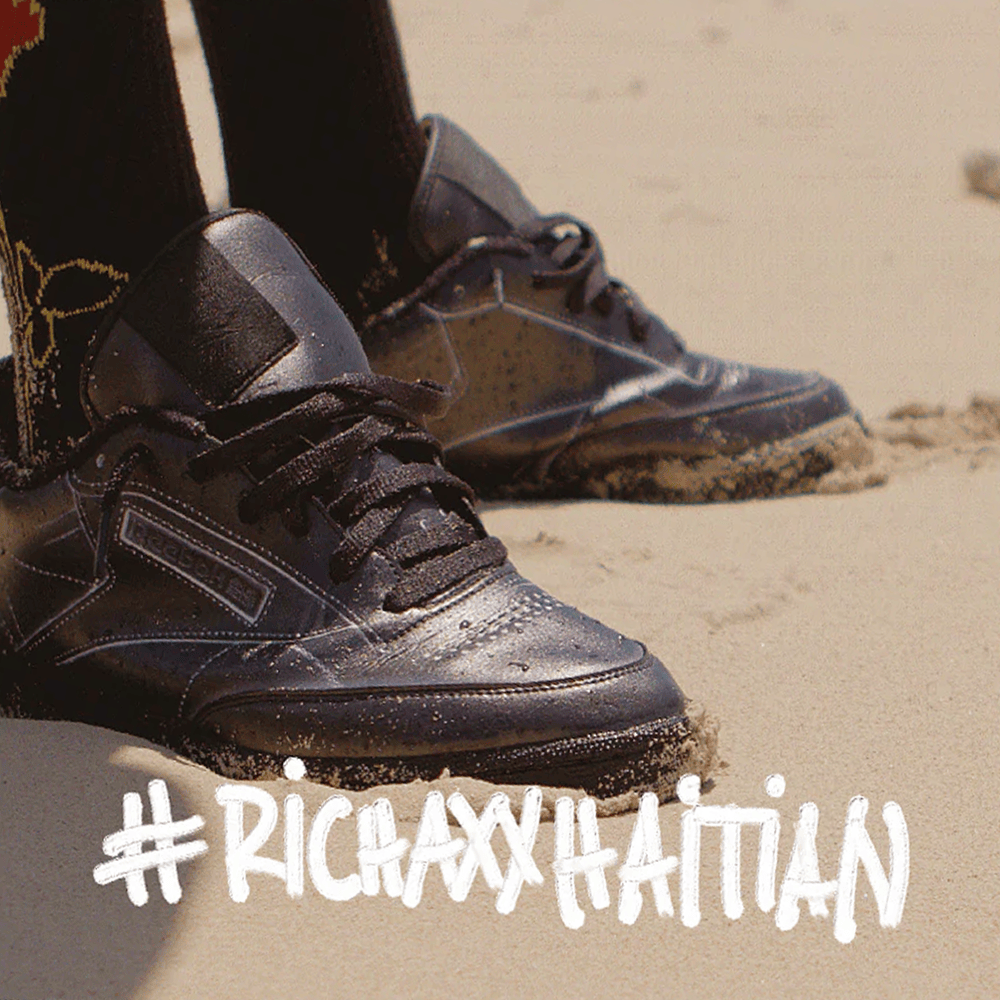
There’s a target on Mach-Hommy’s back. Dead or alive. Reward unknown; although the protraction of techno-feudalism and post-colonial hegemony are probably solid enough guesses. You ask the Haitian-American rapper and record producer yourself. As revealed in his recent public service plea, following shortly after the release of his fourteenth solo album #RICHAXXHAITIAN, there appear to be obscure industry forces at play attempting to curtail the propagation of his message conveyance. Self-released on the 17th May, one day before the momentous annual celebration of Haitian Flag Day, the 17-track project completes the New Jerseyan’s autochthonous album tetralogy—also inclusive of H.B.O. (2016), and 2021’s Pray for Haiti and Balens Cho (Hot Candles)—and was preceded by the eponymous lead single in early May.

Too bad that Google managed to botch the title track’s music video premiere on Mach-Hommy’s own YouTube channel, offering no conclusive explanation for it at all, leading to assume salacious intents behind the ‘unprecedented’ glitch. Too bad that mere days after the album’s public streaming release on DSPs, it mysteriously evaporated from leading outlet Spotify—the latter citing a takedown request from the artist’s camp itself, categorically denied by the Griselda syndicate in the aforementioned video explainer. In both cases, literally involving the largest streaming platform in the world (YouTube), and the on-demand audio service with the highest amount of global paying subscribers (Spotify), the explanations furnished left little to write home about.

In fact, Google’s troubleshooting yielded a complete and laughable non-starter. As outlined in the clip by Mach-Hommy, the internal investigation conducted by multiple layers of YouTube reps upon his flagging of the loss of admin privileges on his own account, as well as the temporary erasure of subscribers during the music video premiere window, returned a pathetic ‘we’ve got no clue as to what happened there, sorry’. Conversely, Spotify dug deeper into its more generous void of incongruous wiggle room in delivering their version of the root cause analysis, owing to the (wholly purposeful) digital record industry’s protocol entanglement. As mentioned, after both the Swedish streaming giant and an unnamed digital distributor washed their hands off by claiming the withdrawal request came from Mach-Hommy’s people, the East Coast MC was informed that his product, the #RICHAXXHAITIAN LP, was missing its Universal Product Code (UPC). An ontological fallacy, for not only was the release perfectly available on all other DSPs at the time, but as Mach rightfully cites in the video, the project wouldn’t have made it to Spotify servers in the first place without it.

Where affairs get even more nefarious is in the aggravating insult provided by the parties at play, who mentioned a now-deleted post by an faceless, nameless X user, interpreting #RICHAXXHAITIAN‘s disappearance from Spotify as a marketing stunt from Mach-Hommy, and fomenting doubts as to who watches the watchdogs in the online pursuits of the truth. The X user alleged that the MC’s strategy was to entice fans by sampling the album as a taster over release weekend, in the hope that they would turn to his webstore to purchase exclusive physical formats—going for a much higher price point. Once again, all of this getting debunked by the artist himself. Putting two and two together, one can’t help but think this is some sort of poetic injustice for a lyricist as concerned with historical revisionism, reparations, the Haitian diaspora, and the plague of colonialism in his ancestral country as he is. After all, retaliations might have assumed newer and more impenetrable forms in the modern age, but they are surely far from a holding pattern of inaction.

This all transpires as being particularly suspicious on account of not just the prolific rapper’s imperialistic establishment antagonism, but also his worthy industry literacy within contemporary digital music practices. Yes he is an actual multi-lingual prodigy thanks to his diverse cultural provenance, yet have you considered that the contemporary record industry’s intentionally dubious language is an idiom he can tally up as yet another atypical string in his bow? When he took legal DMCA action to have all of his works removed from online lyrics providers such as Genius in 2019, he knew he was stirring up a pretty big hornet’s nest. You will likely not be surprised to learn that Genius has long been finessing a number of licensing deals with DSPs under the hood; with one of the largest ones being with, guess whom? Spotify.

This is perhaps a good moment to afford us to elaborate on such content provisioning agreements. We wish we could go into more specifics, but please trust us when we say that we get Mach-Hommy. Without even delving into licensing deals involving the actual sound recordings couched within digital releases, aka the masters we all end up listening on the client side, the narrower lyrics and compositions provisioning business itself is riddled with enough jungly inaccessibility. Not unlike the wider record industry ecosystem, it’s a self-referential distribution funnel washed in a sea of conduits and intermediaries. Rightsholders—such as the self-released and self-published Mach-Hommy—are typically forced to strike deals with certain providers supplying other providers to at least a few degrees of separation before even making it to the end-consumer platforms such as Genius.

Not only does each of these agents retain a significant double-digit kickback on any royalty exploitation event, but within the lyrics consumption realm specifically, these are the kind of publishing deals operating under so-called ‘most-favored-nation’ (MFN) terms. In other words, allowing no room for negotiation or clout at the dealings table whatsoever. What’s even more disheartening within such copyright systems and their application within modern digital platforms is that legal frameworks around royalty rates and statutory regulations are a total mess. Most royalty payments are still remitted via lump sum settlements and upfront reconciliations, with little to no consideration for the actual mechanical reproduction figures for each work. In a way not too dissimilar from Mach’s warlord-stricken gang-centric Caribbean homeland, each end-user platform is free to enact their own price-regulated cartel, benefitting from the lack of international regulation and governance around fair trade.

Yet Mach-Hommy resists. He educates himself, learns the language of the oppressor, and fights with whatever he can. That’s why he’s wanted. That’s why he has a target on his back. And a very concrete countermeasure he enacts is seizing back control of his own art. What he does is that he increases the average consumption price point for each of his superfans, by selling physical formats for three-to-four digit $ price tags. For those versions, he retools the tracklist, too. In #RICHAXXHAITIAN‘s case, track number two “ANTONOMASIA” is titled “SOBRIQUET”, enlisting a guest verse from Tha God Fahim instead of Roc Marciano (allegedly a vox populi decision, as the rapper held a poll during a listening party earlier in the year). “BON BAGAY” at number four is a vinyl-exclusive, while the streaming-available “SONJE” is pushed back on the sequencing to act as the album’s coda. Crucially, “SUR LE PONT D’AVIGNON”, indeed available on streaming services, is wiped off the vinyl version as a quintessential middle finger to French post-colonial forces. Elsewhere on the waxing, “XEROX CLAT” gets retitled to “XEROX TWATS”, while “COPY COLD” and “PADON”—renamed “PARDON” with a Mach-Hommy verse in Tha God Fahim’s stead—are backtracked by a different instrumental beat than their digital counterparts.

In a press statement accompanying #RICHAXXHAITIAN, the wordsmith made the following clear:

I’ve always wanted to rep for Haiti and the cultural and intellectual richness we’ve provided the world. From our musical styles like kontradans that have influenced world music, our natural resources which provide so much raw material for so many important advancements in technology, our thinkers that pioneered philosophical movements and Black pride, and our spiritual leaders who kept the religious traditions of Guinea alive and intact, the religious traditions of Ayiti…

Musically, the album is a masterpiece. It’s a dense, wordy, intricate, disparate, and sticky affair—all at the same time. There’s a glacial undertone throughout the production that exhumes a dejected haziness fitting like a glove atop of Mach-Hommy’s boneless and contorted flows. Complication here is being offered as an act of resistance. Those who really listen, get it. In reviewing the record, good ole Professor Skye made the case for obscurity and incomprehension as a purposeful creative strategy for Mach-Hommy to fence off shoehorning and diluting industrial gentrification. While at the same doing justice to the richly profound social and cultural heritage of Haiti. It’s a valid heuristic, one that enables the New Jersey-native to always be one step ahead of reductive law enforcement. In his line of work, that happens to be private hedge fund-backed technology companies, purporting themselves as the arbiters of an emancipated creative ecosystem, fostering democratized access to all art. Sur le pont, d’Avignon…

We’d like to thank you sincerely for taking the time to read this and we hope to feel your interest again next time. And don’t forget to pray for Haiti.

AV
THE NEW YORK KNICKS ROSTER SET TO SONGS ON PEARL JAM’S DARK MATTER | 2024-04-25

What if each member on the core 2023-2024 New York Knicks line-up entering the NBA Playoffs was a song on Pearl Jam’s latest full length Dark Matter? With box score stats and roster standings updated as of the second game of the First Round best-of seven series against the Philadelphia 76ers in the Eastern Conference (NYK up 2-0), that is exactly what is going to happen here. To get our ducks in a row, the Seattle grunge rock legends’s 12th studio effort was released earlier this month on Republic Records, and comes four years after their 2020 mixed bag Gigaton. All cuts on the project were produced by new-gen West Coast rock historian and Eddie Vedder-worshipper Andrew Watt, clocking in at just shy of 50 minutes on new fierce, ironclad, and robust material.

Before we delve into the sequencing—a quick monition on the draft method used to select the New York Knicks players. We’d be remiss if we didn’t start by acknowledging the perhaps painful omission of 25-year-old center Jericho Sims (#45) from the tracklist. In our operationalization’s defense, the album has only got eleven tracks, so a cursory season playtime extraction coupled with a lower musical match make him the proverbial twelfth man cut from this rock band team. For similar, yet less controversial reasons, further Knicks bench players on the official roster list this season, such as Jacob Toppin (#00), Duane Washington Jr (#1), Charlie Brown Jr (#4), Daquan Jeffries (#8), Shake Milton (#13), Mamadi Diakite (#21), are also excluded from being considered for this shortlist.

1. Scared of Fear — Bojan Bogdanović (#44) | Credit his naturally alarmed glance, or conversely, the gregarious approach he must’ve adopted to break through in the world’s top basketball league hailing from God-forsaken Croatia, but the 35-year-old small forward veteran feels like the best place to start with the PJ record. Slowly coming into this own after the February trade from the Detroit Pistons, he has so far undoubtedly been the more impactful of the two partners at the Law Firm of Burks & Bogdanović. The track’s full-throttle percussions and piercing guitars act as a fitting metaphor for his full-court hustle and shooting prowess, while the sonic plateau culled in the song’s bridge stands to represent the ebbs and flows experienced with the Knicks jersey hitherto. Still, the robust runtime at four minutes and a half nonetheless denotes Bogey’s stoic and earnest style of play on the floor.

2. React, Respond — Miles ‘Deuce’ McBride (#2) | “Don’t let the sky hook beat you to submission / Maybe it’s the price of price of our admission / Ain’t no fucking roses to our condition / Turn this anger into nuclear fission, yeah, baby, baby“. What better set of lyrics to describe the improbable ascent of what is now officially the floor general of the Knicks’s second unit? After a somewhat underwhelming first half of the season—bottlenecked by a wealth of players trumping him in coach Tom Thibodeau’s formation rankings—something unlocked in earnest around the NBA All-Star break for the former West Virginia Mountaineers youngster. McBride is arguably a top three ball handler on the team, and as a nod to the opening song stanza, has never let his smaller size be a limiting factor in his NBA hooping shenanigans. He was ready to seize his chance, and that has led him to become the second pure playmaking guard choice in the line-up—right after none other than breakout team star Jalen Brunson.

3. Wreckage — OG Anunoby (#8) | Befitting his first name shortening acronym, this Englishman in New York plays with the grace, poise, and wisdom of a multi-decade seasoned statesman, belying his mid-twenties age registry. A star trade in the winter transfer market season across the whole league, the Knickerbockers hold a stupidly impactful 20-3 winning record when Anunoby is on the floor (Playoff games included). A wreckage was both the athletic juncture he joined the Manhattan team in—with key starting players Robinson and Randle reported out for the rest of the season at the time—and the clinical picture of his right elbow during that fearful February-March stint, where he himself had to be sidelined, met by most Knicks fan’s exorcisms. The levity, emotion, and lightness with which he plays mirror the track’s sunny and carefree spirit, while the wholesome flair on the lyrical front as well as a soaring and catchy refrain recalling his vastly underrated jams at the rim.

4. Dark Matter — Julius Randle (#30) | For all intents and purposes, the greatest and most popular player on the team. The titular album track is not only its lead single, but its defining and equalizing driving force too. Congruently to its musical twin, Randle is the only element on the list that truly transcends the current team’s zeitgeist, as a three-time NBA All-Star and a two-time All-NBA player—on top being the NBA’s Most Improved Player Award in 2021. Now, scientific method sticklers might be quick to point out how his being out since the end of January due to his right shoulder dislocation should make him ineligible for this tracklist. Yet let us be serious, no Knicks roster list to speak of can afford to neglect its marquee player—especially during a statement season averaging 24 points a game, a whooping five more than his career average of 19. It’s plain and simple: the cut slaps, goes hard, and defines Dark Matter, so does (a healthy) Julius Randle.

5. Won’t Tell — Mitchell Robinson (#23) | The comic relief. Track number five on the album is the most uplifting, its most solar and joyous. Then again, do not get it twisted, Pearl Jam is stuffed with negative space and melancholy, even in its brighter moments. The song’s chorus motif chanting “You can find me here / Waiting for your message to come” seems like an indirect homage to Mitchell’s sweet spot stomping ground under the rim, while his unofficial role as the team’s prankster and meme master lends even more credence to him matching the record’s lightheartedness. We can’t skip the part where we acknowledge the cosmic balance found in this being Dark Matter‘s fifth track, and the traditional center role on a basketball court being labeled as ‘the five’. If you don’t read any more track-to-player pairings past this point, let this be proof this parallelism is worth humoring.

6. Upper Hand — Isaiah Hartenstein (#55) |The team’s tireless workhorse, he who played all 82 regular season games last year—reflected by an ambitious, expansive, and triumphant 6-minute opus. Heralded as way more than a luxury reserve for starting center Mitchell Robinson, Hartenstein kept the Knicks afloat during that critical February-March period, where they didn’t seem able to catch a break in their own town—alas, only to capitulate himself for a brief period under his own Achilles trials and tribulations. Much like the tune, Isaiah can be a smidge inconsistent at times, yet he never falters in blood, sweat, and tears, and most times he does manage to prevail and come out on top. As his signature defensive move, turn to this recent savage in-motion block of Tyrese Maxey’s surefire layup, denying the 76ers a certified win with only seconds left on the game clock during game 2 of the ongoing Playoff series.

7. Waiting for Stevie — Alec Burks (#18) | This one is rough. The second Knicks coming of 32-year-old shooting guard Alec Burks this winter was not supposed to turn out this way. After a somewhat average start in January and February—with sizable minutes as part of coach Thib’s end of 1st and end of 3rd quarter second unit rotation—the AWOL partner of the Law Firm of Burks & Bogdanović gradually faded into the team’s anonymous background, with a measly 30 minutes of combined playtime on the floor during the last ten Knicks games to date, and an even more dreadful 5 total points scored during the same timespan, for bad measure. Swap the “Stevie” for “Alec” on the similarly underwhelming, contrived, and rough around the edges album track’s title, and that tells you everything you need to know here. Mediocrity-fest.

8. Running — Josh Hart (#3) | A clear case for when a one-word song name fits a player like a glove. Josh Hart has low-key been the true blue-collar revelation of this New York Knicks season. The definition of an industrious all-around role player, this guy’s regularly playing 40+ minutes each game, and not batting an eye. Eddie Vedder’s opening verse on the cut, “Got me running, got me running, but the race, it never ends / Got me running, or else I’m done in / You got me coming as you’re going and the chase, it never ends / I’ll be running ’til the second coming” legit sounds like it was written about the versatile 29-year-old Maryland native. Hands down the best rebounding guard of the whole NBA, and its most ruthless birdwatchers’s murderer, Josh Hart epitomizes all the little actions and plays that don’t quite end up in the box score, but that make teams win games, and (hopefully) leagues. The track is a two-minute incendiary blister that cuts throats and claws listeners by their ears, not without splashing specks of melody and introspection. The h(e)art and soul of the project.

9. Something Special — Precious Achiuwa (#5) | The quintessential providential player. Nigerian-American Precious Achiuwa was there when no one else was. A ductile player and homegrown New Yorker—via Miami and Toronto—he is able to seamlessly play each of the five positions on the floor. In those few and far-in between games where Robinson, Randle, Anunoby, and Hartenstein were all down, he rose from the ashes and stood up for the city, carrying the whole quintet’s presence under the basket on his shoulders. Arguably the most underrated overachiever on this Knicks version, it was his outstanding locked-in performance during those cold winter months that made it possible for fans to quickly forgive and forget RJ Barrett and Immanuel Quickley for jumping ship during the trade window—not exactly the easiest kicks to fill. As better and stronger songs come back to relevance on the tracklist, Achiuwa finds himself retreating to warming up the bench a bit more—albeit never forgotten. Not the most skilled, talented, or dexterous player on the list, but boy is he something special.

10. Got to Give — Donte DiVincenzo (#0) | The Knicks sniper with a diesel engine. Big Ragu went from borderline disappointing summer trade wannabe-highlight to fixture shooting guard starter on the 2nd seed team of the Easter Conference in around six months. Whilst at that, he saw fit to set the all-time franchise record for three-pointers in a single regular season with 283 (joining Stephen Curry, James Harden, Klay Thompson, Paul George, Buddy Hield and Luka Doncic as the only players to make 280+ in a season). Coinciding with the tune’s crescendo build, DiVo successfully learned how to make himself indispensable, much like this back-end album highlight. Catchy, agreeable, and so damn trademark Knicks; together with the aforementioned Hart and Jalen Brunson he represents that Villanova Wildcats college basketball core that is daring the Mecca of Basketball to dream big this year. “I’ll be the last one standing / I’ll be the first to forgive, yeah“—if one is to trust Pearl Jam, the sniper’s aim is sharper than ever.

11. Setting Sun — Jalen Brunson (#11) | Last, but not least. Song number eleven for #11. Yes, Randle might be the New York Knicks poster child, but Brunson is their prodigal son. The indisputable leader and top scorer on this team, thanks to his formidable performances and sensational contributions to the Knicks once-in-a-generation season record, Jalen was named an All-Star Player this past February. Like his sonic counterpart, he is beautiful to watch, universally impactful, and the undeniably constituent part of the whole. The guy is averaging 29 points and 7 assists per game this season, for God’s sake. We couldn’t imagine Dark Matter without this wall-to-wall acoustic enchantment coda, and so can’t we the New York Knicks without his 27-year-old point guard. Without being a prisoner of the moment, Jalen Brunson is poetry in motion. Jalen Brunson was born to play basketball.

We’d like to thank you sincerely for taking the time to read this and we hope to feel your interest again next time. And good luck to the Knicks in the Playoffs this time around.

AV

GARY CLARK JR HAS UPLOADED | 2024-01-26

The command completed successfully. More than five years to the day after the release of his 2019 Grammy Award-winning exploit This Land, 49-year-old Austinite Gary Clark Jr has finally uploaded the first teaser pack of new music from his upcoming fourth studio effort, JPEG RAW. Dubbed a nifty and portable sampler, the bundle couches four brand new cuts, all featured on the full album sequence of the blues rocker’s highly-anticipated 12-track project. Fully unfolded as an acronym into Jealousy, Pride, Envy, Greed Rules Alter-Ego, Worlds, JPEG RAW is slated for a street date at the end of March, and continues to fulfill a multi-album obligation with major label Warner Records.

Generously previewed across almost twenty minutes of material laced into four songs at once,—”Maktub“, the title track, “This Is Who We Are“, and “Hyperwave“—the LP is set to also feature samples of Thelonious Monk and Sonny Boy Williamson music, and sports noteworthy co-signs from royalty such as Stevie Wonder and George Clinton. If the sampler is anything to go by, JPEG RAW is poised to both build and expand on the already vast range of sounds and influences championed by the prodigal guitarist on previous outputs. Take the rusty and smokey guitar lick on album opener “Maktub”, which is as immediate and sticky a riff as it gets. While the rest of the same track might get filed as a somewhat canonical Clark Jr effort through and through, one need only press play on “Hyperwave” at number nine on the tracklist to wander into pop-adjacent psychedelia that heavily flirts with a current day singer-songwriter canon.

Elsewhere, the eponymous cut at number two on the record slows things down a smidge, by smoothening some of the opener’s razor edge—yet not without seizing the opportunity to undercut the tune with exuberant tongue-in-cheekness covert as alarm-sounding for talking turkey. One shouldn’t let the apparently harmless lounge-backtrack vibe get it twisted, for the bluesman wastes little time to take no prisoners while preaching his views: “My daughters ain’t gotta shake hips to make tips / No judgement if it makes sense, it made sense / But I ain’t with the ratchet / Only racket they’ll be havin’ is if they pick up a good habit where“. Locked and loaded in the trials and tribulations of fame plus all its dues, Clark Jr attempts to combat inner demons with a healthy dose of self-reflection (“I shoulda paid more attention / All my fault, I did it all for the pictures“), before asking his interlocutor the only question that can redeem him: “If this is what you want, what you waitin’ for? / If this ain’t what you want, what you want?“.

Meanwhile, “This Is Who We Are” is a five minutes and a half epic. Coasting through seas of expansive sonic magnitude before diving headfirst into a pronounced R&B flair, the number is less a responsive answer than a proactively assertive statement. The joint also features angelic BV touches from London-based singer/songwriter and producer Naala, and might double as a central cornerstone of the whole listening experience once the full record becomes available (apparently it’s the first thing Clark Jr wrote for the album). With its lopsided marriage of orchestral elements with dense and viscous tapestry of edgy blues guitar weaves—paired with pierce-loud drumming in the mix—this might not necessarily be the song we deserve, but it’s definitely the song we need.

And then there’s “Hyperwave”. Handily the biggest show-stopping teaser as part of this initial collection of singles. Calling this type of jam unexpected from the Blak & Blu creator would be an understatement. Packing a soft and tender melody into an intelligent psych-rock wireframe, this is the type of material one would peg a post-indie band from the UK with making—yet the Austin six-string prodigy pulls it off in both a tasteful and extremely gratifying fashion. With its bona fide ear worm refrain, the track doesn’t sacrifice soulful transudation at the expense of memorability and accessibility; not the smallest of feats. In a lengthy interview with Forbes, the Warner recording artist revealed the writing sessions that led to JPEG RAW to be loose, pandemic-constrained, and unentangled; admitting how he and his band simply “got together in my studio every Thursday and […] smoke a brisket and […] just sit there and eat barbecue, have a few drinks and play music“.

The haphazard impetus behind the sonic Rorschach inkblot test that became the twelve cuts on the album can certainly be noticed on this sampler. Moreover, hearing how Andre 3000’s recent foray as a flautist into new age jazz inspired him to follow his raw unedited instinct in the same interview draws every door open to a prescient full-blown range and experimentation on the record. Adding that to a more clued in hint where he recalls specific cross-pollinated genre contaminations (“I want my drums to sound like Willie Big Eye Smith meets Jay Dilla. I want my bass to be James Jamerson and Mike Dean“) has us at the edge of our seats to find out what the full project will hold. For Gary Clark Jr is the kind of important artist people will happily wait a long time for. His music and lyrics manage to capture vivid vignettes of fractured modern America, and translate them into universal language and feelings that transcend border and state lines—all the while cruising as one of the biggest rock flagbearers in the mainstream. It’s time he tells us all how we’re really feeling, again.

We’d like to thank you sincerely for taking the time to read this and we hope to feel your interest again next time.

AV