GENTLEMAN GIANNIS | 2025-05-01

More than half of the 2025 NBA Playoff First Round match-ups have already been sorted out. In less than ten days of scheduled playtime since the official kick-off of the ‘postseason that counts’, five teams across the Eastern and Western Conferences have already taken care of business, securing a landlocked spot in the Second Round. Two series sweeps, seeing each Conference’s top seed flat-out ridicule their fellow lowest-seeded Play-In Tournament hopefuls (Oklahoma City Thunder and Cleveland Cavaliers versus the Memphis Grizzlies and the Miami Heat, respectively), one giant upset (sixth-seeded Minnesota Timberwolves dethroning the LA Lakers), as well as a couple predictable verdicts, albeit not without late clutch play drama (here’s looking at you, Indiana Pacers—more on this in a jiffy). Amidst it all, there isn’t even a need to front here: our predictions have so far left a lot to be desired—see bracket below; the 19th April Bluesky timestamp is proof…

Were the Nuggets, Rockets, and Knicks to go on to win their respective series tie in the next couple days, that would leave our bracket accuracy attainment rate at a measly 3/8 correct guesses. That’s a laughable 37%. Achieved by guessing that OKC, the Cavaliers, and the Celtics would win their charitable trips to the Semis, no less—wow. Geniuses. What’s troublesome too here are two deadpan implications from these first ten days of Playoff action: our presumptive NBA Champions Lakers are already on their way to Cancún as of 1st May, and this year’s wishful Cinderella story—the unlikely thrusting of the living-breathing scaffolding Milwaukee Bucks all the way to the Eastern Conference Finals—well, ain’t happening either. Nostradamus would be proud of us.

When your biggest postseason’s brag is that you predicted that the defending NBA Champions Boston Celtics reach the Eastern Conference Finals again, you should definitely stay away from sports betting. Frankly, even a 100% correct bracket guesses should, but that’s a story for a different day. And yet, we really believe(d) in our earnest predictions when we first filled them out. Did we go out on a few limbs here and there, just for fun? Of course. Comment this post if you also had the Lakers making it all the way to raising the Larry O’Brien Championship Trophy this year. Or if you too were hopelessly optimistic that Damian Lillard’s miraculously unprecedented return from his blood clot issue would be the decisive X factor that could bring a somewhat disgraced franchise to unthinkable heights this season, only to capitulate in a seven-game series loss against the reigning champs.

Yes, they were both stretches, but not entirely unfounded. The Lakers won seven out of their ten final Regular Season games—including a marquee triumph against the top Western seed Thunders—and finished third with their best record in six years (50-32, .610 win percentage). Oh, and they low-key pulled off the biggest blockbuster NBA trade of this century, acquiring Slovenian superstar guard Luka Dončić in a multi-pawned deal that sent veteran center Anthony Davis to the Dallas Mavericks. Also, Austin Reaves was on a sensational ascent. And this might be LeBron James’s last season, so why wouldn’t he do everything in his power to tip it off with at least one last Finals appearance? It all kind of made sense.

Not dissimilarly, the Milwaukee Bucks wrapped up the Regular Season with eight straight wins, that arithmetically pulled them out of the Play-In relegation slump, and officially set them apart enough to lock in the official fifth seed vis-a-vis the unlikely All-American success story of the Detroit Pistons. Considering how brutally disappointingly the 2024/2025 season started for the Giannis Antetokounmpo-led franchise, there was a great deal of new wind in their sail that would have allowed us to fantasize about them at the very least making it past the fastidious Indiana Pacers in the First Round (yup, even we’d have to acknowledge that beating the Cavaliers four times out of seven was perhaps too prohibitive and likely not on the cards for this year…). So, about that Bucks-Pacers series…

On Tuesday 29th April, Tyrese Haliburton and co. officially took care of business by eliminating Milwaukee 4-1 in a frankly pretty one-sided best-of-seven series. Pacers in five. The game ended 119-118 in dramatic fashion in overtime, and while the Bucks would probably have deserved to win the game and force a game six back in Indianapolis after blowing multiple double-digit leads, it’s what transpired in the moments immediately following the final buzzer that took on a whole other life of its own. To recap the succession of events for the uninitiated—right after Indiana clinched the series, Tyrese Haliburton’s father John Haliburton, sitting courtside, entered the floor during the celebrations. He then walked up to a petrified Giannis Antetokounmpo and proceeded to wave a towel featuring his son’s face, before directing provocative remarks at the Greek Freak. Giannis then confronted John, leading to a brief but tense exchange before teammates intervened to dissuade the situation.

There is so much that can, has been, and will be written about the altercation. For starters, the public embarrassment expressed by Tyrese over his father’s actions, indicating in a postgame press conference that he had had a conversation with his father to address the situation while also planning to speak with Antetokounmpo at a separate time. Tyrese’s awkwardness was followed by John’s too, who took little time to issue a forced public apology on social media, acknowledging how his behavior did not reflect well on himself or his son. As if it were not enough, it’s news as of 1st May that after conversations with John Haliburton, the Indiana Pacers front office saw fit to ban Tyrese’s father from attending the team’s home and road games for the foreseeable future. And yet the teachable, noble moment here comes from the former NBA MVP and Champion himself. Let us unpack the complete answer Giannis gave during his own presser after the game, when asked to speak on the incident:

All I’ll say is that I believe in being humble in victory. That’s the way I am.

Now, there are a lot of people out there that can say, ‘No. When you win, you gotta talk shit. It’s a green light for you to be disrespectful towards somebody else. I disagree. I have won a championship. They haven’t. That doesn’t say anything. I’m not trying to minimize their effort, but I remember when I won, my mom, she’s never missed a game from February 11th or 13th when she came to Milwaukee against the Knicks, she’s never missed a game. When we won a championship, I remember my mom was scared to cross. She was like, ‘Am I allowed to come and hug my son?’

Except now my brother does media this year. He wants to come back and play, but like, except Thanasis, you’ve never seen my family sit in a courtside seat. This is not something that we do. We don’t. I try to keep my family away from the game.

But losing the game emotions run high. Having a fan, which at the moment I thought it was a fan, but then I realized it was Tyrese’s son, which I love Tyrese – I think he’s a great competitor – he was his dad, sorry.

Coming in the floor and, um, showing me his son a towel with his face. ‘This is what we do. This is what we f**king do. This is the f**k we do.’ I feel like that’s very, very disrespectful.

You know, my dad, my dad if you guys go and ask and learn my dad’s not with us no more. My dad used to come in the family room and was the most respectful person ever. You know when you come from nothing and you’ve worked your whole life to sell stuff in the street and your whole life you’ll be scared of the police of deporting you and sending you back to your country. You have to protect your kids with all means. You create this mentality of being humble your whole life.

To not kind of disrespect anybody, not make the tension high, the emotions high, so anybody can you know snitch on you, say something bad about you. So when he came here I remembered I was like, ‘Dad, why are you so humble? Why are you going to the family room? You don’t even say a word. You sit in the back. Why, why, why are you like that?’ ‘Don’t worry, don’t worry about it. Don’t worry.’ That’s how I grew up. That’s what I had around.

So when I see other dads, which don’t disrespect, maybe if my son play basketball, I might be in the court. I might be the one on the court and like 20 years later you can play this interview and say ‘Giannis, you’re contradicting yourself.’ But we’ll see in 20 years, but I’m talking about right now how I feel. You know having somebody’s that which I’m happy for him and I’m happy for his son and I’m happy that he’s happy for his son. That’s how you’re supposed to feel.

But coming to me and disrespecting me and cursing at me, I think it’s totally unacceptable – totally unacceptable. OK, and … I’m not the guy that points fingers because in my neighborhood snitches get stitches. So I don’t want to say something you know for him to say to get fined or anything, but it’s not respectful. I talk with him at the end and we huh, I think we’re in a good place.

For the record, John Haliburton’s social media handle is @PapaHaliburton. Please. Like, who does that? How much more obvious can the familiar vestibule guised as genuine grassroots support get? While it’s evident that the Haliburton-Antetokounmpo incident has sparked welcome discussions about appropriate conduct for family members and fans during professional sporting events—highlighting the importance of sportsmanship and respect—we claim no better metaphor could be realized to capture the modern day’s delusion of spoiled nepotist entitlement. The kind that involves parents as chief architects of it. And honestly, the Haliburtons embody so much of that. Incidentally, 25-year old guard Tyrese, a two-time NBA All-Star, just won the Most Overrated Player in the NBA award this year in a recent anonymous player poll by The Athletic, receiving 15% of the votes (ironically, good guy in this story Giannis Antetokounmpo finished tenth on the same list).

This story basically writes itself—Haliburton is a non-factor Olympic gold medalist, too. Last summer, he was drafted as part of Team USA’s men’s basketball roster at the 2024 Paris Olympics, where the selection managed to secure the highly coveted gold medal (all the while this season’s NBA Clutch Player of the Year, the New York Knicks’s Jalen Brunson, stayed home to record podcasts…). However, unsurprisingly, Haliburton’s on-court contributions were limited. He merely appeared in three of the six games, totaling 26 minutes—the fewest among all players on the roster. He did not step foot on the hardwood floor in either of the games past the group phase (the semifinal against Serbia and the gold medal game against France). Granted, he was a good sport about it all, tipping off the experience with legitimately funny humor on social media (postingWhen you ain’t do nun on the group project and still get an A‘). But this also kind of makes sense. Doesn’t it?

Go back to Giannis’ integrity lesson for a second. Re-read it in full. This doesn’t all happen in a vacuum. John Haliburton doesn’t walk up to Giannis with hostility at the buzzer, before even hugging his own game-winning shooter son, had he and Tyrese not perfected the gold digging upwards mobility of ‘take your dad to work’ models. Heritage, respect, and sacrifice typically don’t fail people in moments of need. They don’t get washed away by ’emotions’. They either pre-exist, or they don’t. The Nigerian-Greek power forward is obviously one of the greatest basketball players of all time. Arguably the greatest and most incisive player of the last decade. Since his 2013 debut, the guy has been sporting a career average 24 points per game (accompanied by a 55% field goal percentage), with a peak 31.1 points-per-game registered during his 2022-2023 season. As he reminded the audience during the press conference, he is the one with NBA Championship and three MVP titles, not them. Still, Giannis’s most honorable achievement to date might just have come off the court. Yes, Giannis Antetokounmpo is a gentleman, and a damn good basketball player whilst at it.

We’d like to thank you sincerely for taking the time to read this and we hope to feel your interest again next time. Oh and yeah, we do root for the Knicks over here at EMS, but these Pistons man…

AV

DETROIT PISTONS: AMERICA’S TEAM | 2025-03-28

As of Friday 28th March, with less than ten games left in the 2024/2025 NBA Regular Season, the Detroit Pistons have officially established themselves as franchise basketball’s America’s Team. Michigan’s Motor City team currently sits as the fifth seed in the Eastern Conference, sporting a .562 winning percentage and an overall net record of 41 wins and 32 losses hitherto. Not only would this ranking translate in the Pistons clinching direct playoff access for the first time since 2019, but the existing match-up picture would see them face the certainly not-unbeatable Indiana Pacers in the first round. All of a sudden, the Eastern Conference Semifinals aren’t a pipedream anymore. Granted, there are another nine games left in the regular season—incidentally, tonight Detroit is slated to face the projected Eastern Conference champions and undisputed season revelation Cleveland Cavaliers, at home—and lots can still change between now and mid-April. Yet, their performance so far this season reflects a historic and unprecedented improvement, transforming the franchise from the league’s lowest-ranked team to unwavering playoff contenders.

As a refresher, it’s worth reminding that last year, during the 2023/2024 NBA Regular Season, the Pistons finished dead last with a measly league-worst record of 14 wins and 68 losses (.171 winning %). Two seasons ago, same thing—they closed off with 17 wins and 65 losses (.207 winning %). This year alone, the club has already tripled the amount of wins from last year, with another nine attempts to go. Earlier in February, they even recorded their longest winning streak (eight games) since the golden franchise era of the 2006/2007 season—and as of their 73rd game of the season, they improved their average points per game by 6 (up from 109 last year), their field goal percentage by more than 1% point (47.8% compared to 46.3%), and elevated their three-point field goal percentage by nearly 2% points (36.3% over last season’s 34.8%). And although their free-throw percentage is dipping slightly compared to twelve months ago (a current 77.6% vis-a-vis 78.5% in 2023/2024), they are tracking better stats than in previous years across the whole front and backcourt: steals per game, blocks per game, total rebounds per game, and assists per game.

What’s not to love obsessively about this? How can the country not root for them? For those needing more convincing; so far this season their effective field goal percentage (adjusted field goal % to better account for three-pointers) jumped from 52 to 55%, while their offensive rating—ergo, points scored per 100 possessions—improved by more than 5. Defensively, they are par for their reputational Bad Boys course again, having ameliorated their defensive rating (points conceded per 100 possessions) bringing it down from 118 last year to this season’s 111, not unlike their opponents effective field goal percentage, which has seen a near 2 percentage points drop from last year (decreases mean good, in the latter two cases). All from a team that has consistently finished in the bottom three of the Eastern Conference in the last five years, with a meager all time high of 23 wins in a single season (2021/2022). A proverbial all-American redemption tale if we’ve ever seen one.

From blowout red carpets, to serious Eastern Conference Semifinal contenders. From near laughing stock of the league, to top ten NBA team in rebounds per game and field goal percentage. All in less than twelve months. But what’s to thank for this remarkable transformation? Well, quite a bit. First and foremost, re-signing core talent during the offseason. Securing a contract extension with franchise cornerstone and legitimate Most Improved Player-candidate Cade Cunningham in July last year ensured dexterity, leadership, and continuity on the court. Secondly, placing a few strategic free agency acquisitions on the chessboard: scoring veteran forward Tobias Harris as well as signing sharpshooter and living-breathing mascot Malik Beasley provided offensive versatility and experience. Moreover, absorbing Tim Hardaway Jr via a trade with the Dallas Mavericks ensured consistent perimeter shooting and yet more veteran presence, further addressing the team’s need for reliable scoring options. Similarly, the recent addition of reigning FIBA World Champion and tournament MVP, Germany‘s Dennis Schröder, increased depth at the point guard position, dishing solid experience and facilitating mad ball handling movement.

The Michiganian franchise also showcased and proved their sharp ability to grow in-house talent and draft promising prospects. Sourcing small/power forward Ron Holland II as the 5th overall pick in the 2024 NBA Draft infused young incisiveness with significant potential into the roster, while the definitive explosion of young center Jalen Duren as well as evil twin Ausar Thompson as Swiss-army-knife small forward this year are other significant contributions to the team’s unlikely success this season. All this notwithstanding the fact that one of their most impactful players between October and December, former Purdue shooting guard Jaden Ivey, has been sidelined since 1st January after sustaining a season-ending injury in a nasty collision with Orlando Magic guard Cole Anthony. Last, but definitely not least, appointing former Cleveland Cavaliers head coach JB Bickerstaff to lead the team in the offseason—someone known for his effective communication and leadership skills—introduced a new strategic vision and leadership style, enriching the team’s improved impact. And although it’s harder to gauge, Trajan Langdon’s hire as the new President of Basketball Operations before last summer surely enhanced a front-office overhaul able to respond to a multi-year Playoff drought.

As Detroit Bad Boys reports, the Pistons will officially finish the season above .500 for the first time in a decade with just one additional win in their final nine games. While that win might not come tonight, against projected title contenders Cleveland Cavaliers, were they to eke out four more before the postseason, Detroit will go as far as securing their best regular season record since 2007-08. Not to mention the fact that so many of their wins happened in clutch time (final 5 minutes of the fourth quarter with a score differential of 5 or less). We haven’t checked this, but the Pistons have got to be a top five NBA team in terms of clutch games this year. What’s even more impressive, as the same article puts it, America’s team miraculous turnaround “is already among the biggest in NBA history. If Detroit wins just three more games [before the regular season ends], they will have the seventh-biggest jump in wins from one season to the next“. Before adding important context: “if you look at the top six turnarounds in NBA history, they are all built on major talent infusion and return from injury“.

We would be remiss not to finish off singing the Pistons praises by focusing on their best player, former NBA first overall pick in the 2021 NBA Draft Cade Cunningham. The 23-year old point guard was deservedly named an NBA All-Star for the first time this past February, and makes for a more than plausible All-NBA Second Team hopeful, when this season is in the books. The Texas native is basically a walking averaging double-double, with a current trading of 25.7 points, 9.2 assists and 6.1 rebounds a game. These numbers are up from 17, 19, and 22 points per game in his first three seasons, respectively. He’s already played more individual games than in any single season before (66), averaging 35 minutes a match up on a roster not exactly devoid of options and bench depth. He’s even managed to turn around his +/- ratio for the first time in his professional career, recording a net 2.7 points when he’s on the floor after three years in the minus. Plus the guy’s hella likable, plays with unique calm, collection, and poise, and makes it look like he’s having a lot of fun while at it. That, and so much more, is why the Detroit Pistons are America’s Team.

We’d like to thank you sincerely for taking the time to read this and we hope to feel your interest again next time.

AV

THOUGHTS ON PARIS 2024 OLYMPICS BASKETBALL | 2024-08-04

Having it made past the preliminary round of the group phase at the Paris 2024 Olympics men’s basketball discipline, it strikes us as just as good a time as any to draw some initial reflections on what has gone down hitherto on French hardwood floor. Of the initial crop of twelve qualified countries, only eight are left. Spain, Japan, South Sudan, and Puerto Rico all have already boarded their respective flights home. With only one somewhat unconvincing win against a surprising Greece—ironically qualified for the knockout stages as one of two best thirds of the group phase—Spain is the obvious disappointment at this point in the tournament. While certainly no longer the global basketball powerhouse it once was during the past two decades, the Iberians bid adieu to the 2024 Summer Olympics with a lukewarm 1-2 record, and the second lowest amount of points scored amongst already eliminated nations.

Conversely, youngest country on the block South Sudan can be proud of the fluid and defiant ballin’ performance they showcased in Lille—netting a high scoring 3-game run (261 points made, the fifth best overall), peppered with relative low-margin losses against Gold medal favorites USA (103-86) and Serbia, the reigning Silver medalists at the 2023 FIBA World Cub (96-85). Generally, the shorter quarter clock limitations and spatial constraints of FIBA courts compared to the NBA’s have kept overall game scores between a moderate range—with a low of 66 (set by Brazil against France) and a high of 110 in the impressive US Basketball team’s debut against Serbia. What’s more, as many as eleven games out of a total of eighteen within the preliminary round ended with a scoring margin smaller than a twelve point-differential; just three games had a score spread higher than twenty points at the final buzzer. This is well-fought balling.

With four nations represented in the quarter-finals—Germany, Greece, France, and Serbia—Europe funnels into the knockout rounds with the most teams still in the race, followed by North America (USA and Canada), as well as South America and Oceania with one country each; Brazil and Australia, respectively. Reigning World Champions Germany and Tokyo 2020 winners USA have so far emerged as distinct favorites to snatch the most precious metal by quite a margin, playing the most spotless and dominant basketball of the bunch. Considering how the knockout rounds bracket locked in, one shouldn’t be surprised to find them tête-à-tête in the grand finale this coming Saturday 10th August. The Germans will go at length to honor their World Champion title, and surely are thirsty for revenge after the close game verdict of their spectacular exhibition game in London on 22nd July (88-92), leading up to the Summer Olympics kickoff.

The US-German folie à deux is followed a few miles behind by the ever promising young guard of Canada—third ranked at the latest FIBA 2023 World Cup in the Philippines, Japan, and Indonesia—yet perhaps a tad bit inconsistent throughout its three group wins. Granted, it got the job done and then some, but paradoxically each of its victories not only came by virtue a thin margin, but also highlighted concerning game lapses that could cost them dearly in a more unforgiving prize fight situation. Tournament host France is going to prove a hostile and arduous opponent for the Gilgeous-Alexander-led contingent, incidentally rounding up the cluster of suitable winners at this point into the competition, alongside Serbia. Australia, Greece, and especially Brazil all seem too flawed and talentless to aspire to make it all the way to Gold.

To go out on a limb, our premature prediction sees Germany cruise somewhat comfortably over Greece on the upper left corner of the bracket, only to meet a debilitated Canada having needed to move heaven and earth to knockout home country darlings France, in what might be the biggest upset of the elimination rounds. On the right hand side of the bracket, we reckon the Serbians will come away victorious over a disgruntled and downcast Australia, with an obviously rested and made up USA awaiting them in the semifinals on Thursday 8th August. On Saturday, before USA and Germany will face off at 9:30p CET in the prize fight and a revenge of their contested friendly match up a few weeks prior, Canada will probably huff and puff through multiple hounds of hell to deservedly repeat their bronze accolade from last year’s World Cup, edging off a worthy opponent in current NBA regular season MVP Jokić’s Serbia.

At the summit, it’ll be the shovel and lunch pail team spirit of Germany versus the indomitable talent of the American Dream Team—we’re tilting savagely on our limb, but we’ll co-opt an infamous Gary Lineker soccer quote to adorn our Gold medal prediction: “[Basketball] is a simple game: [ten] men chase a ball for [40] minutes and at the end, the Germans always win”.

We’d like to thank you sincerely for taking the time to read this and we hope to feel your interest again next time.

AV

HAPPY BELATED, BASKETBALL | 2023-12-26

This past 25th August, during a session of the United Nations General Assembly in New York, the Philippines brought forward a U.N. Resolution co-sponsored by over seventy nations, adopted by consensus. The initiative designates every 21st December as World Basketball Day—notably, the day one James Naismith first introduced the game in Springfield, Massachusetts, 132 years ago. The concept of World Basketball Day was initially sparked by NYU Professor David Hollander, who advanced it in his recent illuminating book How Basketball Can Save The World (2023). Crucially, portions of the original proposal laced into his publication are included in the final resolution adopted earlier in the year.

Over the summer, Prof Hollander collaborated with the Philippines to bring the petition to life, a country with a deep, symbiotic, and remarkable passion for basketball. The Southeast Asian country happened to be co-hosting the exciting 2023 FIBA World Cup—starting on the same day as the resolution’s adoption, later conquered by underdog Germany. Additionally, the longtime advocacy efforts of Hollander’s namesake NYU university class played another pivotal role; over multiple months he and his students engaged with international ministers and stakeholders, urging them to bring forth this proposal. Fast forward to late summer, and basketball is the first team sport ever to obtain an official U.N. international day recognized. Such a historic decision not only reflects the global significance and impact of the game, but also its power to unite people worldwide.

In the resolution that passed the new observance, the U.N. General Assembly commended Indonesia, Japan, and of course the Philippines for hosting this year’s World Cup, and explicitly encouraged relevant authorities to exert every effort to ensure the tournament leave a lasting legacy for peace and development around the world. Simultaneously, it also instigated everyone, everywhere, to play, watch, read, discuss or otherwise connect to basketball game—a connection to each other everywhere. To coincide with the celebration of the first ever World Basketball Day on 21st December, the Permanent Mission of the Philippines to the U.N.—in collaboration with the Naismith Basketball Hall of Fame—organized a roundtable discussion focused on basketball and peace, featuring none other than Julius “Dr. J” Erving,  basketball’s original skywalker.

As the inaugural World Basketball Day was observed and celebrated last week, it invited everyone everywhere to play, watch, read, discuss or otherwise connect to the game. Luckily, Memphis Grizzlies’s phenom Ja Morant just got reinstated into the NBA after a long suspension, so that should help glue even more people to screens the world over. Moreover, the premiere US league’s first ever In-Season Tournament made its thrilling and defiant debut earlier this fall, witnessing a hard knock yet obstinate Los Angeles Lakers bring home the coveted trophy in December. These platforms and many more mark a connection to each other everywhere, affirming a global common oneness that is set to push us toward the idea of one world, united, to do the things only one world can do. Starting with basketball, the one thing we all seem to do.

In present times, basketball has grown to become one of the most popular and widely played sports in the world. FIBA estimates that almost half a billion people worldwide are playing basketball every day. In the hundred and thirty-plus years since it was invented, governments and nation states have risen and fallen, wars have been won and lost, borders drawn and redrawn, ideologies proven and disproven, corporations have formed and dissolved, trends come and gone. Yet basketball has consistently grown. In a world shaped by fictitious borders, there are so many challenges that require stateless solutions—climate, intellectual property, bioengineering, diseases, hunger, water—tenets that affect everyone, everywhere. Where does one begin? Where can we all come together? What’s one thing everyone everywhere is onboard with? Basketball.

For Dr James Naismith, the Canadian physical education instructor who created basketball to keep rowdy students active during the winter months back in 1891, always meant the game to be universal. For all of us, everywhere, from its inception. He created a single discipline that was stateless—suited to any and all people, anywhere, anytime—with basic core principles that fostered cooperation, ease of play, spatial intimacy, self-governance, and even a kind of freedom. Today, there is arguably no social, cultural, or athletic institution that matches basketball in ubiquity and influence. Just stop in your tracks and take a look around at fashion, sneakers, music, as well as vernacular.

Earmarking World Basketball Day, Prof Hollander outlined five simple and concrete ways through which people can honor the event globally (see below). Ranging from encouraging the youth to pick up a basketball and start kicking it, to experiencing the game first-hand, the barrier-less approachability of the discipline highlights its grassroots simplicity. It’s no wonder so many people are taking to it on a daily basis. Whether that’s attending team practices, official matches, or merely heading to the nearest court in search for a pick up game, basketball acts as a lowest common denominator across countries, languages, ethnic groups, and cultures. It’s only right we all take a moment to celebrate it—unbeknownst to most, we’ve been doing so for over a century.

We’d like to thank you sincerely for taking the time to read this and we hope to feel your interest again next time. And happy belated birthday, Basketball, this time around.

AV

UNTITLED UNRELEASED. | 2022-02-21

We’re practically two months into the new year and still devoid of any conclusive information as to what timeline, shape, or form Kendrick Lamar‘s forthcoming studio project is to take. Which basically marks a whole lustrum since his last—the Pulitzer Prize for Music and Grammy Award-winning magnum opus DAMN. More damagingly, we are now quietly coming up on seven years since the release of one of the 21st Century’s most essential bodies of work, as the 34-year old Compton native graced both mainstream music and contemporary social theory studies alike with To Pimp a Butterfly‘s unparalleled epistemological substance. Since then, technologies, governments, and diseases have come and gone, and yet the Top Dawn Entertainment MC who now calls himself Oklama has hitherto surrendered little to no hints pertaining to his next big musical statement.

In times when rough draft B-side collections such as his throwaway untitled unmastered. compilation retain more inherent artistic value than most of what’s being glossed and primed on the entertainment frontline, a world surrogated by NFTs and fifth vaccination jabs is in excruciatingly dire need of a new Kendrick Lamar project. Sure, there was his ‘at service’ pgLang transmedia company announcement a few years back. Then a handful of microwaved slim picking mentions in outlets of varying credibility. One has but to decrypt the tea leaves to realize that juncture is overtly ripe for K.Dot to sculpt and place a new societal lighthouse. As distributed and hypernormalized social textures implode underneath the inertia of a post-structural world, the closest antidote to a panacea of all said ills would embody the likeness of the coloured canvass that only he could crystallize.

Don’t take it from us, but turn to one of Lamar’s most promising and minutely defined rap disciples, Chicago’s very own Saba, who just weeks ago took one for the whole team and rendered his personal introspective account of a cross-generational journey coasting through maturation, grief, and repentance on his spectacular third full length conscious hip-hop helping Few Good Things. Albeit infused and informed by different compelling events across incongruous geographical latitudes, the Pivot Gang‘s co-founder reduction of distilled socio-ethnical errands, coupled with the undercurrent of an inevitable splash of survivor’s remorse, orbits around the same solar system that birthed wise-beyond-their-years coming-of-age chronicles such as Kung Fu Kenny’s good kid, m.A.A.d city and the aforementioned TPAB. We’ll take Few Good Things for now, but Kendrick going another full year without dropping would entail catastrophic consequences.

Authors and tastemakers are crumbling under a similar pressure. The near embarrassing proliferation of retrospective album reviews, video essays, and pleas for release involving the most revered Black Hippy member’s discography of late is proof. Most recent in this slew of saturated accounts is a whole entire official podcast season dedicated to the ideation and production of TPAB, courtesy of Spotify’s exclusive podcast series The Big Hit Show; involving a who’s who of auteurs and contributors shaping the work of art that went on to win, inter alia, the Best Rap Album prize at the 2016 Grammy Awards. Shockingly, given its hosting platform donors, the show is underwhelming and reductive at best—nonetheless it stands to denote how pronounced our current lack of new Kendrick Lamar alimentation really is.

Inconveniently enough for our zeitgeist’s re-aligning wellness, pgLang came out of the woodwork to spoil some of the anticipatory thrill apropos a new and still untitled Kendrick Lamar album at the beginning of the year, as it revealed the production of a live-action comedy film jointly with Paramount Pictures to begin in the spring. The theatrical collaboration is set to include South Park honchos Matt Stone, Trey Parker, and Vernon Chatman, with its plot ellipsing around a Black man’s tribulations whilst working as a slave re-enactor at a living history museum. Either Oklama manages to cut all the musical God’s nectar he needs to bundle, package, and manufacture his fifth studio LP before April, or else we might be in for another agonizing, this time somewhat ‘justified’, wait for an updated map for the lost.

So here’s to Kendrick Lamar quenching this mean old world’s thirst before long. For despite love, loss, and grief have disturbed his and our comfort zone, the glimmers of God speak through his music and family. While the world around him and us evolves, we reflect on what matters the most. The life in which his words will land next. As he produces ‘his final TDE album’, we know he feels joy to have been a part of such a cultural imprint after seventeen years. The struggles. The success. And most importantly, the brotherhood. May the Most High continue to use Top Dawg Entertainment as a vessel for candid creators. As Kendrick Lamar continues to pursue his life’s calling. There’s beauty in complexion. And always faith in the unknown.

I’d like to thank you sincerely for taking the time to read this and I hope to feel your interest again next time.

AV

A BARN’S CRAZY OLD HORSE | 2021-12-13

No Interweb argonaut under the sun needs any further thinkpiece or featured essay on anything to do with legendary and God-like status singer/songwriter Neil Young. The 76-year-old Canadian-American Grammy and Juno Awards winner has successfully been conducting a prolific and accomplished recorded musical career for over fifty years now, has put out around fifty studio albums depending on how one counts, and can probably tally up articles, reviews, and profiles about him in the thousands at this point. Gentleman’s got content under his cowboy belt—whether that’s auditory wavelengths captured, fixated to medium, and dished out first-handedly by Young himself, or shelled by the wider “villain” media and entertainment lunar system, the sheer critical mass of information readily available about the glorious Crazy Horse bandleader is pretty much countless.

What’s certain is that this is not the right place to find an objective, lineage-faithful, enduring, or even chronicling literary pièce de résistance on the former Crosby, Stills & Nash-affiliate. Instead, much like previous instalments hitting this neck of the webwood, the presently unfolding before your very eyes sets out to be a rather short, straightforward, passionate, and biased two cents-container attempting at making head or tails of yet another sublimely mesmerizing and thoroughly compelling late-into-the-calendar-year, early December alt-folk outing for the ages. Whilst admittedly being taken aback and left disarmed by the whole notion of a new Neil Young & Crazy Horse collection of original tracks to begin with, the rootsy collective’s fourteenth studio album to date Barn materialized as a low-key two for two for the Ontario-native musician, following in the outstanding spiritual footsteps of last year’s re-exhumed Homegrown.

While clearly ontologically fungible from the above hypothetical continuing field of comparison on account of the not-so-insignificant addition of Young’s iconic and larger-than-life backing band Crazy Horse—which after inordinate amounts of line up changes both imposed and by design, in 2021 responds to the names of Billy Talbot on bass, Ralph Molina on drums, and former E Street Band six-string fixture Nils Lofgren—barring a few live re-issues in-between the two projects, Barn represents the official successor to Homegrown for all intents and purposes (which in turn, mind you, was actually recorded in the mid 1970s). In many ways akin to the latter in its nonchalant low-fidelity woven into straight up memorable songwriting immediacy, this latest Volume Dealers-produced LP came out on Warner Music’s Reprise Records on 10th December, and can be further unpacked, dissected, and experienced on the folk rock heavyweight’s brilliant digital Archives service.

At the risk of sounding microwaved and self-evident, a communal musical undercurrent to all ten cuts on this thing is their off-the-cuff, pulsating, (other)wordly, if haphazard ethos: admittedly not always working to the record’s presentation and packaging favour (one can’t but irritatedly fret at how unsanitized, butchered, and abrupt the fade out outros on “Canerican” and “Shape of You” ring), there is a sharp ‘in the moment’ sewing through the album’s tapestry. Much of this sweaty and stoic oomph could undoubtedly be attributed to the rustic and rural recording sessions and their live take approach, taking place in, well, a barn skewed deep into the soil in Colorado’s Rocky Mountains. Reflecting the very edifice’s rudimentary, leaky, and perforated architectural layout, these songs sound simultaneously like the best version possible of a rough draft demo and as polished and glossy a taping round could get in such a dusty and austere environment. If there ever was an album in 2021 for which overused and gentrified attributes such as earthy and organic could be stitched to, then it’s Barn.

In spite of his best efforts to balance it all out for the heretic master compressions required by skimpy contemporary digital streaming services, Young’s voice is barely audible when buried in the EQ and mixing on fierce rockier standout “Heading West” or even the defiant blues-soaked “Change Ain’t Never Gonna“, giving listeners the impression they oughta move closer to the stereo PAs funnelling the vocals to properly make out what’s being sung. Modern sound engineering 101 breaches notwithstanding, such an idiosyncrasy directly adds to the record’s charm, mystique, and charisma, poetically annulling sterilized barriers of gatekeeping control exercised by today’s means of music distribution. The fact of the matter remains: this album—and above all its recording—is flawed, spotty, but grand, looking a little too sonically obfuscated and muffled to lure in casual Zoomer listeners, but emanating too much intention and earnestness to be written off by musical savants. Not unlike the very wooden angular barn depicted on the project’s front cover.

There exists lots on this full length that is perhaps purposefully left to mystical imagination, such as a subdued yet clearly registerable nod to Young’s storied creative kinship with Pearl Jam (the aforementioned “Canerican”‘s clawed opening riff tastefully recalls that of the grunge giants’ smash hit single “Alive“). Meanwhile, the record’s tail end is a pure sight for romantic eyes, with “Tumblin’ Thru The Years“, “Welcome Back“, and “Don’t Forget Love” all supplying boundless degrees of unconditional tender and elliptical daydreaming, one after another, rarely dared to display in the mainstream. It’s genuinely hard to imagine a seasoned and surly old man pushing eighty—of Young’s caliber, no less—melt like Swiss cheese over lyrics such as: “When you’re angry and you’re lashing out, don’t forget love / You don’t know what you’re talking about, don’t forget love / When the wind blows through the crime scene and the TV man starts talking fast, don’t forget love“.

Lest this goes unnoticed: pretty much every composition on Barn sports but a handful of chord changes throughout itself, and any additional bell and whistle fleshing out the necessary meat on each song’s bone clocks in as nothing more than instinctive and captivating instrumental improvisation (case in point, the beautiful intermezzos of the formidable “Welcome Back”). They say growing old bestows perspective, wisdom, and tranquility upon the bearer, and in Neil Young’s case—and crucially on Barn—such a rite-of-passage appeared to have translated into a confident back to basics approach. Everything from the songwriting, to the innocent topical focus, through to the undeniable stickiness of some of the hooks, sounds dated, evergreen, and entropic in nature at the same time. Mr Young might be an old man by now, but he sure has been first and last, nimble enough to look at how the time goes past, ascertaining that he might still be all alone at last: ultimately rolling home to his true inner self.

I’d like to thank you sincerely for taking the time to read this and I hope to feel your interest again next time.

AV

TWELVE GOING OVER | 2021-10-14

The idea of bonus tracks in recorded music has always been both an intriguing and polarising one, historically affording somewhat uncalled for opinions coming from a plethora of stakeholders and contributors in the wider music space. Everyone from fans to critics and artists themselves seem to hold moderately loaded mixed bag stances on the notion of bundling non-album cuts as part of deluxe, or expanded, versions of studio LPs. Their modes of employment might just be as varied and versatile as the opinions they go sprout, as both songs originally left on the cutting room floor, as well as alternate versions of tracks included in the main full length tracklist (spearheaded by acoustic and live re-takes), have habitually found themselves getting second lives breathed as part of single B-sides, territorially-bound album versions, celebratory anniversary reissues, and more recently optimised digital streaming economy unit economics.

Despite quite literally ‘not making the cut’ on whatever final incarnation a full body of work translated into, artists old and new (and, crucially, their sly record labels) have long been known to be stoking alternate ways of stitching superfluous bonus tracks on top of some physical or digital variation of packaging for their official projects. English singer/songwriter Sam Fender, who recently unveiled his second studio album Seventeen Going Under on Polydor Records, saw fit to dilute his nominal 11-track album version through five additional records, sequenced on the so-called 16-cut Deluxe version of his critically acclaimed Bramwell Bronte-produced outing. This is per se nothing under the sun new for the 27-year-old North Shields native, who had hitherto widely flirted with both intra-LP-cycles non-album tracks (see 2018’s EP Dead Boys, or singles such as “Millennial“, “Greasy Spoon“, and “Hold Out“) as well as bonus offerings on fully fledged studio LPs (case in point, the live rendition of “Use” on his debut LP Hypersonic Missiles).

However, Fender’s latest curatorial choice in time affords us the weird and wonderful opportunity to decouple the faux-embedded five-track EP stacked across tracks 12 and 16 on top of the sonic gesamtkunstwerk represented by the Seventeen Going Under Deluxe version. Instead of embarking onto the conventional highway of reviewing the real record Sam intended listeners and year end’s list to appraise, we’re shifting gears to zero in on the throwaways; the fat that was supposed to be cut. Starting with the mystically hypnotising glazed tenderness of “Better Of Me“, sequenced at number twelve on the revamped tracklist, a softly blistering cry of monolithic matter-of-fact earnestness espoused with unambitious allegoric poetry: “And I hated you / I was so jealous of your standin’ / And I envied your happy family / Oh, I looked like shit / Stuck in all my vice rotations / Tryna’ find light in every broken soul“. Easily one of Fender’s most out-there ‘experimental’ outings to date, the song dabbles in both sampled loop tapestry and one-dimensional syncopated drumming, to render a bona fide moment of cathartic implosion.

The following careless and lighthearted “Pretending That You’re Dead” is a successful exercise in pure The River-era Springsteen-meets-Smiths worship, complete with unadulterated ‘end of the world’ lyrics and seas of chorus-effected guitar licks that don’t quite seem to want to give the tune any melodic respite. Meanwhile, the sheer forlorn weight of the brilliant “Angel In Lothian” sits at number fourteen on the deluxe project, fiercely distributing heart-wrenching accounts on awarding the number one prize for the most ruthless sabotage to one’s very self: “And I claw at the door every bad night / But somehow it’s blocked from thе other side / I claw ’til my skin comes apart / Until I feel something“. Out of all five bonus tracks making up this crop, this is hands down the one that should have made the official record—both for reasons of focused thematic addressability and watertight musical delivery.

Penultimate offering “Good Company” aptly showcases the barer and starker nuance of the widespread acclaimed heartland rock artist, conveyed through a relatively impressive lullaby-esque handpicked arpeggio, sped up to such an extent where one can’t but admire the awe-inspiring muscular elasticity of the performer’s fingers. Although a tad underdeveloped—lest we forget, these are records Fender did not find worthy of his main course offering—lyrically the song sticks out for its emotional and assertive ambivalence, with Sam caught drowning under the blank bullets of the existential crossfire that comes with some degree of acceptance of the duality of man. If anything, it acts as a necessary wind down from the prior aguishly dense full hour of music, segueing into the conclusive piano-led “Poltergeist“, an introspective ballad pulling the curtains over the roller coasting one-man ethics errands show that just preceded it, with some of the most evocative and poignant vocal passages on the whole record: “I haven’t been the best of men / Morality is an evolving thing / I can blame the times, I can blame the weeks / I can blame the things that we saw as kids / I’m a waster darling, and I’ll tell it straight / With all my failures on a platе / She picks at them and doesn’t chеw / And spits them out for me to view“.

Be it the darlings that were never properly killed, file them under a philosophical approach on the quantum physics notion of God’s particle, or lace them into a Lacan’ian theory of inverse psychoanalysis—some might argue that aside from allowing and affording the true enjoyment of the main musical oeuvre to begin with, Fender’s ‘hidden’ EP within Seventeen Going Under inherently stands as a significantly deserving little project of its own. These renegade cuts, more than ever before in the English act’s still relatively infant discography, stand to signify the wide-reaching and holistic songcraft prowess of one of the UK’s biggest musical prodigal sons. By creating a superalbum of sorts, Fender managed to turn his sophomore full length into a meta ‘project of projects’, simultaneously upholding and defining the curtailing confines of conventional music release formats. Much like Erwing Schrödinger’s cat experiment in quantum mechanics, Seventeen Going Under is both eleven and sixteen tracks long, and its boundless enjoyment (or distaste) ought not be attained in spite of the five extra bonus tracks, but precisely because of the inclusion of the excessive bells and whistles.

I’d like to thank you sincerely for taking the time to read this and I hope to feel your interest again next time.

AV

RATHER THAN NEBRASKA, PRESSURE MACHINE IS THE KILLERS’ TUNNEL OF LOVE | 2021-09-10

As first reactions and reviews of The Killers’ seventh studio LP Pressure Machine started to reel in, shortly after the record’s release date in mid August, many a critics and fans were quick to draw uncompromising parallels between said project and Bruce Springsteen‘s Nebraska. One would be doomed to fault them—the creative and spiritual surface-level similitudes between the two albums abound in spades. For starters, both full-lengths sound bare, dour, and austere, and sit adjacently to one of each respective act’s bigger, louder, and more mainstream outings to date—that is, 1984’s Born in the USA for Springsteen and last year’s Imploding the Mirage as far as the Las Vegas quartet is concerned.

Moreover, on a thematic level, apparent bona fide heartland rock and its derived blue-collar sensibilities permeate both projects’ lyrical menageries from cradle to grave, and while this is not anything new for either artist, the executional earnestness and intention of both Nebraska and Pressure Machine are peak career-level for both. Notwithstanding a creative je ne sais quois ethos pledging allegiance to full blown electric arena rock instrumentation as their trademark modus operandi, these two records and their wall-to-wall unplugged, reverberated, and acoustic tapestries seem to stick out like sore thumbs in each artist’s wider discography.

Pernickety and rambunctious thinkpiecers and fact-diggers need little time to push parallels even further, to the point of stressing out how both 1982’s storied Nebraska and this year’s Pressure Machine saw the light of day at the dawn of what would be poised to be a volatile and erratic decade to come: without clear winners or losers, and soaked amidst new technological frontiers enthralling and deranging folks in equal measure. Not to mention the comparisons drawn between both records being—loosely speaking—’concept albums’ about the good, the bad, and the evil of modern ordinary, down-on-their-luck working class anti-heroes, sparing no mention of sins and unredeemable qualities.

Now for the juicy bit, ladies and gentlemen—contrary to public opinion, we instead maintain that rather than Nebraska, Pressure Machine is The Killers’ very own Tunnel of Love, aka the Boss’ cherished eight studio album (1987). We stand to defend such assertion through a multitude of deductions and derivative clues, ranging from face-value chassis to low-level musical dissections and presumptions. At the risk of overthinking and exceedingly intellectualise the creative process engraved at the heart of both albums, we’ll go as far as to unpack each single record sequenced on the Las Vegas quartet’s bundle, and bring forward educated hypotheses as to what their companion spiritual Tunnel of Love pieces are.

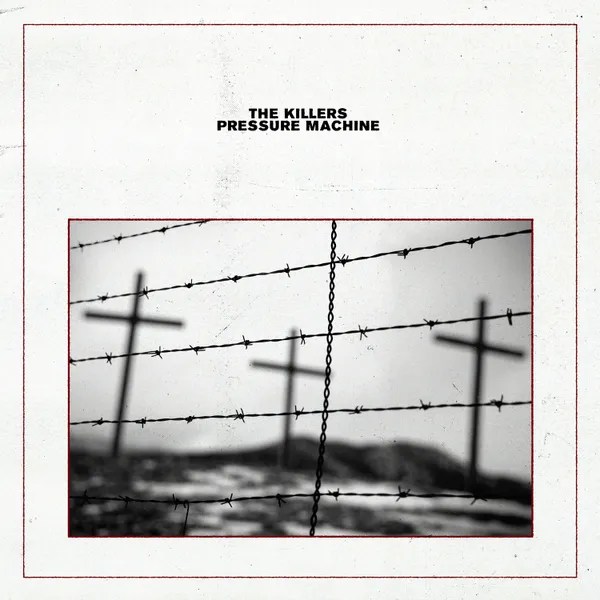
Humour us on some documentarist archival trivia first. For Christ’s sake: look no further than the two album’s front covers (reported below) and the evident color scheming and wireframing they share. Would the communal traits start and end here, this would obviously be a non-starter on account of how many other albums sleeves share similar flairs and iconographies. Let us look at both records’ runtimes then—a field of comparison that should win over the curiosity of most. Springsteen’s Tunnel of Love clocks in at exactly 46:25 minutes, while the abridged (i.e. the non-spoken interludes and skits version) duration of Pressure Machine comes eerily close at 46:19 (!). We’re talking negligible differences of a mere six seconds across full length projects featuring twelve and eleven tracks, respectively (Nebraska instead only plays for 40 minutes).

Speaking of which—delving into the collections of songs laced into both LPs, the non-inclusion of the New Jersey prodigal son’s “Ain’t Got You” as part of this pound-for-pound creative appraisal is the sole concession we’re humbly asking from our dear readers, which we’re sure you’ll oblige. With its humorous and faux-bragging a cappella demeanour, coasting atop of a minimalistic and one-dimensional analogue tapestry, not only does the Tunnel of Love sound like a fish out of water amidst the sincerity and heart-on-sleeve vulnerability of the subsequent eleven numbers, but the songwriting at the core of its tune is nothing to write home about either, frankly.

We’ll cut to the chase: Pressure Machine’s first track “West Hills“‘s sombre, waltzy, and granite appeal could easily be equated to “Tougher Than the Rest“, incidentally the opening cut on an analytical Tunnel of Love minus “Ain’t Got You” too. Conversely, the jollier and softer stylistic undertones of subsequent album lead single “Quiet Town” are not too far removed from the incisive impact of Springsteen’s “Brilliant Disguise“, especially as both songs wrestle with darker and more dour lyrical textures juxtaposed to the easier on the ear instrumentation. Meanwhile, the stark and naked acoustic strumming of the unplugged “Terrible Thing” has got to make it Pressure Machine’s very own “Cautious Man“—easily the most bare bone stripped back offering on Tunnel of Love.

Bear with us, as we continue to ask for a certain degree of mental elasticity and artistic openness. Are the vocal cadences, angular sonic dynamics, and overall compositional structures of “Cody” not somewhat reminiscent of those in “Walk Like a Man“? The similitudes here are not the uncanniest under the sun, but they’re definitely there when listening closely enough. Even more striking are the percussive and harmonic parallels between “Sleepwalker” and the title track on the Boss’s album though. Beyond the subtle mutual melodic nods, try to pay specific attention to the rhythmic pockets between 1:09-1:43 on the former and 0:58-1:35 on the latter. Not talking about actual beats and rudiments, but rather grooves, patterns, and tightness.

Elsewhere on Pressure Machine, the Phoebe Bridgers-assisted folklore troubadour lullaby “Runaway Horses” and its shtick would in many ways sit quite at home placed back-to-back to the inflections and cadences heard on “When You’re Alone“, would it not? Moving on from there; absent the just ever so slightly increased BPM rate, track seven on Pressure Machine “In the Car Outside“—undoubtedly one of the stickier and melodically riper tunes this side of the heartland fence—is not necessarily miles away from the gelid synth tapestries, melancholic paratexts, and exaggeratedly lingering instrumental outro similarly sported by “Two Faces“. What we mean is that these two tracks sound like they just shine the same light.

By a similar token, the Las Vegas band’s frontman Brandon Flowers’ verse delivery and intonations on album standout “In Another Life“, sequenced at number eight on Pressure Machine, seem to recall in large parts the auditory rendering of the moral voluptuousness of “All That Heaven Will Allow“—both deep cuts’ unclothed and one-dimensional simplicity underline more than one lowest common denominator. Meanwhile, when decoupled from their apparent musical shells and boiled down to the narrating arc of their inertia-driven linear storytelling ethos, The Killers’ incredible “Desperate Things” (incidentally the most Nebraska-esque Killers helping to date) and Springsteen’s “Spare Parts” ring as if they could have genuinely sprouted from the same writing session.

Next thing we know, we’re nearing the end of Pressure Machine’s side B and runtime as a whole, as a result of our ambitious and pretentious intellectualisation. One could say we reserved the best for last, as The Killers’ gentle, tender, and pretty title track, with its soft and cradling arpeggio and elliptical trajectory, is nothing if not The Boss’ “One Step Up“s legitimate and groomed daughter. Closing number “The Getting By” (NB: clocking in at 5:10) represents the ultimate grand finale of references, both on a musical and empirical level. When paired up with Tunnel of Love’s own curtain call “Valentine’s Day” (NB: 5:12 minutes long), their dialled-down groove and idyllic six-string work are almost too close for comfort, making both tunes mutually interchangeable without impacting either album’s flow.

Listen, we’re in no way suggesting The Killers did this on purpose. We’re fully aware that some of the analogies presented above are more reliable and valid than others. Some of them certainly come off as a bit of a stretch. But most of the facts and figures illustrated above speak for themselves. Forget not, this has got to be seen as part of a creative continuum where musicians are constantly borrowing from each other’s work. Where they’re getting inspired and influenced by previous musical references and artistic milestones. One where they’re often, consciously or unconsciously, paying both tribute and worship to past beacons of theirs. Brandon Flowers and his band are no strangers to admitting to adoring and borrowing from the generous sounds of The Boss: after several albums on which their Nevada glittery gloss lent them a glamorous façade, the pressure of their American songwriting machine finally caught up on them.

I’d like to thank you sincerely for taking the time to read this and I hope to feel your interest again next time.

AV

IN DEFENSE OF CHRIS LORD-ALGE’S MIX OF THE REPLACEMENTS’ DON’T TELL A SOUL | 2021-08-15

Minneapolis, MN alternative rock giants The Replacements released seven studio albums during their active lifetime as a band throughout the Eighties. It comes probably as no surprise that the front end of their discography—culminating with their legendary back-to-back triplet that transitioned them onto major label stardom, Let It Be (1984), Tim (1985), and Pleased to Meet Me (1987)—is commonly and widely considered to be their musical and creative apex, by both high and low-brow listeners alike. There is also little denying of the fact that a specular widespread fan consensus over their last two full length outings, 1989’s Don’t Tell a Soul and the following year’s swan song All Shook Down (basically a proto-Paul Westerberg solo helping), is somewhat lukewarm and nothing to write home about, at best.

Here’s the catch: hoarding broad-brush critical agreement never pushed the envelope of stoked human progress. However, speaking of broad brushes, more than revisiting and reclaiming entire parts of The Mats’ overall recorded studio output—which incidentally is completed a raft of additional live albums, compilation bundles, and EPs—this piece looks to rewrite history for on one particular project. Or rather still, its hitherto tainted, jagged, and misunderstood legacy.

Such zeroed-in record answers to the name of the aforementioned Don’t Tell a Soul: an 11-track album initially released on 1st February 1989 on Warner Music’s Sire Records. It’s The Replacements’ sixth, and the first ever featuring lead guitarist Bob “Slim” Dunlap on tape, who was called up in lieu of late and disgraced founding member Bob Stinson in early 1987. Now, before delving irreparably into the nooks and crannies of the argumentation here, at this stage it should probably be mentioned how this album did in actuality fare largely favourably with both music critics and the mainstream at the time.

For Christ’s sake—according to trusted sources including the documentary The Replacements: Color Me Obsessed, Don’t Tell a Soul still stands as the band’s biggest selling LP to date. Which is something that makes a featured thinkpiece set out to defend it and its glossy sound engineering such as this one all the more logically frail. Yet anytime The Replacements, their commitment to self-derangement, and their larger-than-life looming indie lore come into the foray, logic and rationality always kind of seem to default to getting thrown out of a conceptual window.

Remember the raft of additional live albums, compilation bundles, and EPs that help beef up and ornament The Mats’ lauded discography on top of their seven studio LPs? Well, glad you do—for it turns out that one of the most recent issues as part of said catalogue is an ambitious four-disc, 60-track box set filed under the title Dead Man’s Pop. It was earmarked, manufactured, and distributed in 2019 by Rhino Entertainment, under the careful curatorial supervision of the band’s biographer Bob Mehr as well as a slew of syrupy Warner execs. Crucially, the collection’s first disc is entirely comprised of a remixed, re-arranged, and re-sequenced version of Don’t Tell a Soul.

Colloquially dubbed the Don’t Tell a Soul Redux, this overhauled and reimagined collection of tracks both sprouted and harvested from raw session mixes by the album’s original producer (albeit not final mixing engineer) Matt Wallace—who was pretty much a nameless, faceless indie bloke at the time. These stood in sharp contrast to the subsequent major label-endorsed mixing work and production carried out by 80s engineering royalty and multi-Grammy Awards-winning Chris Lord-Alge, whose pedigree and portfolio read like a greatest hits list of names of that decade (Tina Turner, Carly Simon, Bruce Springsteen, Madonna).

Therefore, far from a nostalgic and self-indulgent collector’s item, Dead Man’s Pop’s inherent revisiting flair ended up pulling out all the archival stops, except becoming an actual 30th-year anniversary reissue of Don’t Tell a Soul. For one, it’s completed by a slate of additional bundles, starting with a second disc of rarities and non-album cuts billed We Know the Night: Rare and Unreleased, collating early versions of rough drafts from the group’s Don’t Tell a Soul studio sessions, as well as late-night drunken collaborations recorded with storied singer/songwriter Tom Waits. Two final batches of tracks attached to the box set combine to form a full live album titled The Complete Inconcerated Live, expanding on the quartet’s eponymous 1989 promotional EP.

Now for the aggravating bit, ladies and gentlemen: multiple sources (as well as the horse’s very own mouth) claim that such a rush of new-found curatorial blood to the head was motivated by principal songwriter, co-founder, and creative mastermind Paul Westerberg’s fundamental dissatisfaction with their original product released thirty years ago. A reckoning that translates into the epiphany that Paul himself, bassist Tommy Stinson, stickman Chris Mars, and Slim Dunlap—in addition to countless fans around the globe—had had to coexist and wrestle with such a profound juxtapositional ethos as they looked back on their best selling album for over three decades. Pretty on brand for The Mats, if you ask us. Let that sink in for a moment.

This still leaves us at the mercy of a discursive place acknowledging how the band, its closest entourage, its devoted and diehard fans, as well as most of the critical ivory tower leagues rallied together in solidarity begging for ‘another chance’. They all convened and called for The Replacements to take another stab at the true work of art that lurked beneath Don’t Tell a Soul’s surface level polish and uptight elegance. In this respect, look no further than group’s frontman Paul Westerberg going as far as stating that “[the record] sounded good until the label brought in people to mix it to make it sound like everything else on the radio”. Elsewhere, so Wallace in retrospect: “At the time, when the mixing […] was completed, I had numerous musician friends who were rabid fans of The Replacements and each one […] accused me of ‘ruining The Replacements’”.

Yet again on the other side of this raison d’être inquisition lie folks such as yours truly—evidently allied with hundreds of thousands of disposable income-owners and unit-movers—who are struggling to make heads or tails of such a tardive and, frankly, spoilt creative undoing. This is done while hastily pointing at selected stems (requesting exhibit ”Asking Me Lies“), flat out superior songwriting-to-tape on key tunes (requesting exhibits “They’re Blind” and “Anywhere’s Better Than Here“), a more cohesive overall listen and tracklisting (requesting exhibit “I Won’t“), as well as BVs that actually enhance a composition rather than jeopardise it (requesting exhibit “We’ll Inherit the Earth“), to humbly will-whisper into existence a trialling accompanied by the following sentence: the original 1989 Don’t Tell a Soul is a better album. Period.

Your honours, isn’t this the part where we would take it upon ourselves to analyse and dissect individual clues to further cement and corroborate similar claims? Should we, though? Instead, one could surely begin with stressing out how no one involved in the conception of the record, from Paul himself to higher-ups at the label, was or is a foolish impulsive decision-maker actively pursuing a high-budget product’s kneecapping. Certainly, one has got to surrender their self-centrism and loosen their tie and trust the process here—yet perhaps more importantly embrace the notion that the band, its management, and the underlying business that supports and profits from it must’ve arrived at the decision to enrol Chris Lord-Alge on mixing duties carefully and considerably.

Yes, of course the irony of lining up signifiers such as management, business, and profit next to a band like The Replacements all in one sentence is not lost on us. Yet we humbly ask: has a sly and red herring-y knack for a dorky and naive smoke and mirrors facade not always been The Mats’ divisive modus operandi all along their blistering career? What if Dead Man’s Pop and its apparent long-overdue redemptive fanfare—finally cancelling alleged wrongs committed at the height of the group’s major label career—were all yet another sublime con-job sculpted by Paul and co. to mock industry and fanbase alike? What if we all chose to believe that the original version of this album is The Replacements’ second career act’s pièce de résistance? No matter the real answer—Mr Westerberg would not want us to tell a single soul anyway.

I’d like to thank you sincerely for taking the time to read this and I hope to feel your interest again next time.

AV

SWISS INTERMISSION | 2021-07-18

Ceresio Lake water the best. 45.9863° N, 8.9700° E.

Create your own travel license here. Listen to Call Me If You Get Lost by Tyler, The Creator here.

I’d like to thank you sincerely for taking the time to read this and I hope to feel your interest again next time.

AV