
Ryan Adams has gone dark in 2026. Not in a creative or musical way (although his 2025 tail-end LP Self Portrait wasn’t exactly wedding material), but in the sense that he’s all but disappeared from the global ether. In many ways, one could argue he’s been dark since his embryonal artistic early days in the mid-Nineties. But what we’re noticing here is a relatively uncharacteristic online strike on the part of the 51-year old singer/songwriter, whose otherwise spontaneous, irreverent, and unhinged social media approach had largely been dominating the past few years, for better or worse. Interestingly, the tumbleweed of silence appears to have transferred over to his natively managed PaxAm email newsletters too, with the last issue—announcing the underwhelming live ‘re-imagining’ of Another Wednesday—dating as far back as early 2025.
Sure, what appears to be a carefully constructed absence might have something to do with the presumable umpteenth change in management style, an agency representation line up switch, or the fact that his main source code of news and updates—his official Instagram page—has been bio’d with a ‘Run by mgmt’ for a while now. Because of all of this, aside from announcing gnarly custom signature guitars and a solo acoustic European tour slated for this Fall via boilerplate publicity post write ups, the DRA has been missing in action in the year of our Lord 2026. Expect for… teasing new studio albums. That should track for someone with almost forty full lengths out attached to his name, shouldn’t it?
At any rate, to get our ducks back in a row, let us point you in the direction of as recently as mid May this year, when the PaxAm CEO and founder made a rare online appearance to low-key couch an informal announcement within a more formal announcement that he was in the middle of working on his second new album, tentatively titled Animal (this in spite of declaring it ‘finished’ last December…). With that being said, the real reason we’re here today is momentous, for it is to discuss a different PSA from the Adams camp that came out just a tad before that, on 27th April. On said date, his management put out an unexpected message alerting fans in a somewhat sterilized and sanitized fashion that the long-awaited, long-requested Suicide Handbook LP was indeed going to finally come out on 12th June. We didn’t hear it from the former Blue Note recording artist directly, but this is generational news if you’re an early Noughties Ryan Adams nostalgic and a third act revisionist.
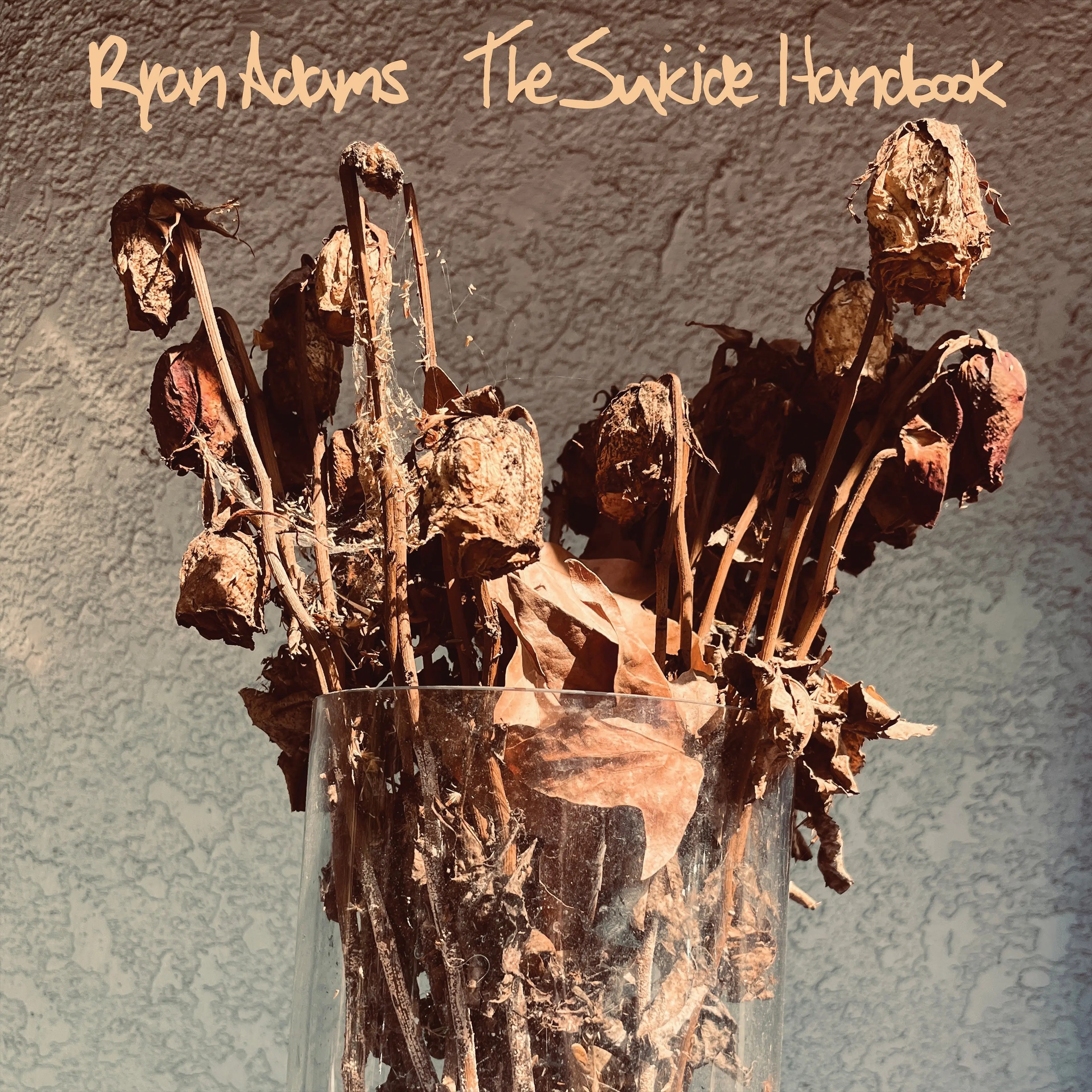
Billed by his label PaxAm as one of the alt-country prodigy’s “most elusive and mythic recordings”, the 21-track compilation was further advertised as “a raw and intimate collection of songs that captures the songwriter at his most unguarded. Recorded at the beginning of his solo career and long circulating only through bootlegs, the album has earned a legendary status among die-hard fans and fans of the Americana genre alike for its stark stripped-back beauty”. So, a quarter century since it first began circulating as a leaked bootleg in light of his then-label Lost Highway Records’s refusal to release it as an official album due to its darker and sadder tones, The Suicide Handbook has at long last, miraculously, seen the light of day. Let us delve into it head-first.
Filed as what should probably count as the former Whiskeytown and Cardinals frontman’s thirty-second solo studio album since his 2000 debut Heartbreaker, the lore tape did in fact come out a few weeks ago as promised. That felt like a good start. Available in both physical formats (vinyl and CD) as well as digitally, The Suicide Handbook‘s official (and original) 21-song tracklist was regrettably downgraded to 18 records on DSPs (digital service providers, ergo the Spotifys and Apple Musics of this world)—in all likelihood due to ongoing rights disputes over three cuts that ended up getting released in their original version on 2002’s Demolition via Lost Highway/UMG: “She Wants to Play Hearts“, “Cry On Demand“, and “Dear Chicago” (bizarrely listed as just “Chicago” on PaxAm’s website).
Luckily, the same fate wasn’t reserved to the batch of songs that went on to be re-recorded for DRA’s Gold (“Wild Flowers“, “Touch, Feel & Lose“, “Firecracker“, “La Cienega Just Smiled“, “Just Saying Hi” later retitled to “Answering Bell“) and his Cardinals’ joint Easy Tiger (“Off Broadway“). As music industry cats and copyright lawyers would know it, the clue is in the re-taping of the masters, aka the sound recordings of all of these, whose streaming licensing exclusive is probably still owned by Lost Highway, unlike the song ideas themselves, aka the compositions, which should be under Adams’s publishing control no matter the exploitation format (alongside the early acoustic renditions of these songs, i.e. the ones being released now on The Suicide Handbook). Look no further than this litmus test artifact to get a sense of how deliberately intricate and nuanced the copyright framework is for commercial music. As a case in point—and to add insult to injury—the album actually began to disappear from DSPs at around 6am ET on Monday 22nd June, and is still unavailable for streaming at the time of this writing.
It’s a good thing PaxAm was allegedly in a position to at least salvage the non-Demolition songs, for releasing the record without all nine aforementioned tunes would have made little to no sense at all—particularly accounting for the loud vox populi calling for The Suicide Handbook to finally be released in its original 21-track incarnation for over two decades… Mind you, even considering how stunning and enchanting this collection is wall-to-wall, losing “She Wants to Play Hearts”, “Cry On Demand”, and “Dear Chicago” to Demolition sounds and feels like an incredibly low blow for the end digital product.
Not only were these three tunes sacrificed for a top-down imposed, glorified palate cleanser mixtape of loosies following the stratospheric success of his first two records (2000’s Heartbreaker and Gold the following year), but both “Cry On Demand” and “Dear Chicago” would have remained peak standouts even amidst such a strong collection of tracks. One is left wondering whether Ryan ever considered re-recording those three to re-snatch their master rights back, effectively putting out a more cohesive and unified record across playback formats? Let us run with the assumption that this was the time he thought better of whipping up impromptu low-fidelity home-spun versions of exquisite gems in the spirit of retaining the original sound cohesion across all 21 tracks.
Something we should say for full disclosure at this point is that we weren’t exactly terribly familiar with or attached to the 2001/2002 bootlegged version of The Suicide Handbook before this revamp. That acclaimed and treasured collection seemed to be unifying legions of his erratic and disjointed fanbase, acting as the one album that slipped through the cracks, the one that put even the most voraciously polarized in agreement. The reason for our alleged indifference is that even though we have been covering every single release the DRA has dropped since 2015, we weren’t necessarily soaked in nostalgia, and mostly kept it a buck oriented to his forward-looking, newer material. Not that there was any scarcity of it, mind you: just in the eleven-year lifespan of this site, the world’s preeminent pinball historian has dished out as many as twenty studio albums (not counting live ones!).
Back to the record. What immediately stands out when bumping the tape from the top is the incredibly crisp and fine-tuned quality of these recordings. This alone is a welcome breath of fresh air on account of the relatively inconsistent production, mixing, and engineering found on some of his latest albums. This thing is an acoustic and mostly unplugged affair, with Ryan’s sharp song crafting, his voice, and some impeccable guitar playing carrying most of the weight, most of the time. Cuts like “Perfect and True” and “Tell It to My Heart” on the front end of the record, or even “Bow to the Sad Lady” and “Miss Sunflower” on the flip side, are not only sensationally intense and catchy, but they also reveal themselves over repeated listens, thus carrying lofty replay value.
The hushed and untouched veneer that permeates these tracks feels almost unfair in the way that it further decouples the already unmediated heart-on-sleeve confessionals committed to tape beyond any self-effacing charades. A tune like “For No One”, at number nine on the tracklist, has got to be one of Adams’s best tracks in his released catalogue, hands down. The way its melancholic yet self-aware storytelling gets accompanied by soft and husky piano licks and a tasteful steel guitar is just true blue trademark DRA. Truly and honestly, with the benefit of twenty-twenty hindsight, it does strike us as odd and ill-informed at best that such a sticky and timeless collection of songs—one that he might have intended to come out as a double-disc album in 2001—was shelved by the imprint on grounds of lack of commercial viability. This album in its totality stands as a top 3 all-acoustic Ryan Adams project ever (we’ll throw Ashes & Fire and Wednesdays in there too).
And don’t even get it twisted—the performances are far from perfect, but as most music goes, that’s kind of the point. In spite of the refreshingly elevated studio-grading recording and playback quality of most of these songs, there are a whole host of apparent blemishes still in the mix, such as hitting bum notes at the end (“Bow to the Sad Lady”) or portions of studio mic banter bleeding through (check out the concluding seconds of “Off Broadway”). There are also a couple of tea leaves left on the record that strict music historians would perhaps have liked to have seen elsewhere; cf. streaming-version coda “Idiots Rule the World” both hinting at and perhaps better belonging to his later LP Love is Hell (2004). Nothing that distracts or takes away from the unified listen to The Suicide Handbook though. This is a statement—or better yet, signature—release by Ryan Adams.
The multi-hyphenate creative auteur has sure been keeping busy at work over the past year, and not insignificant parts of us are glad he’s done that largely while being away from the jaws of online hell. There also appear to be clues that he might even have relocated away from Los Angeles and the U.S. West Coast altogether. During the aforementioned rare online camera appearance this past May, he hinted at a cleverly subtle rebrand of his label to PaxPm—something he first teased in November last year.
The business transfer assumption further appears to be validated by the copyright disclaimers printed on physical formats of The Suicide Handbook, listing his new label mailing address in the Southeast of the U.S., on 3630 Peachtree Road NE, Suite 600, Atlanta GA 30326. To make matters slightly more convoluted, PaxAm’s merchandising arm seems to be incorporated somewhere else altogether: PaxAm Shop 3200 South 24th Street, Kansas City KS 66106. Not that it should matter all that much. Instead of geographical or logistical clarification, if there is anything we could ask him and his entourage would be to please bring back this record to global streaming services—after being held prisoner 26 years, it’s too good for its time in the limelight to just have lasted ten days.
We’d like to thank you sincerely for taking the time to read this and we hope to feel your interest again next time.
AV
RYAN ADAMS
THE SUICIDE HANDBOOK
2026, PAXAM
Discover more from Everything Must Swing
Subscribe to get the latest posts sent to your email.

