
We’ll start by saying that the new A$AP Rocky and J. Cole joints both go pretty hard. Mega hard, in fact. They better do, after almost a decade of teasing, undoing, and gestating for each. At this time, we’re fairly confident in saying that DON’T BE DUMB and The Fall-Off are the two MCs’ best projects to date. Let us throw in some context. As far as J. Cole is concerned—nearly two decades after his debut mixtape The Come Up, the Dreamville Records-founder has handily risen to the top tier of the hip-hop stratosphere as a rarified album-focused spitter, amongst a legion of singles-driven ambulance chasers. The Fayetteville, NC-native deliberately forged his body of work on his own terms, earning major accolades and a fiercely loyal fanbase. Now 41, he gives us what is reportedly his final album, aptly titled The Fall-Off. Rather than a true blue victory lap, the expansive, 2-disc, 24-track oeuvre showcases sustained creative energy and nurtured reflection. And it’s jammed with hoopin‘ references.
The front-end, filled with nods to his Carolinian stomping grounds and his 2014 Forest Hills Drive era, highlights Cole’s storytelling strengths and influences—from Nas-inspired lyricism to more personal, vulnerable moments. On disc 2, the stronger of the two, he shifts from nostalgia to self-assessment, examining his legacy and growth with heightened maturity. By the album coda, he ties past and present together, returning to the profound sense of place that has long defined his journey. A diametrically opposed introduction is in order when it comes to Rocky. As soon as he emerged as the breakout star of Harlem’s A$AP Mob in the early 2010s, he seemed destined for fame—pairing striking flows with a sound that blended New York street rap, Houston chopped-and-screwed textures, and hazy electronic ultralight beams. After the success of his 2011 breakout mixtape LIVE.LOVE.A$AP, he quickly rose through rap’s heavyweights ladder. In recent years, Lord Flacko vastly expanded his focus beyond music, stepping into acting, high-fashion design, and high-profile cultural moments—not without prompting some to question whether spitting 16s was still his priority.
His latest fourth studio LP, DON’T BE DUMB, answers that decisively. His first full-length since 2018’s TESTING, the Tim Burton-artistically directed tape reasserts his place among hip-hop’s narrow elite, balancing brash confidence with refined avant-garde artistry. The pretty motherfu**er addresses rivals and past conflicts head-on, while also embracing a seasoned, eclectic sound—moving from jazz-inflected experimentation to psychedelic trap. True to form, his sharp curatorial instincts shine throughout the hour-long full length, pairing unexpected collaborators and producers (aside from Burton, BossMan Dlow, Brent Faiyaz, Gorillaz, Doechii, Jessica Pratt, Sauce Walka, Slay Squad, Westside Gunn, and will.i.am inter alia) in ways that nod to his beginnings while pushing his style forward.
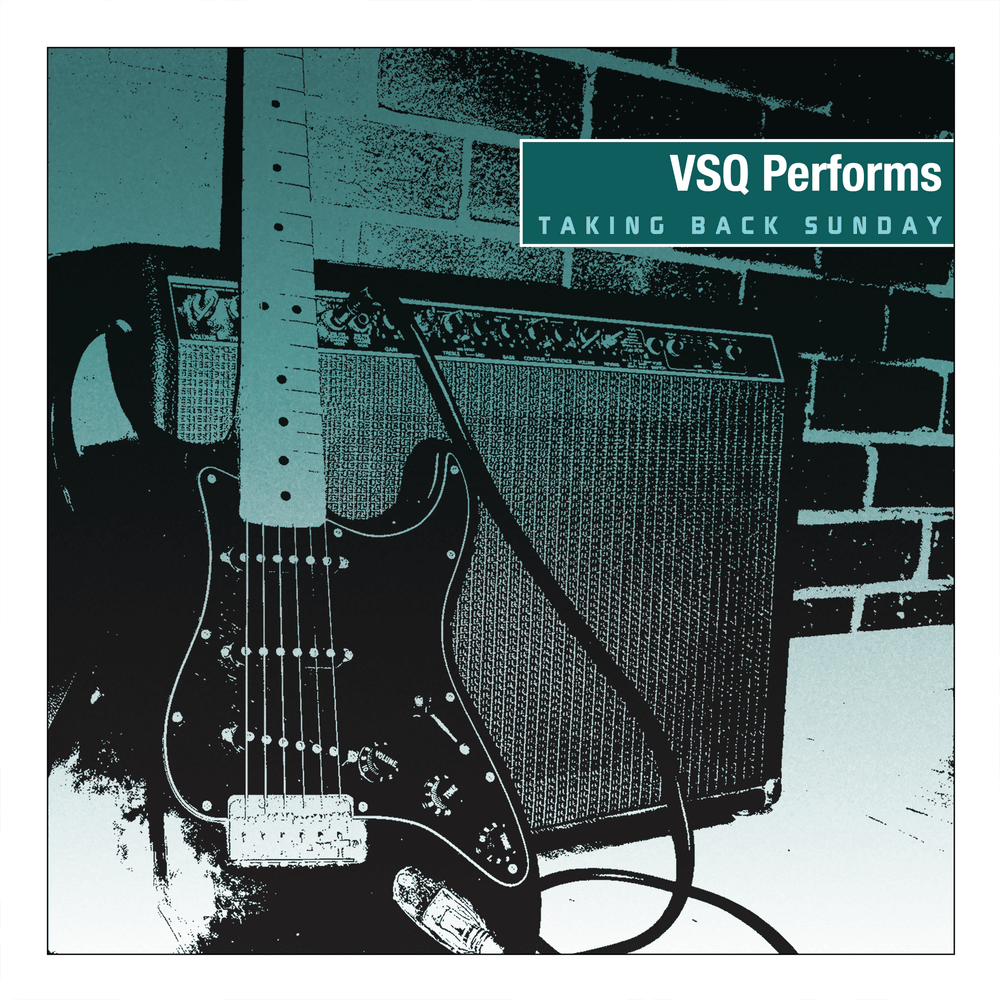
The above mentioned rap excursuses aside, we’re actually here to talk about the twentieth anniversary of a classical music tribute to Taking Back Sunday? Yup. Our curious object of inquiry is a bizarre 2006 musical ode by the so-called Vitamin String Quartet—VSQ in short—featuring instrumental, string-driven covers of the most popular Taking Back Sunday tunes at the time. The 12-track collection, released on Vitamin Records in the April of two decades (under the influence) ago, re-arranges the Long Island emo veterans’ high-energy, guitar-driven sound from their first two records through violin, viola, and cello renditions. There’s even an original composition and arrangement by VSQ, titled “You’re Good News (To Me)“, to bookend the collection. The whole thing kind of rules. Not sure a whole lot of TBS stans are aware of it.
Oddly enough, the album changed its nominal title from the initial ‘Strung Out on Taking Back Sunday: The String Quartet Tribute‘ (as evidenced here) to VSQ Performs Taking Back Sunday around 2015—presumably due to changing distribution licensing reasons. Hilariously, by virtue of its main high-brow genre, the concerto is also listed under the Apple Music Classical streaming service (peep here), causing the composer metadata to get rendered as a scrambled itemized hodgepodge including a mix of Mark O’Connell, Adam Burbank Lazzara, Shaun Cooper, Fred Mascherino, Frederick Paul Mascherino, and Tom Tally, a former VSQ member. Yeah, no John Nolan sadly.
So what’s good with Vitamin String Quartet? Since launching in 1999, VSQ has been dubbed as a leading force in classical crossover, bringing string interpretations of contemporary music to a global audience. Their work seems to have soundtracked study sessions, weddings, and standout film and TV moments, with high-profile placements in recent productions like Bridgerton and The King of Staten Island. Praised by Variety and Nylon, VSQ is now one of the world’s most popular contemporary string ensembles. With more than 300 releases under their belts at this point, the quartet has reimagined an eclectic range of artists—from Cardi B to Björk, and from Studio Ghibli scores to goth metal—seamlessly blending classical instrumentation with original pop, rock, hip-hop, and electronic music. This kind of goes to show how big Taking Back Sunday was at the halfway point of the 2000s to be handpicked amongst such company (and to think that their most commercially successful record, Louder Now, hadn’t even come out yet at the time).
To date, VSQ has amassed over two billion streams, nearly four million downloads, and more than one million physical sales. For all intents and purposes, they’re pretty huge. Apparently, seven of their LPs have charted on Billboard, including a #4 peak in the Classical and Classical Crossover categories. VSQ Performs Lana Del Rey even earned them a 2021 Libera Award nomination for Best Classical Record. The outfit is based in Los Angeles, where the rotating collective is said to be frequently collaborating with fellow musicians and visual creators, continuing to expand a vast catalog. As a case in point, their long-running VSQ Performs the Hits instalment series has helped make classical versions of modern pop both accessible and culturally relevant, while front-to-back album tributes showcase the ensemble’s versatility.
Happy twentieth anniversary to this fabulously weird record. It rules so hard. We wouldn’t mind checking out an updated 2026 version with some of TBS’s more sophisticated and mature tunes in the latter part of their discography. Surely “Where My Mouth Is“, “Everything Must Go“, “Call Me in the Morning“, “We Were Younger Then“, “Nothing At All“, “Fences“, “Holy Water“, and “Amphetamine Smiles” would all absolutely rip when performed with the magic fiddles of VSQ. There you go, that’s more than half the tracklist of the redux album already. Over to you, Vitamin String Quartet.
We’d like to thank you sincerely for taking the time to read this and we hope to feel your interest again next time.
AV
Discover more from Everything Must Swing
Subscribe to get the latest posts sent to your email.
 Everything Must Swing